


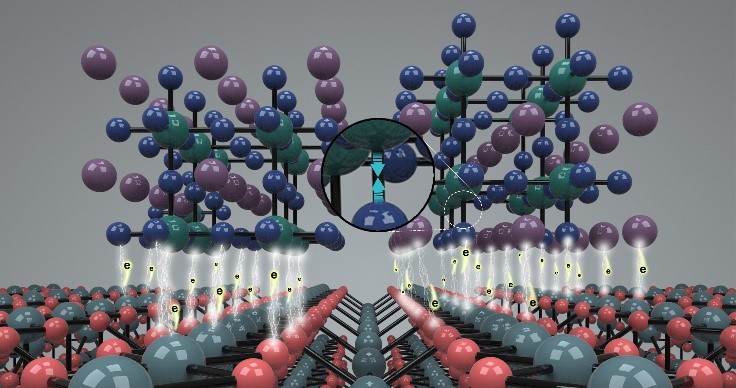
Boosting the stability improvement of cesium lead halide (CsPbX3) perovskite nanocrystals (NCs) remains a serious challenge. In this work, CsPbX3 NCs are effectively anchored on a hierarchical (h-) alumina (Al2O3) substrate to form seminude CsPbX3@h-Al2O3 composites, which can emit strong green light even after being stored in water for 30 days, in sharp contrast to the pure CsPbBr3 NCs. Other oxides, such as TiO2, ZnO, and SiO2, have no boosting effect on the moisture resistance of perovskite NCs. Subsequent density functional theory calculations (DFT) reveal a significant charge transfer and strong Coulomb attraction between CsPbBr3 and Al2O3. The substantial charge transfer via alumina substrate modulation not only can enhance the internal stability of CsPbBr3 but also can cause CsPbBr3 to be insensitive to water adsorption. These findings are expected to deepen our understanding of improving the stability of CsPbBr3 NCs and shed light on the design of novel perovskite composites for longterm stable optoelectronic devices.
Read more at The Journal of Physical Chemistry Letters:
https://pubs.acs.org/doi/10.1021/acs.jpclett.0c00811
03 Apr 2020