

Master of Veterinary Medicine (MVetMed)
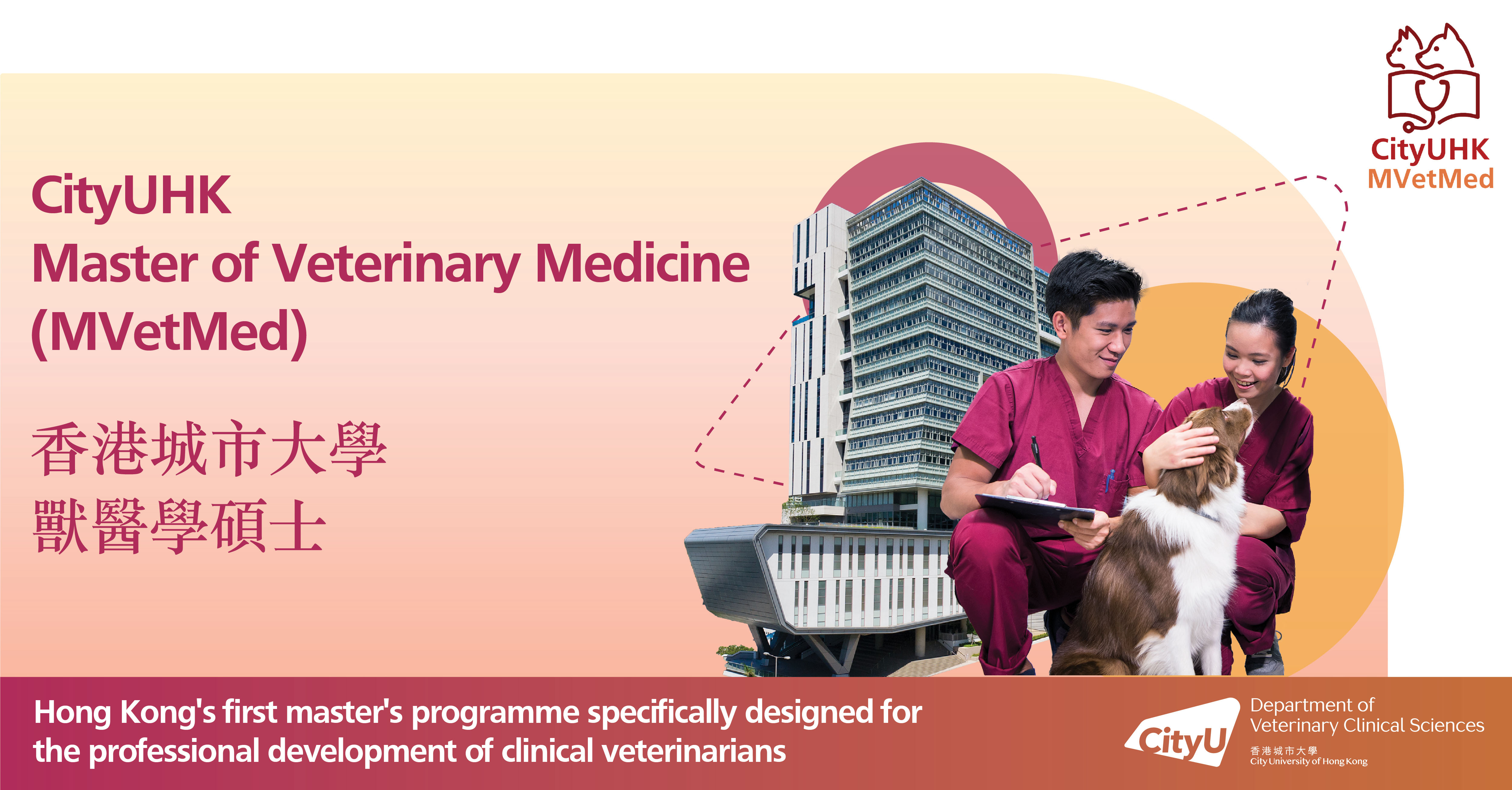
Hong Kong's first master's programme specifically designed for the professional development of clinical veterinarians.

One-year full-time curriculum

Focus on Small Animal Medicine

International Faculty
Our vet school is Asia's only internationally dual-accredited, recognized by both the RCVS and the AVBC .
CityUHK Hong Kong campus learning

Strengthening Clinical Reasoning and Diagnostic Skills

English-taught curriculum
Programme Aims & Objectives
Programme Aims
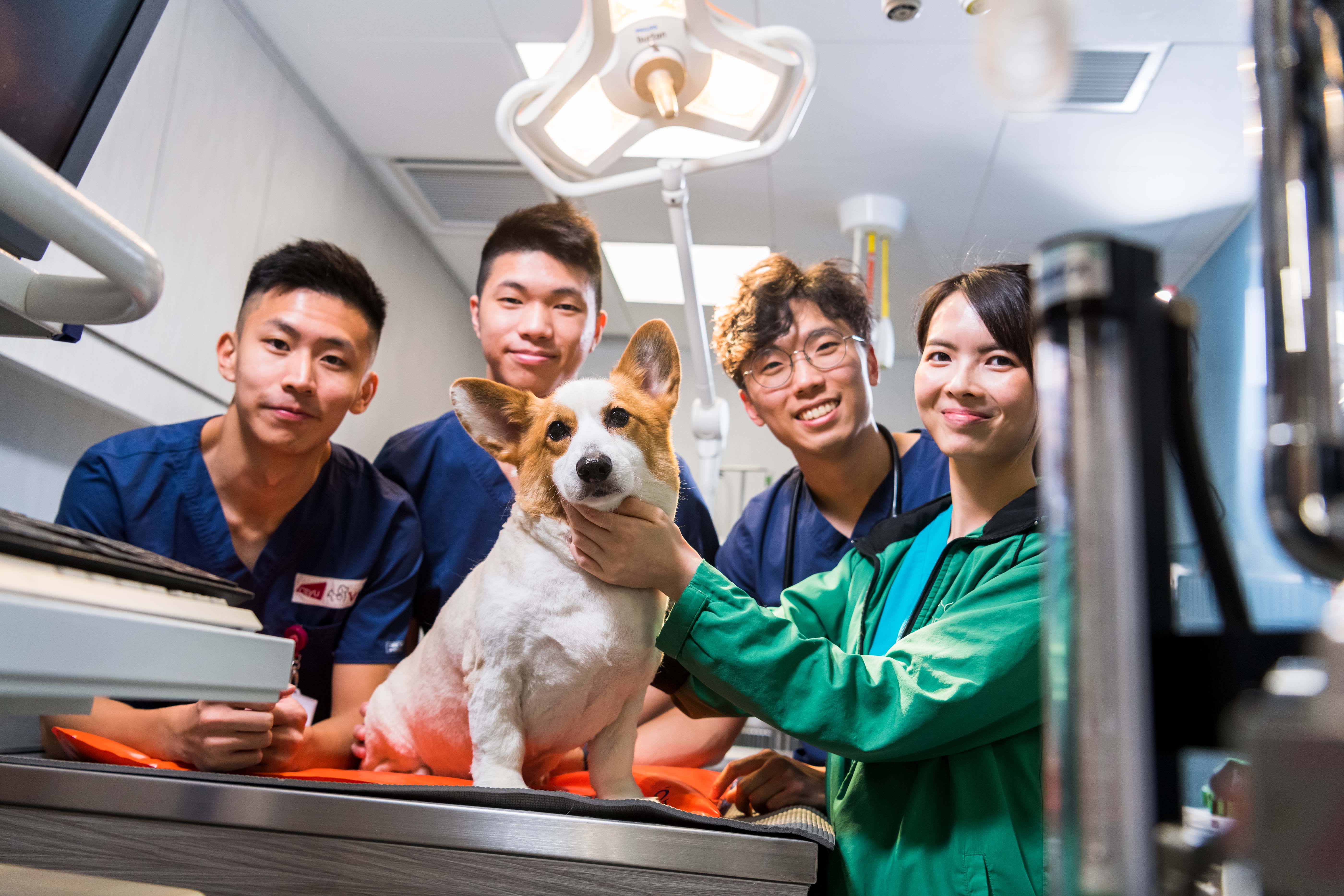
Veterinary medicine is undergoing rapid transformation through advances in diagnostics, therapeutics, and evidence-based practice. This programme bridges the gap between theoretical veterinary education and advanced clinical expertise, preparing graduates for careers in veterinary clinical practice. Designed for veterinary graduates with limited small animal clinical experience, the Master of Veterinary Medicine Programme (MVetMed) equips students with clinical reasoning skills in small animal medicine while fostering critical thinking for modern veterinary challenges. In particular, the MVetMed is designed to:
- Transform theoretical knowledge into clinical proficiency through immersive training in clinical reasoning, diagnostics, and case-based medicine, supplementing primary veterinary education.
- Develop interdisciplinary expertise in emerging areas such as advanced imaging, epidemiology, and One Health, preparing graduates for diverse roles in clinics, research, or public health.
- Empower veterinarians to advance animal health through evidence-based practice, diagnostics, and adaptability to global veterinary standards.
Graduates will bolster their skills to practice as clinicians, diagnosticians, or industry professionals in an evolving veterinary landscape.
#The MVetMed programme does NOT serve as a qualification for graduates to take the National Veterinary Practitioner Qualification Examination in Chinese Mainland or to register with the Veterinary Surgeons Board of Hong Kong.
Programme Intended Learning Outcomes (PILOs)
Upon successful completion of this Programme, students should be able to:
- Demonstrate effective clinical reasoning by critically evaluating diagnostic dilemmas and proposing innovative solutions.
- Apply cutting-edge diagnostic techniques (e.g., imaging, molecular testing) to clinical small animal cases.
- Design and implement evidence-based treatment protocols that integrate current research findings with clinical practice.
- Communicate complex veterinary concepts clearly to diverse audiences, including clients and colleagues.
- Demonstrate a patient-centered approach and enhance animal welfare into daily clinical practice.
Programme Structure
Students must complete 30 credit units to graduate from the MVetMed Programme, including 6 core courses (18 credits) and 4 elective courses (12 credits).
Course Descriptions
Core Courses (18 credit units)
Semester A
| Course Code | Course Title | Level | Credit Unit |
|---|---|---|---|
| VCS5001 | Integrated Small Animal Medicine: Part I | P5 | 3 |
| VCS5002 | Integrated Small Animal Medicine: Part II | P5 | 3 |
| VCS5005 | Clinical Practice and Professional Skills | P5 | 3 |
Semester B
| Course Code | Course Title | Level | Credit Unit |
|---|---|---|---|
| VCS5003 | Integrated Small Animal Medicine: Part III | P5 | 3 |
| VCS5004 | Integrated Small Animal Medicine: Part IV | P5 | 3 |
| VCS5006 | Evidence-Based Medicine | P5 | 3 |
Elective Courses (12 credit units)
Students can broaden their academic experience by selecting elective courses offered by various academic units across CityUHK*.
To meet programme requirements, students are required to complete two elective courses per semester, totaling four elective courses during the academic year.
*Elective course offerings are subject to change from year to year.
Semester A
| Course Code | Course Title | Level | Credit Unit |
|---|---|---|---|
| VCS8001 | Introduction to Food Animal Medicine | R8 | 3 |
| PH5105 | Basic Biostatistics in Public Health | P5 | 3 |
| PH5106 | Fundamentals of Epidemiology in Public Health | P5 | 3 |
| IS5542 | Generative Artificial Intelligence for Business | P5 | 3 |
| IS5113 | AI Ethics and Regulations | P5 | 3 |
Semester B
| Course Code | Course Title | Level | Credit Unit |
|---|---|---|---|
| VCS5007 | Exotic Animal Clinical Medicine | P5 | 3 |
| VCS5008 | Applied Advanced Diagnostic Medicine | P5 | 3 |
| PH8003 | Communication Skills - Conference Organisation | R8 | 3 |
Admission
Entrance Requirements
Applicants must satisfy the University's general entrance requirements and the following programme-specific entrance requirements:
- Applicants for admission to the MVetMed must hold a recognized Bachelor of Veterinary Medicine (BVM) or Doctor of Veterinary Medicine (DVM) degree (or equivalent).
English Proficiency Requirements
Applicants whose entrance qualification is obtained from an institution where the medium of instruction is NOT English should also fulfil the following minimum English proficiency requirement:
- a score of 79 (for tests taken prior to 21 January 2026) or 4 (for tests taken from 21 January 2026 onwards) (Internet-based Test) in the Test of English as a Foreign Language (TOEFL)@#; or
- an overall band score of 6.0 in International English Language Testing System (IELTS)@#; or
- a score of 450 in band 6 of the Chinese mainland's College English Test; or
- other equivalent qualifications.
@TOEFL and IELTS scores are considered valid for two years. Applicants are required to provide their English test results obtained within the two years preceding the start of the University's application period. 'TOEFL iBT Home Edition', 'TOEFL MyBest Score', 'IELTS Indicator', 'IELTS One Skill Retake' and 'IELTS Online' are not acceptable. All TOEFL results must be sent directly by the Educational Testing Service (ETS) using CityUHK's institution code 3401, while IELTS results must be sent via the IELTS Results Service e-delivery to 'City University of Hong Kong - Graduate School'.
#Applicants with an IELTS overall band score of 6.0 or a TOEFL overall score of 4 will be required to pass an interview for English proficiency conducted by the concerned academic unit. Applicants with a comparable overall score of 79 or above shown on the TOEFL report may be exempt from the interview requirement. Interviews for other applicants may not be required.
Selection Criteria
Selection will be based on the applicants' undergraduate qualifications and, if necessary, the interview results.