

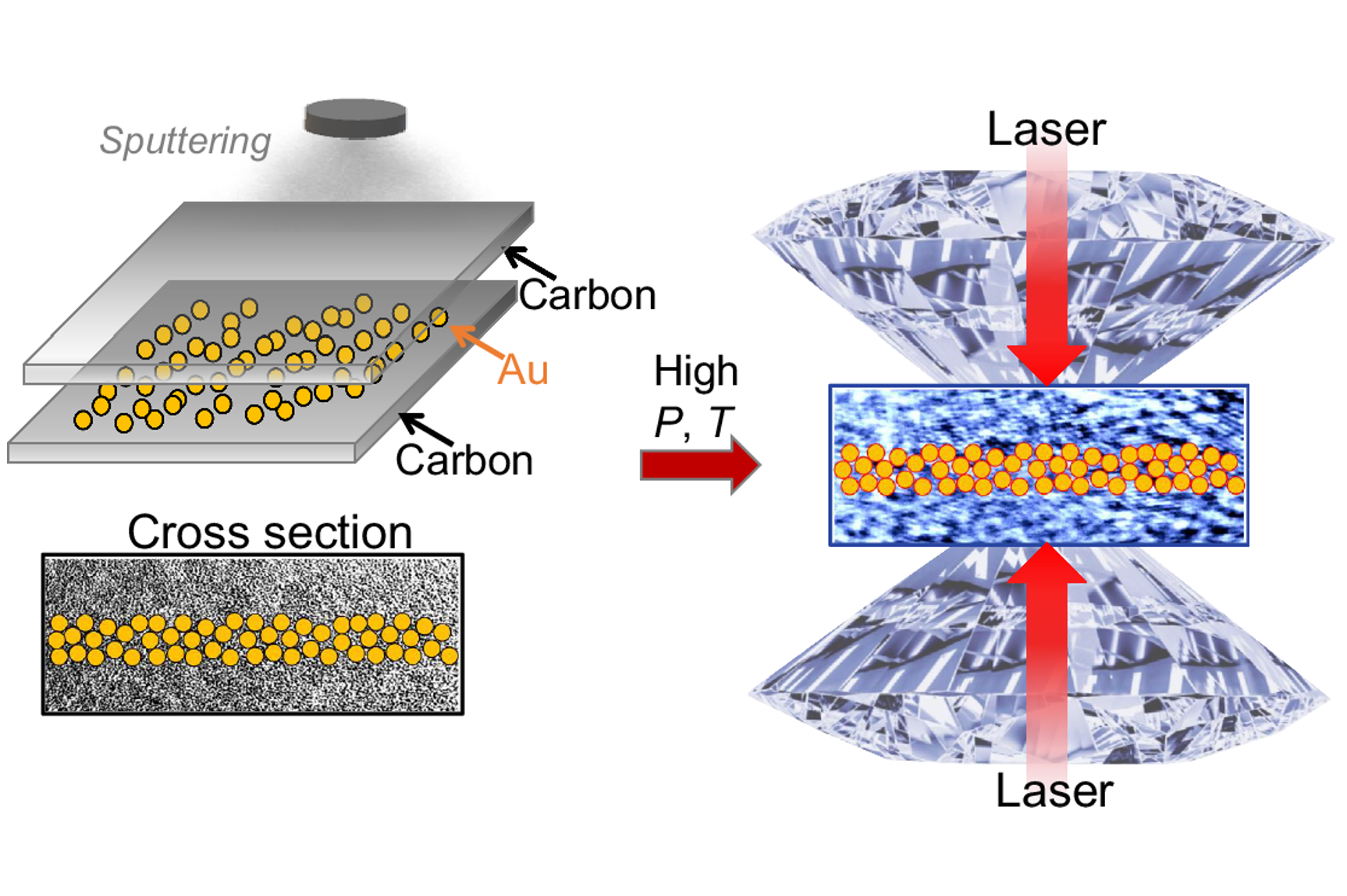
High-pressure environments can induce extraordinary material properties—from room-temperature superconductors to ultrahard phases—yet these states typically vanish immediately upon pressure release. A groundbreaking interdisciplinary study jointly led by Professor Yong Yang's team at City University of Hong Kong and Professor Qiaoshi Zeng's team at the Center for High Pressure Science and Technology Advanced Research (HPSTAR) in Shanghai has overcome this technological barrier. The teams successfully developed a freestanding carbon-gold nanoparticle-carbon nanomembrane structure, enabling high-pressure solid materials to remain stable under ambient conditions while retaining practical applicability.
The CityUHK research team employed their self-developed Polymer Surface Buckling-Enabled Exfoliation (PSBEE) technique (first reported in 2020) to fabricate ultrathin sandwich-structured nanomembranes. These precisely engineered nanostructures feature uniformly dispersed gold nanoparticles between carbon layers, serving as precursors for synthesizing nanostructured diamond capsules (NDCs). When subjected to extreme conditions of 56 GPa ultrahigh pressure and 2200 K high temperature, these nanomembranes transform into diamond capsules that permanently encapsulate gold nanoparticles. Remarkably, the NDCs maintain tunable internal pressures of up to ~26 GPa even under ambient temperature and pressure.
This study was recently published in Nature Communications (DOI: 10.1038/s41467-025-61260-9). The breakthrough lies in achieving long-term stabilization of high-pressure materials under ambient conditions, opening new avenues for both fundamental research and practical applications of high-pressure-phase materials.
For more details, please read the full article in Nature Communications.