

A breakthrough in structural materials has been made by scientists from City University of Hong Kong in collaboration with Chinese Academy of Sciences, University of California, Berkeley, and Shanghai Jiao Tong University: a heterogeneous high-carbon low-alloy steel that simultaneously achieves ultrahigh strength, ductility, and toughness—breaking the long-standing "strength-ductility/toughness trade-off" in metals. Published in Proceedings of the National Academy of Sciences (PNAS), the steel, processed via a simple Q–P–T method, delivers an ultimate tensile strength of 1670 MPa, 30.7% elongation, a strength-elongation product of 51.3 GPa·%, and a fracture toughness of 137.6 MPa·m¹/². Unlike expensive high-entropy alloys or complex medium-Mn steels, this "plain steel" uses minimal alloying elements (Fe-0.67C-1.48Mn-1.53Si-0.038Nb, wt.%) and avoids multi-step rolling, making it cost-effective for large-scale production.
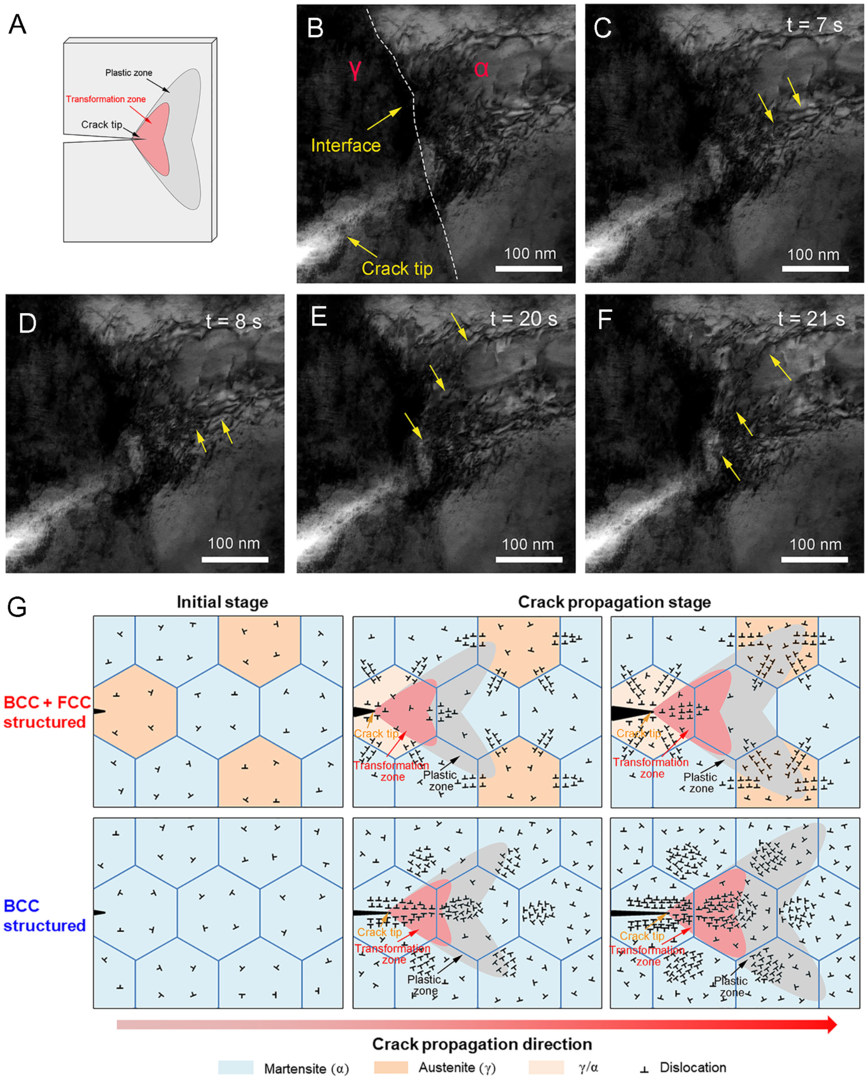
The key to such high-performance properties lies in a tailored heterogeneous microstructure—tempered lath martensite (hard phase) embedded with carbon-enriched retained austenite (tough phase)—and two novel deformation mechanisms. By in-situ transmission electron microscopy observations, the team discovered "dislocation absorption at the crack front (DACF)": unlike conventional metals where dislocations are emitted away from crack tips (worsening stress concentration), dislocations from martensite migrate toward the martensite/austenite interface and are absorbed by the retained austenite. This relieves localized stress and retards crack propagation. Complementing this DACF is "dislocations across martensite/austenite interface (DAMAI)" effect, where dislocations transfer from the martensite to the austenite, softening martensite and hardening austenite to enhance ductility. Notably, the carbon-enriched austenite remains stable, preserving these toughening effects—unlike the transformation-induced plasticity effect that often degrades toughness in other steels.
Scientifically, this work establishes a new paradigm for designing metals: finding heterogeneous microstructures to manipulate dislocation behavior, rather than relying on expensive alloying, to overcome intrinsic property trade-offs. Technically, the simple Q–P–T process eliminates the need for multi-step rolling or cryogenic treatments, while the low-alloy composition (no rare or expensive elements) reduces production costs—addressing a critical barrier for industrial adoption of high-performance steels. Moreover, the steel outperforms existing low-alloy steels, titanium alloys, and even some high-entropy alloys in both performance and affordability, making it ideal for high-demand applications like automotive structural parts and heavy machinery and further marking a major step toward next-generation structural materials.
For more details, please read the full article in PNAS.