

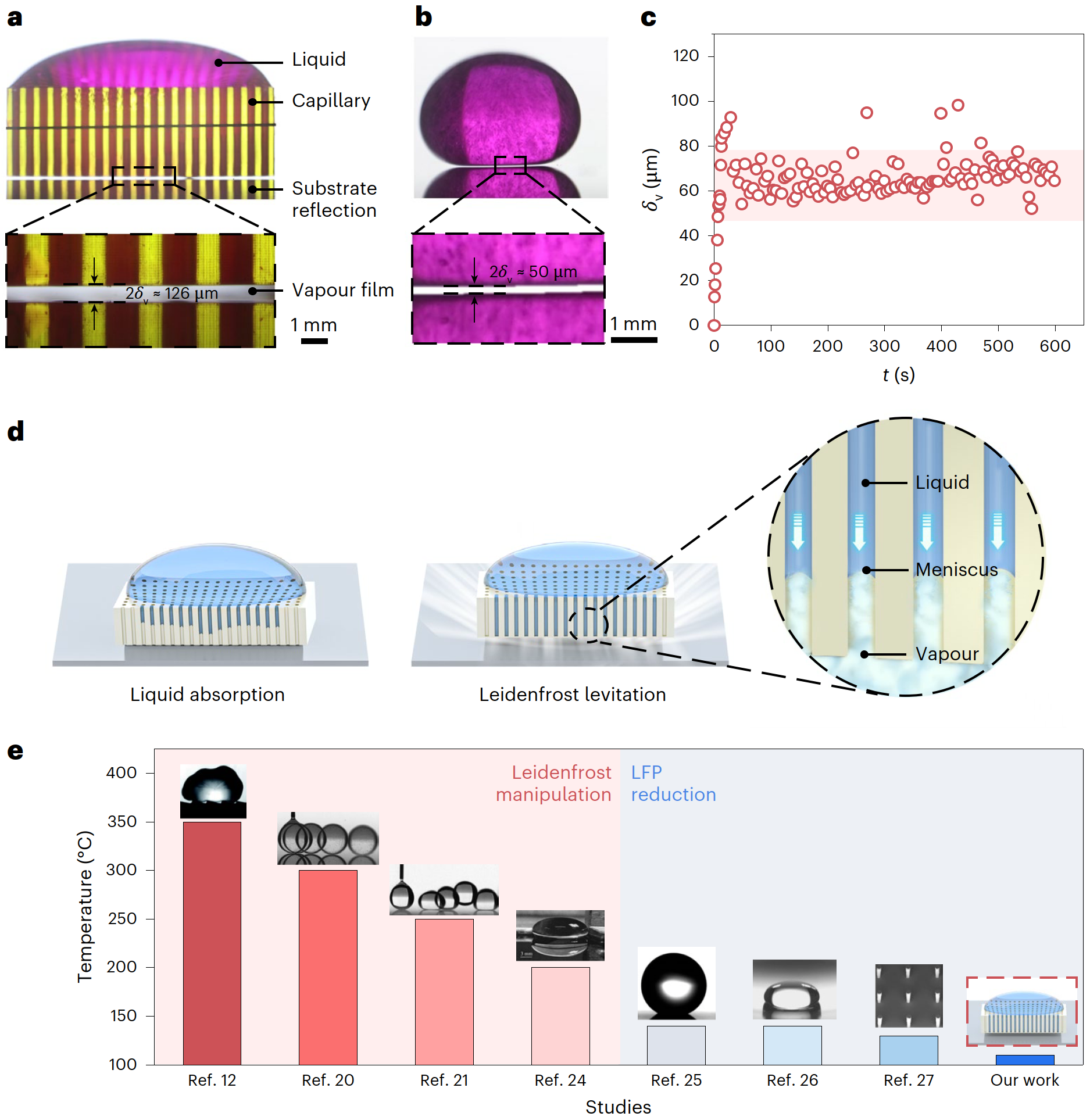
A team led by Prof. Steven Wang from City University of Hong Kong has discovered capillary Leidenfrost effect, a paradigm shift from conventional droplet-based to solid-based Leidenfrost systems. It achieves stable solid levitation at just 110°C—far below the ~200°C threshold of traditional Leidenfrost droplets—without complex surface engineering. The team demonstrated 8-meter continuous self-propulsion, load delivery, and universal applicability across engineered, natural, and metallic materials, even replicable at room temperature with liquid nitrogen.
This effect relies on periodic capillary structures that stabilize the liquid interface, enhances heat conduction, and store liquid. Capillary-confined evaporation generates a continuous 50–80 μm vapor film, eliminating the chaotic oscillations that plague traditional Leidenfrost droplets. The team identified dual parallel heat transfer pathways and modified the classical theoretical model to precisely predict vapor film thickness. Tilted capillaries create asymmetric vapor escape and a wedged vapor film, producing directional propulsion without engineered surface gradients.
This work opens a new avenue for solid-based levitation, resolving long-standing controllability and scalability limits of traditional Leidenfrost systems. It advances fundamental understanding of interfacial evaporation and multiphase flow. Technologically, its low triggering temperature, material universality, and simple fabrication enable low-cost, scalable applications. Furthermore, it enables transformative advances in contactless transport, drag reduction, and soft robotics, delivering an energy-efficient blueprint for frictionless actuation systems.
For more details, please read the full article published in Nature Physics.