

Artificial Intelligence-designed Shape-morphing Neural Interface Reaches Deep Brain Folds Safely
Jun 2026
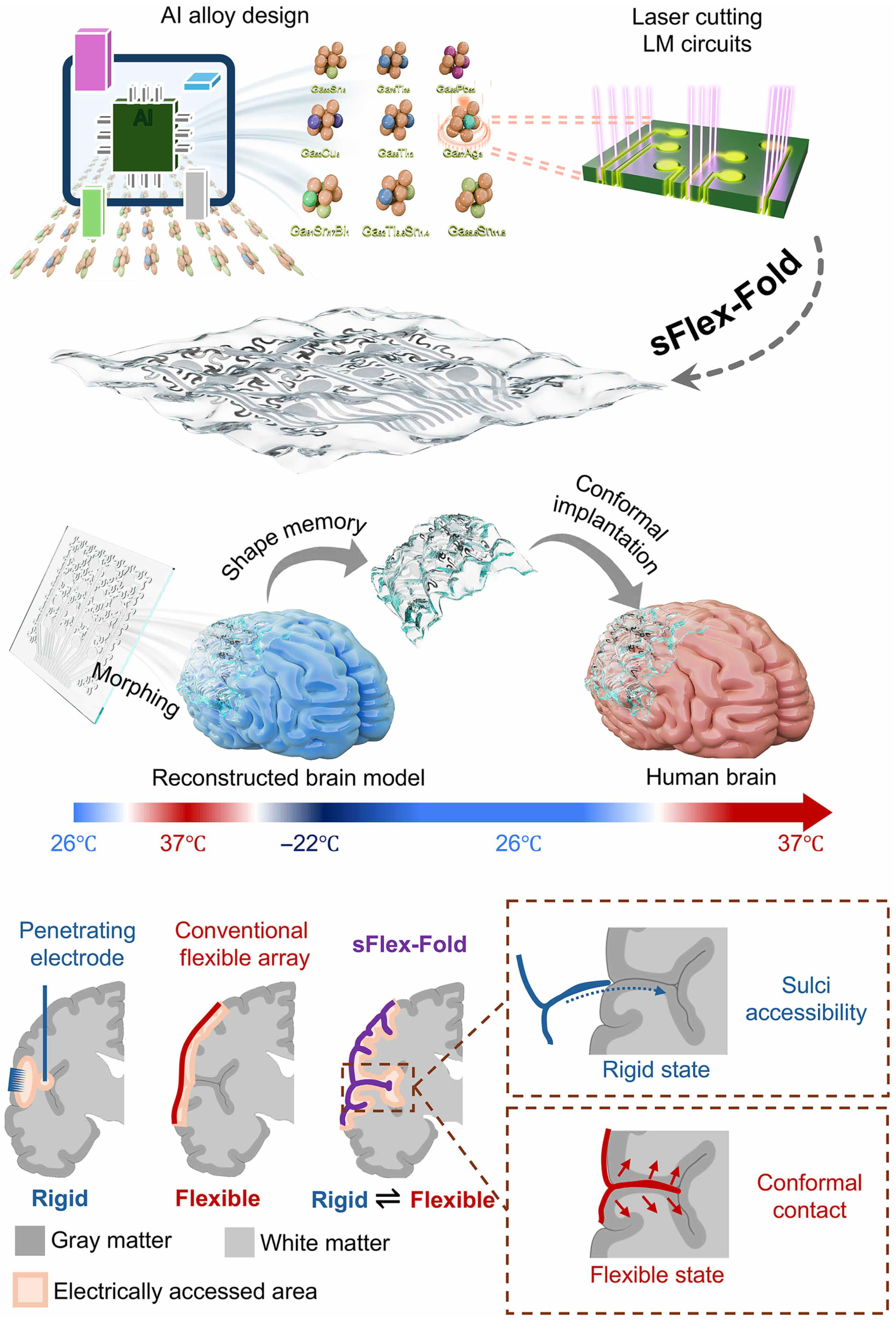
Published in Science Advances, a team led by Prof. Peng Shi and Prof. Yong Yang at City University of Hong Kong has developed sFlex-Fold, a flexibility-switchable neural interface that achieves nondestructive 3D access to both cortical gyri and deep sulci - resolving a decades-long tradeoff between deep tissue reach and gentle tissue compatibility in neurotechnology.
The core mechanism centers on an artificial intelligence-optimized gallium-silver (Ga₉₇Ag₃) liquid metal alloy, screened from 35,145 candidate compositions to have a sharply tuned melting point of 36.2°C. Rigid at room temperature, the device can be pre-molded into complex folded shapes to penetrate deep sulcal folds while covering >80 cm² of curved cortical surface. Upon contact with body tissue, the alloy core melts within seconds, reducing the device’s effective modulus by three orders of magnitude (from 2.03 GPa to 1.66 MPa) to match soft brain tissue mechanics. Patterned via low-energy laser cutting with ~10 μm resolution, the PDMS-encapsulated interface supports high-fidelity neural recording and stimulation.
Validated in rodent and porcine models, sFlex-Fold delivers a ~10-fold leap in conformal contact than conventional flexible arrays, with negligible glial scarring and dramatically lower surgical risk over 4-week implantation. This unlocks the first non-destructive pathway to full-cortex brain mapping, powering advances in epilepsy monitoring, neurodegenerative disease discovery and next-generation brain-computer interfaces. By finally granting safe, high-fidelity access to the two-thirds of the primate cortex hidden deep within sulcal folds, it rewrites the playbook for clinical neurotherapeutics and opens uncharted territory in human brain science. Here is the full article published in Science Advances.
The core mechanism centers on an artificial intelligence-optimized gallium-silver (Ga₉₇Ag₃) liquid metal alloy, screened from 35,145 candidate compositions to have a sharply tuned melting point of 36.2°C. Rigid at room temperature, the device can be pre-molded into complex folded shapes to penetrate deep sulcal folds while covering >80 cm² of curved cortical surface. Upon contact with body tissue, the alloy core melts within seconds, reducing the device’s effective modulus by three orders of magnitude (from 2.03 GPa to 1.66 MPa) to match soft brain tissue mechanics. Patterned via low-energy laser cutting with ~10 μm resolution, the PDMS-encapsulated interface supports high-fidelity neural recording and stimulation.
Validated in rodent and porcine models, sFlex-Fold delivers a ~10-fold leap in conformal contact than conventional flexible arrays, with negligible glial scarring and dramatically lower surgical risk over 4-week implantation. This unlocks the first non-destructive pathway to full-cortex brain mapping, powering advances in epilepsy monitoring, neurodegenerative disease discovery and next-generation brain-computer interfaces. By finally granting safe, high-fidelity access to the two-thirds of the primate cortex hidden deep within sulcal folds, it rewrites the playbook for clinical neurotherapeutics and opens uncharted territory in human brain science. Here is the full article published in Science Advances.