

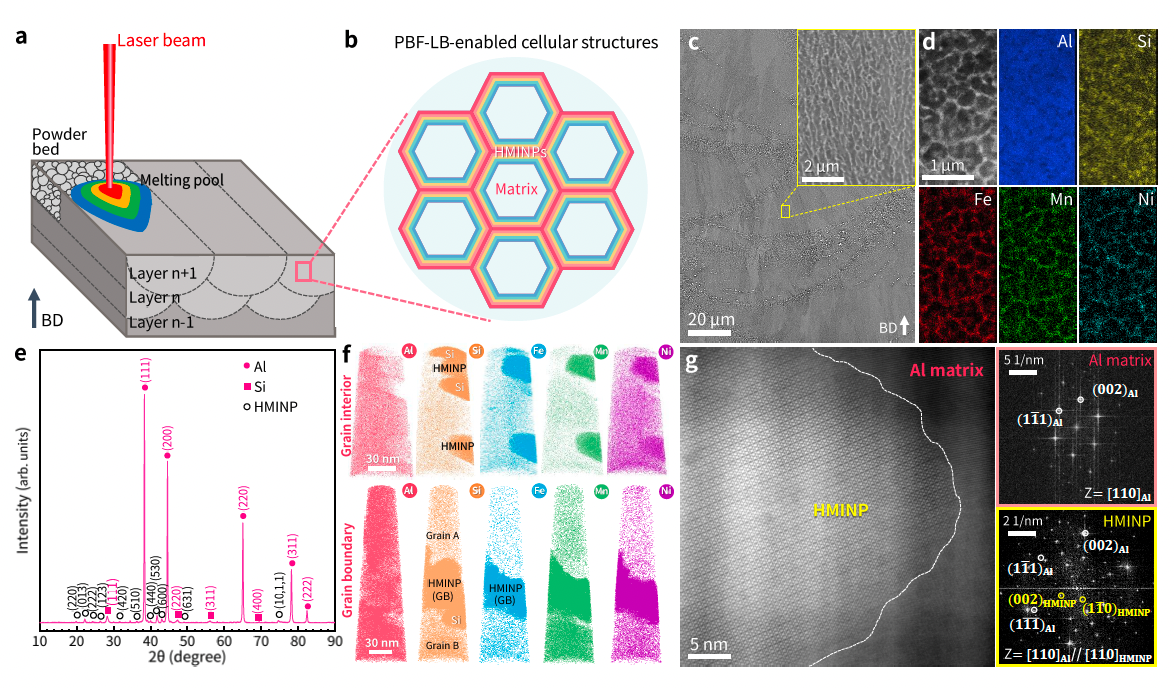
Published in Nature Communications, a team co-led by Prof. Jian Lu from City University of Hong Kong has developed a strong, ductile and heat-resistant aluminum alloy via laser powder bed fusion additive manufacturing, breaking the long-standing high-temperature performance bottleneck of commercial aluminum alloys. Without any post-treatment, the as-printed alloy achieves 582 MPa room-temperature tensile strength, retains 114 MPa tensile strength and exceptional creep resistance at 400 °C, and has entered commercial use in marine engineering and aerospace.
This breakthrough hinges on embedding ~14 vol% heat-resistant multicomponent intermetallic nanophases at solidified cell boundaries to form thermally stable cellular structures; partial solid-state amorphization of these nanophases during straining at 300–400 °C creates a unique nano-dual-phase glass-crystal structure for extra toughening. Uniquely, it uses abundant impurity elements from recycled aluminum without costly rare earths, resolving the classic trade-off between precipitate thermal stability and high volume fraction in aluminum alloys. This work enables low-cost, scalable production of lightweight high-performance components, driving energy efficiency, carbon neutrality and sustainable manufacturing across aerospace and new energy industries. Here is the full article published in Nature Communications.