
Year of Entry
2027Application Deadline
20260915T020000Z20270131T155900Z
Mode of Study
Combined †Mode of Funding
Non-government-fundedIndicative Intake Target
80Minimum No. of Credits Required
30Normal Study Period
Full-time: 1 year;Part-time: 2 years;
Maximum Study Period
Full-time: 2.5 years;Part-time/Combined mode: 5 years;
Mode of Processing
Applications are processed on a rolling basis. Review of applications will start before the deadline and continue until all places are filled. Early applications are therefore strongly encouraged.Programme Outlines
Programme Aims and Objectives
Entrance Requirements
Programme Content
The programme is designed to equip students with the essential knowledge, skills, and mindset to become leaders in technological innovation in the AI age. The rapid advancements in artificial intelligence (AI) have created unprecedented opportunities for innovation across industries. The programme places a strong emphasis on AI-driven innovation, focusing on two key dimensions:
• AI as an enabler of innovation – using AI-powered tools and methodologies to enhance the process of designing new materials, devices, products, processes, services, and systems for innovation.
• AI as an intelligent feature in innovation – integrating AI as a core intelligent function in new products, processes, services, and systems for innovation.
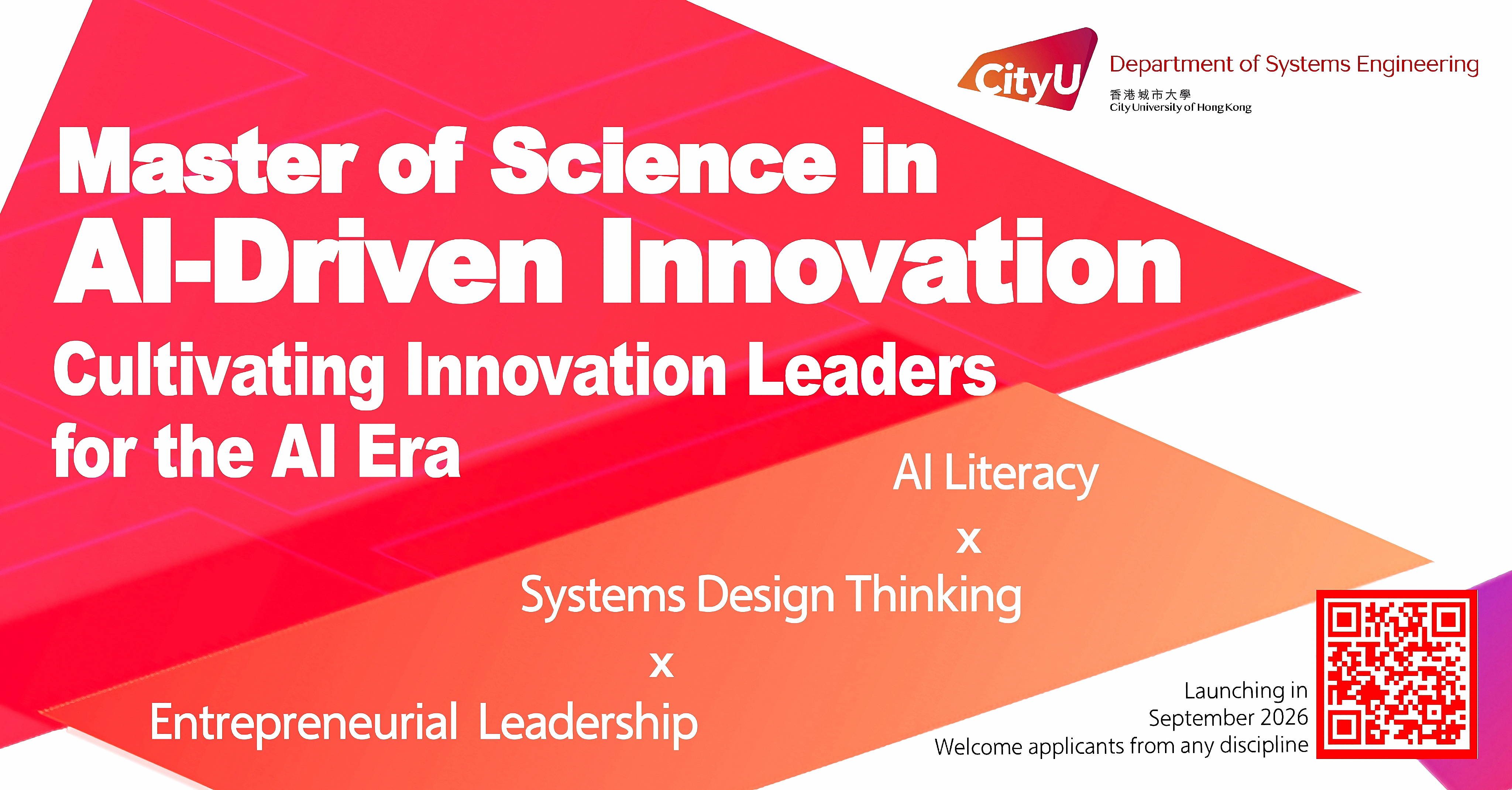
This programme responds to the growing global and local demand for talents who can fuse AI and innovation expertise to drive transformation across industries. By blending technological innovation and AI with systems design thinking, as well as entrepreneurial leadership, the programme aims to nurture innovation leaders, who are capable of shaping the future of industries in the fourth industrial revolution.
Applicants must be a Bachelor’s degree holder. All disciplines are welcome.
English Proficiency Requirements Applicants whose entrance qualification is obtained from an institution where the medium of instruction is not English should fulfil the following minimum English proficiency requirement: · a score of 79 (for tests taken prior to 21 January 2026) or 4 (for tests taken from 21 January 2026 onwards) (Internet-based Test) in the Test of English as a Foreign Language (TOEFL)@#; or · an overall band score of 6.0 in International English Language Testing System (IELTS) @#; or · A score of 450 in the Chinese Mainland’s College English Test (CET-6); or · other equivalent qualifications @TOEFL and IELTS scores are considered valid for two years. Applicants are required to provide their English test results obtained within the two years preceding the start of the University's application period. 'TOEFL iBT Home Edition', ‘TOEFL MyBest Score’, ‘IELTS Indicator’, ‘IELTS One Skill Retake’ and ‘IELTS Online’ are not acceptable. All TOEFL results must be sent directly by the Educational Testing Service (ETS) using CityUHK’s institution code 3401, while IELTS results must be sent via the IELTS Results Service e-delivery to 'City University of Hong Kong - Graduate School'. #Applicants with an IELTS overall band score of 6.0 or a TOEFL overall score of 4 will be required to pass an interview for English proficiency conducted by the concerned academic unit. Applicants with a comparable overall score of 79 or above shown on the TOEFL report may be exempt from the interview requirement. Interviews for other applicants may not be required.
Required Core Courses (12 credit units)
|
Course Code |
Course Title |
Credit Units |
|
SYE6012 |
Technological Innovation and Entrepreneurship |
3 |
|
SYE6302 |
Design Science |
3 |
|
SYE6601 |
Introduction to Artificial Intelligence: Concepts and Applications |
3 |
|
SYE6602 |
AI-Driven Innovation: Seminars and Projects |
3 |
Programme Electives (18 credit units)
|
Course Code |
Course Title |
Credit Units |
|
SYE5006 |
Operations Management |
3 |
|
SYE5009 |
Industrial Marketing Management for Engineers |
3 |
|
SYE5010 |
Engineering Management Principles and Concepts |
3 |
|
SYE6009 |
Project Management |
3 |
|
SYE6015 |
Supply Chain Management |
3 |
|
SYE6037 |
Managing Strategic Quality |
3 |
|
SYE6050 |
Engineering Economic Analysis |
3 |
|
SYE6053 |
Business Process Improvement and Innovation |
3 |
|
SYE6102 |
Managerial Decision-Making Systems with Artificial Intelligence |
3 |
|
SYE6103 |
Financial Engineering for Engineering Managers |
3 |
|
SYE6105 |
Risk and Decision Analysis |
3 |
|
SYE6106 |
Intelligent Manufacturing for Engineering Managers |
3 |
|
SYE6110 |
Data Analysis and Artificial Intelligence for Systems Engineering |
3 |
|
SYE6309 |
Smart City and AI Technologies |
3
|
|
SYE6610 |
AI Innovation Internships |
3 |
|
SYE6612 |
The Fourth Industrial Revolution |
3 |
|
SYE6620 |
AI-Based Media Entrepreneurship |
3 |
|
SYE6621 |
Agentic AI for Innovation |
3 |
|
SYE6631 |
AI for Financial Services |
3 |
|
CAI6002 |
Venture Creation Seminar |
3 |
|
SM5345 |
Introduction to Digital Processes: From Creative Computation to Fabrication |
3 |
|
SM5354 |
Design Thinking and Innovation in Media |
3 |
|
IS5113 |
AI Ethics and Regulations |
3 |
|
IS5542 |
Generative Artificial Intelligence for Business |
3 |
|
IS6423 |
Artificial Intelligence for Business Applications |
3 |
|
IS6620 |
Large Language Model with Prompt Engineering for Business |
3 |
|
DSC6004 |
Data Analytics for Smart Cities |
3 |
|
DSC6016 |
Predictive Analytics and Financial Applications |
3 |
|
DSC8007 |
Deep Learning |
3 |
|
DSC8009 |
Data Mining and Knowledge Discovery |
3 |
|
EE5434 |
Machine Learning for Signal Processing Applications |
3 |
|
EE5437 |
Internet of Things Technologies for Future City Applications |
3 |
|
EE5438 |
Applied Deep Learning |
3 |
|
EE5606 |
Artificial Intelligence for Antennas in Wireless Communication |
3 |
|
EE6435 |
Multi-Dimensional Data Modeling and its Applications |
3 |
|
EE6621 |
Computational Physiology and Neural Systems |
3 |
|
MNE6001 |
CAD/CAM Integration |
3 |
|
MNE6002 |
Computer Controlled Systems |
3 |
|
MNE6007 |
Advanced Automation Technology |
3 |
|
MNE6126 |
Sensors for Robotics, AI and Control Systems |
3 |
|
MNE6128 |
Advanced Machine Learning and Quantum Computation for Engineering |
3 |
|
NS5007 |
Human and Artificial Intelligence |
3 |
|
NS5009 |
Ethical Application of Artificial Intelligence in Biological Sciences and Healthcare |
3 |
|
NS6002 |
Advanced Computational Neuroscience |
3 |
|
BME5110 |
Biomedical Engineering Design |
3 |
|
BME6135 |
Engineering Principles for Drug Delivery |
3 |
|
BME6138 |
Robotics in Minimally Invasive Healthcare |
3 |
|
BMS5010 |
AI in Health Science Research & Management |
3 |
|
BMS5011 |
Wearable Technologies & Health Science Research |
3 |
|
BMS8110 |
Genomics and Bioinformatics |
3 |
|
PH5101 |
Health Economics and Outcomes Research |
3 |
|
PH5105 |
Basic Biostatistics in Public Health |
3 |
|
PH5106 |
Fundamentals of Epidemiology |
3 |
|
PH6202 |
Infectious Disease Epidemiology |
3 |
|
PH6204 |
Public Health Surveillance & Risk Analysis |
3 |
Remark: These elective courses will be offered subject to the availability of resources.
Total Credit required for the MSc Programme: 30