

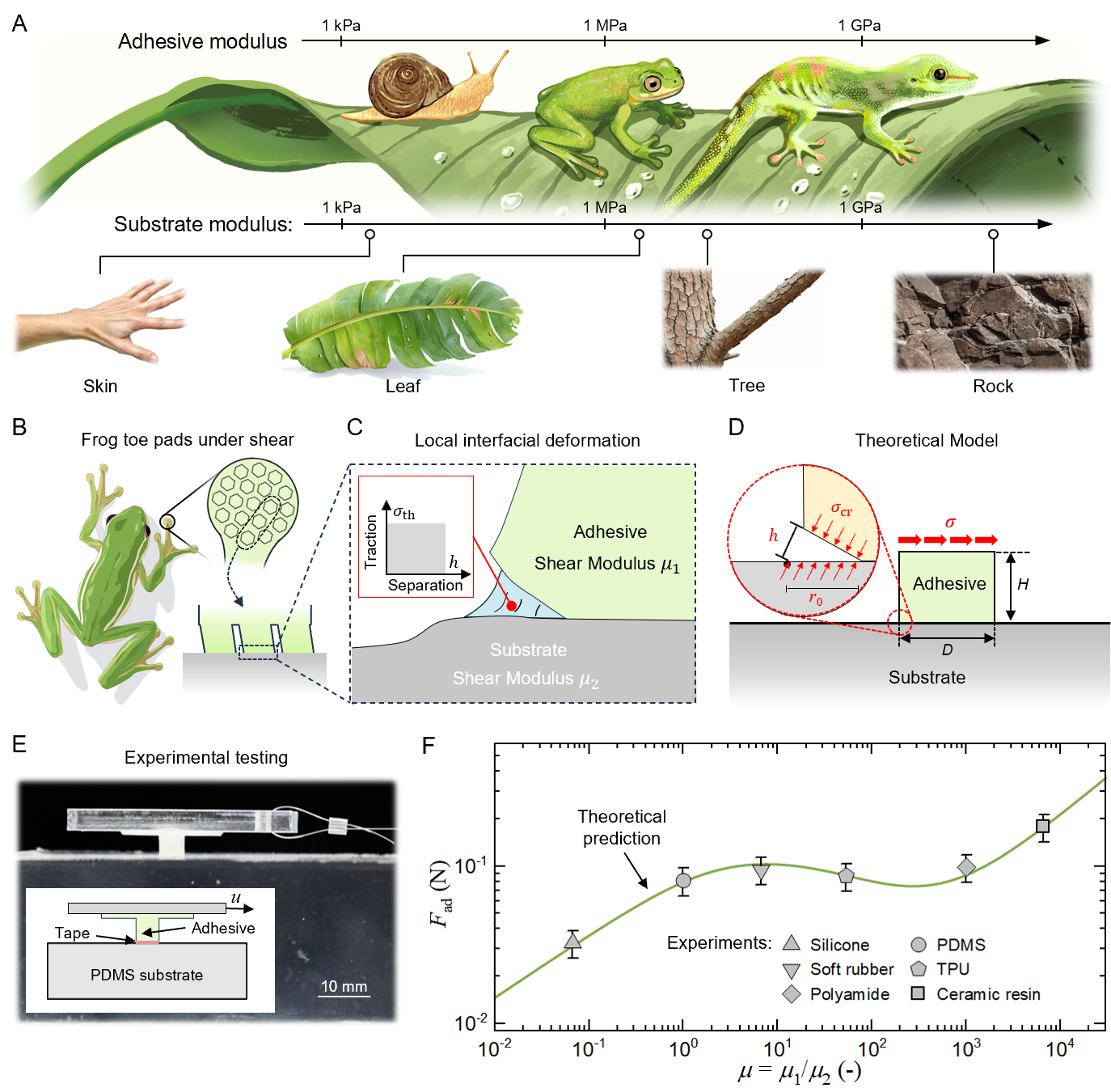
Published in PNAS, A collaborative research team led by Professor Changhong Linghu of City University of Hong Kong, Professor Weiqiu Chen of Zhejiang University and Professor Huajian Gao of Tsinghua University has solved a decades-long materials paradox: whether stiffening an adhesive can strengthen or weaken shear adhesion, a question that has yielded conflicting experimental results across biology and engineering. Combining analytical modeling, cohesive-zone finite element simulations and systematic experiments that validate the predicted peak-valley behaviors, a unified mechanical framework spanning over six orders of magnitude in elastic contrast was established. Counterintuitively, they proved that shear adhesion follows a robust nonmonotonic trend with stiffness, with well-defined local maxima and minima marking optimal regimes for reliable attachment or on-demand release.
The core mechanism overturns a widespread assumption: despite global shear loading, interfacial failure does not arise from sliding along the interface. Instead, it initiates at the free edge and is dominated by opening-mode fracture within a narrow cohesive zone. The nonmonotonic behavior emerges from a tug-of-war between two competing effects: amplified corner stress singularities that accelerate crack initiation as stiffness rises, and suppressed elastic deformation that slows crack growth. Such an interplay creates distinct attachment-favorable and detachment-favorable regimes, with transitions that can be quantitatively predicted from the modulus ratio.
This work reconciles conflicting experimental observations across disciplines and rewrites the foundational design rules for adhesive systems. By establishing modulus contrast as a stand-alone, quantifiable design variable, it delivers predictive adhesion map that let engineers dial in robust attachment or on-demand release with precision, no longer relying solely on surface chemistry and interfacial energy. The findings provide novel, effective design guidelines for next-generation wearable patches, soft robotic grippers and microelectronic transfer printing, as well as shedding new light on biological adhesion strategies from gecko climbing to cancer cell invasion.
Here is the full article published in Proceedings of the National Academy of Sciences of the United States of America (https://www.pnas.org/doi/10.1073/pnas.2610914123).