

3D-printed NiTi Alloy Breaks Performance Barrier for Green Elastocaloric Cooling
May 2026
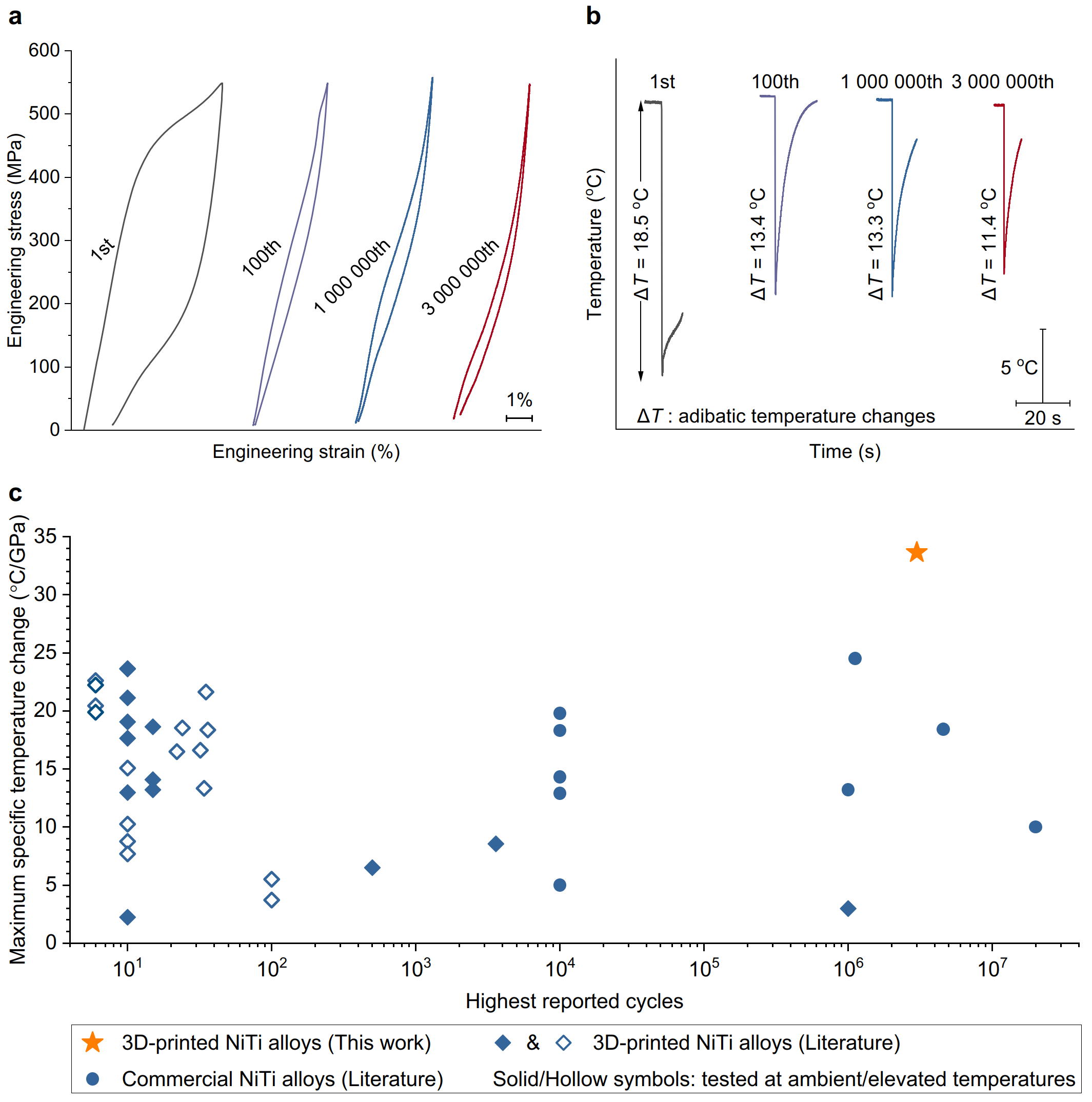
A research team co-led by Prof. Jian Lu from City University of Hong Kong has developed a novel 3D-printed NiTi alloy for elastocaloric cooling, resolving the long-standing critical trade-off between cyclic durability and specific temperature change (ΔTspe) that limited prior 3D-printed refrigerants. Published in Nature Communications, the alloy achieves a record 3 million fatigue cycles without failure, paired with a peak ΔTspe of 33.6 ℃·GPa⁻¹—an 11-fold enhancement over state-of-the-art 3D-printed counterparts—and powers a macroscale cooling prototype with a 20 ℃ temperature span and 50 W cooling power.
This breakthrough stems from an ultralow-defect (0.02% porosity) bimodal microstructure via laser powder bed fusion and single-step annealing: 77.7% micron grains and 22.3% refined grain clusters synergistically suppress dislocation slip and crack propagation while facilitating reversible stress-induced martensitic transformation, with annealing-induced Ti₂Ni precipitates tuning the phase transition temperature for efficient room-temperature operation. This work unlocks 3D printing’s potential for sustainable solid-state cooling, eliminating the high material waste and geometric constraints of conventional processing, and delivers a zero-emission alternative to vapor-compression refrigeration with fluorinated greenhouse gases, addressing soaring global cooling demand amid climate change. Here is the full article published in Nature Communications.
This breakthrough stems from an ultralow-defect (0.02% porosity) bimodal microstructure via laser powder bed fusion and single-step annealing: 77.7% micron grains and 22.3% refined grain clusters synergistically suppress dislocation slip and crack propagation while facilitating reversible stress-induced martensitic transformation, with annealing-induced Ti₂Ni precipitates tuning the phase transition temperature for efficient room-temperature operation. This work unlocks 3D printing’s potential for sustainable solid-state cooling, eliminating the high material waste and geometric constraints of conventional processing, and delivers a zero-emission alternative to vapor-compression refrigeration with fluorinated greenhouse gases, addressing soaring global cooling demand amid climate change. Here is the full article published in Nature Communications.