

MSE Seminar – Prof. Jacob KLEIN (22 - 23 October 2026)
 MSE Seminar – Prof. Prof. Jacob KLEIN (22 & 23 October 2026)
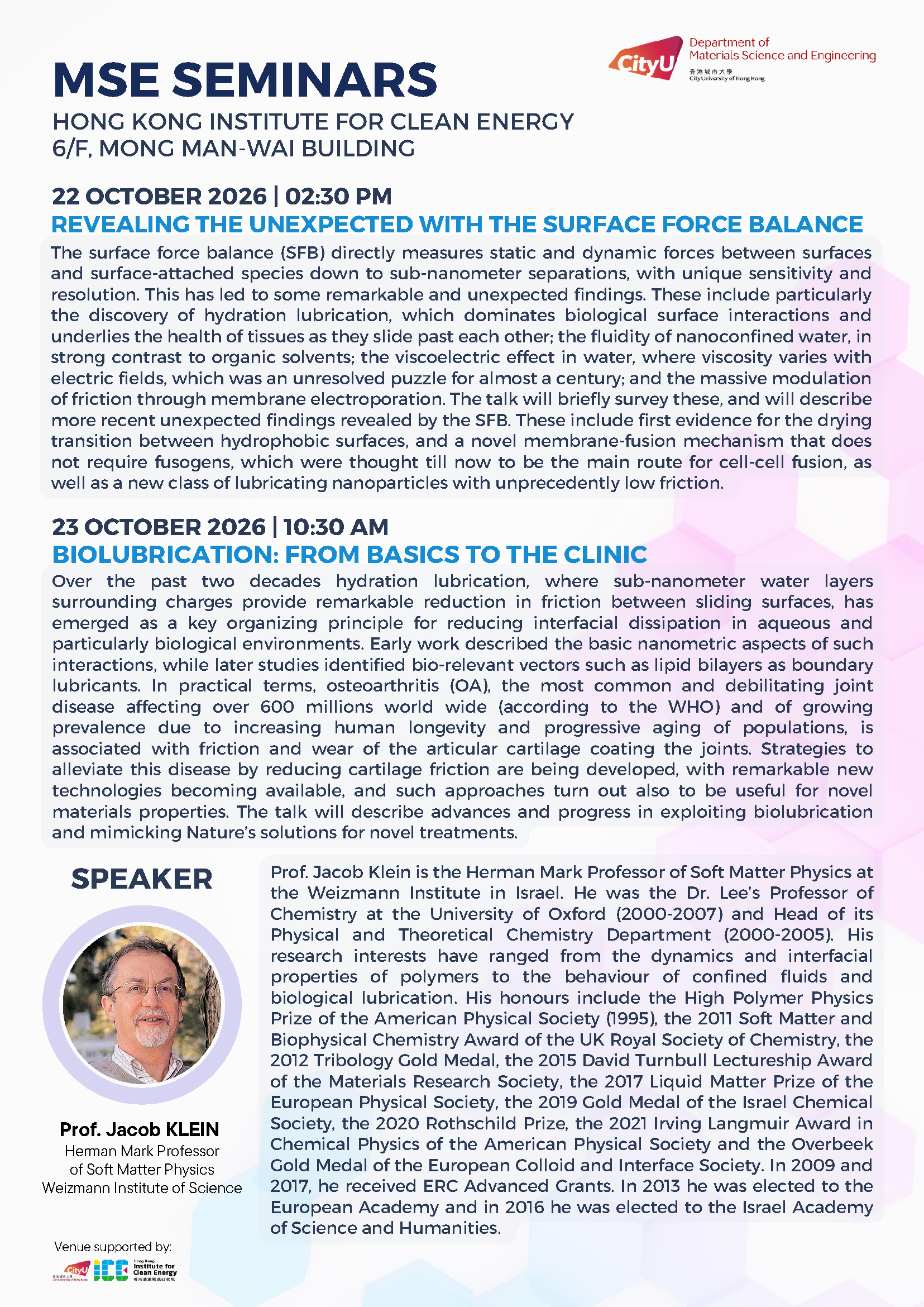
| Title: | Revealing The Unexpected With The Surface Force Balance | Biolubrication: From Basics To The Clinic |
| Date: | 22 October 2026 (Thursday) | 23 October 2026 (Friday) |
| Time: | 02:30 pm | 10:30 am |
| Speaker: | Prof. Jacob KLEIN Herman Mark Professor of Soft Matter Physics Weizmann Institute of Science |
|
| Venue: | Hong Kong Institute For Clean Energy, 6/F, Mong Man-Wai Building | |
| Abstract: |
The surface force balance (SFB) directly measures static and dynamic forces between surfaces and surface-attached species down to sub-nanometer separations, with unique sensitivity and resolution. This has led to some remarkable and unexpected findings. These include particularly the discovery of hydration lubrication, which dominates biological surface interactions and underlies the health of tissues as they slide past each other; the fluidity of nanoconfined water, in strong contrast to organic solvents; the viscoelectric effect in water, where viscosity varies with electric fields, which was an unresolved puzzle for almost a century; and the massive modulation of friction through membrane electroporation. The talk will briefly survey these, and will describe more recent unexpected findings revealed by the SFB. These include first evidence for the drying transition between hydrophobic surfaces, and a novel membrane-fusion mechanism that does not require fusogens, which were thought till now to be the main route for cell-cell fusion, as well as a new class of lubricating nanoparticles with unprecedently low friction. |
Over the past two decades hydration lubrication, where sub-nanometer water layers surrounding charges provide remarkable reduction in friction between sliding surfaces, has emerged as a key organizing principle for reducing interfacial dissipation in aqueous and particularly biological environments. Early work described the basic nanometric aspects of such interactions, while later studies identified bio-relevant vectors such as lipid bilayers as boundary lubricants. In practical terms, osteoarthritis (OA), the most common and debilitating joint disease affecting over 600 millions world wide (according to the WHO) and of growing prevalence due to increasing human longevity and progressive aging of populations, is associated with friction and wear of the articular cartilage coating the joints. Strategies to alleviate this disease by reducing cartilage friction are being developed, with remarkable new technologies becoming available, and such approaches turn out also to be useful for novel materials properties. The talk will describe advances and progress in exploiting biolubrication and mimicking Nature’s solutions for novel treatments. |
| Enquiries: | mse@cityu.edu.hk | |