

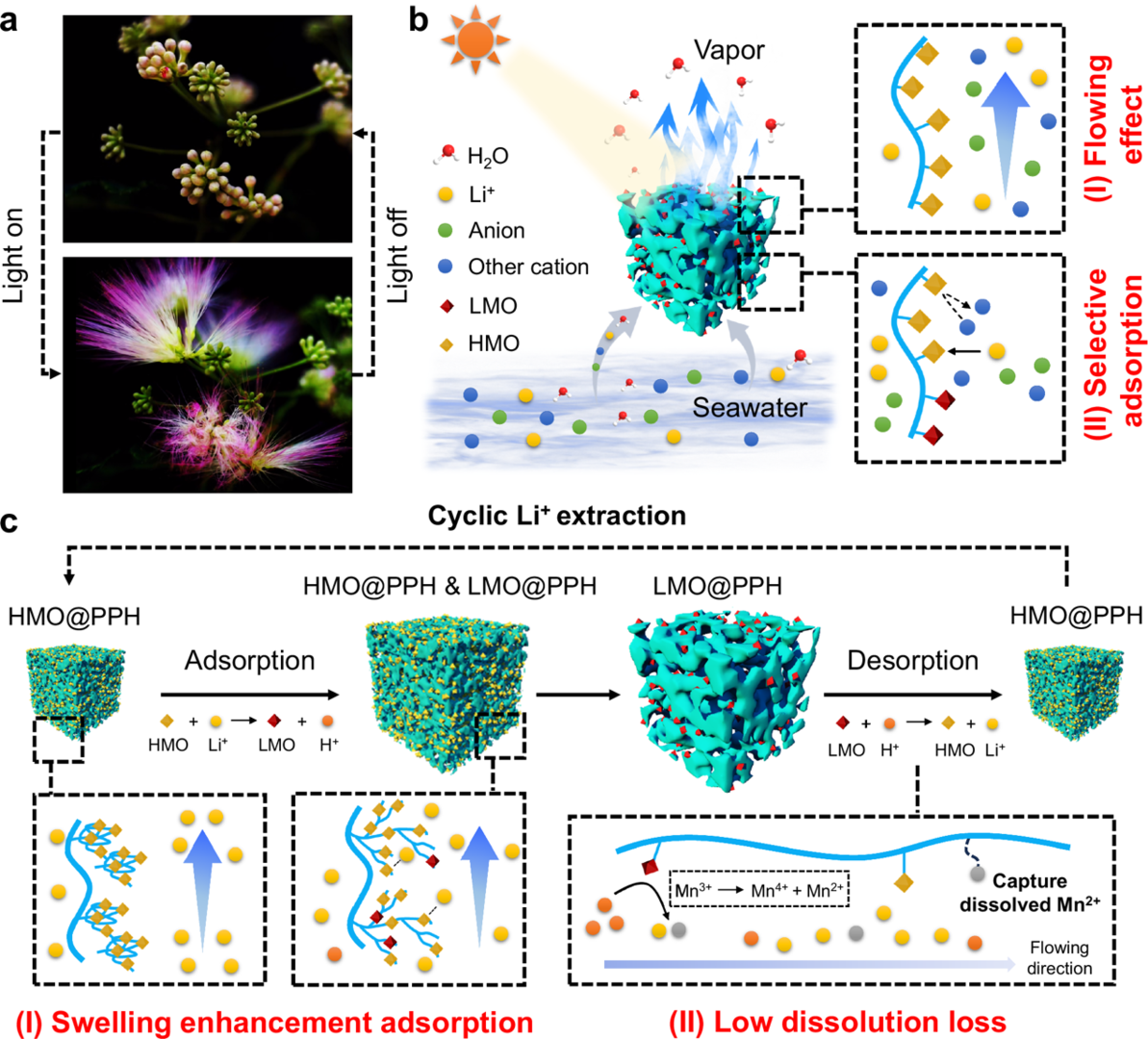
A research innovation led by Prof. Jian Lu at City University of Hong Kong, in collaboration with National University of Singapore, Nanyang Technological University, Taiyuan University of Technology, and Shanghai Jiao Tong University, brought forth an adsorbent-responsive bionic photothermal ion pump (APIP) with enhanced, reversible lithium extraction from seawater. Published in Nature Communications, the APIP addresses longstanding challenges in lithium-ion sieve (LIS) technology—poor adsorption performance after granulation, manganese dissolution loss, and slow kinetics—by achieving a high lithium extraction capacity of 34 mg/g hydrogen manganese oxide (HMO), even outperforming pure HMO powders. Under one sun illumination, the APIP’s lithium extraction kinetics accelerated by 2.9-fold, maintained stable performance over seven cycles, and exhibited strong selectivity for Li⁺ despite seawater’s ultra-high Na⁺/Li⁺ ratio (~19,000:1).
The APIP’s success stems from mimicking the Albizia julibrissin’s ion accumulation and light-responsive structural changes. The team integrated HMO (a high-performance LIS) into an interpenetrating network hydrogel via an innovative in-situ crosslinking and ion-exchange strategy, ensuring uniform HMO dispersion. Four core mechanisms drive its performance: 1) Adsorption-responsive swelling exposes more active sites during Li⁺ capture; 2) Low free water content and polymer chain chelation of Mn²⁺ minimize HMO dissolution; 3) Solar-driven photothermal evaporation creates Li⁺ concentration gradients and convective flow to boost mass transfer; 4) Uniform HMO distribution avoids agglomeration, preserving adsorption efficiency.
This work marks a critical breakthrough by merging biomimetic design with photothermal technology to overcome LIS limitations. Scientifically, it establishes a new paradigm for tuning ion adsorption via swelling-thermal coupling, expanding understanding of interfacial evaporation-enhanced ion separation. Technologically, the APIP’s facile fabrication, low energy consumption (solar-driven), and scalability address key barriers to industrial seawater lithium extraction. Societally, it unlocks seawater’s 230-billion-ton lithium reserve, 2000 times land reserves, alleviating global lithium shortages for electric vehicles and renewable energy storage. Furthermore, the APIP is promising for tiered seawater resource utilization (clean water, lithium, and other valuable ions), contributing to UN Sustainable Development Goals for water security and sustainable resource management.
For more details, please read the full article in Nature Communications.