

Chiral Seeds Break Room-Temperature Valley Polarization Record in Lead-free 2D Heterostructures
Oct 2026
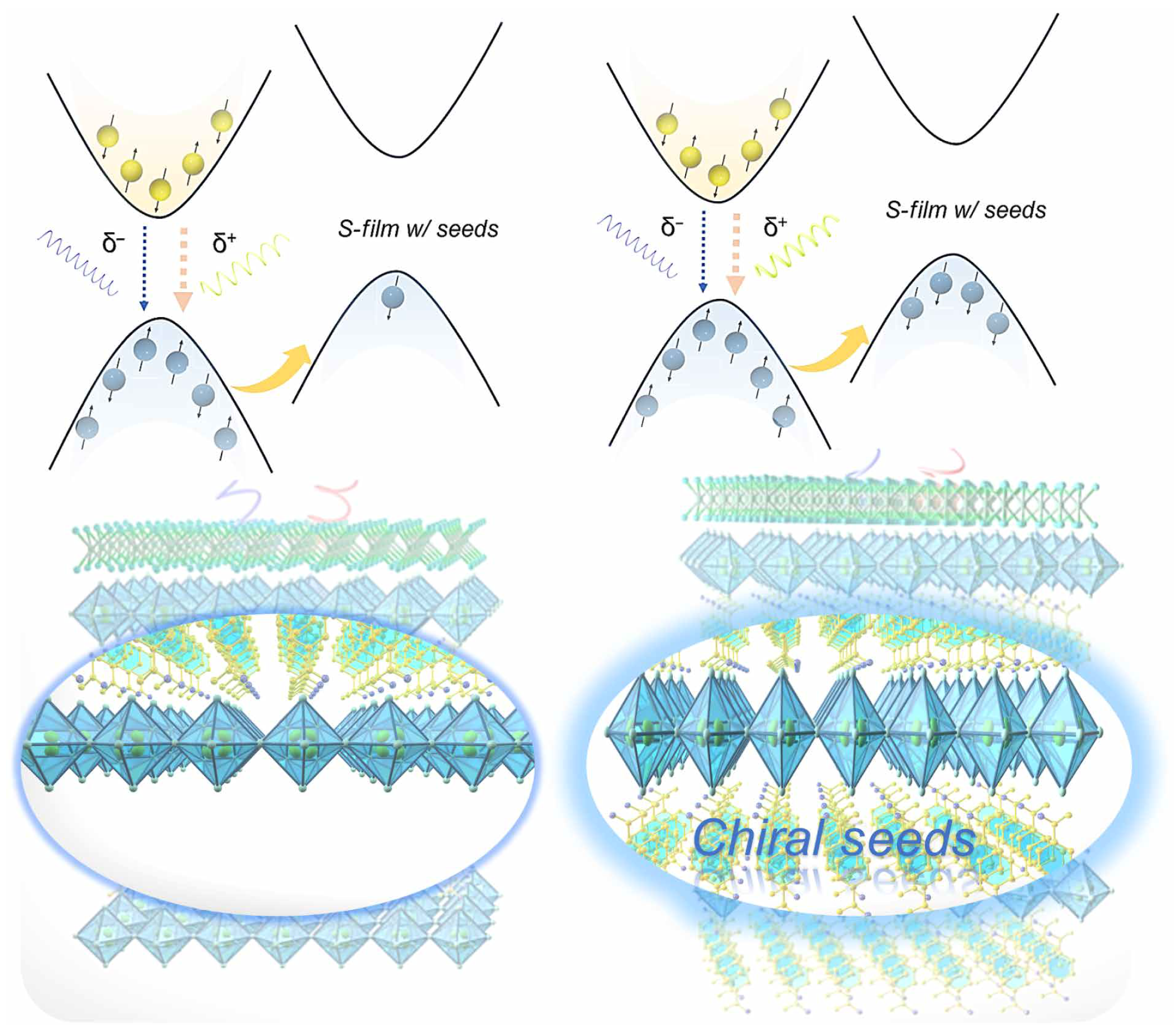
A collaborative team from City University of Hong Kong and Fudan University has achieved record room-temperature valley polarization in monolayer tungsten disulfide (WS₂) using a seeded lead-free chiral tin perovskite heterostructure, delivering a peak valley degree of polarization of 14.9% at ambient conditions — among the highest value ever reported for an all-solid-state system operating with no external magnetic fields, resonant optical excitation or cryogenic cooling. The device retains clear polarization signatures across days of continuous testing, marking a major leap from lab curiosities toward deployable valleytronic technology.
The performance surge originates from an amplified chiral-induced spin selectivity (CISS) effect at the heterointerface, enabled by an ultra-thin chiral molecular seed layer. The seeds distort the inorganic perovskite octahedral lattice, break inversion symmetry and strengthen excitonic coupling, which widens spin-dependent band splitting and sharpens the spin-filtering function of the perovskite. Combined with a favorable type-II band alignment, this enhanced CISS effect drives efficient, spin-selective hole extraction from WS₂ into the perovskite, creating a pronounced population imbalance between the K and K′ valleys. Ultrafast pump-probe spectroscopy confirms an ~8-fold acceleration of interfacial hole transfer with the seed layer, directly boosting valley polarization strength.
This breakthrough removes a central bottleneck for practical valleytronics, which has long been limited to cryogenic temperatures or external fields due to rapid room-temperature intervalley scattering. The lead-free, all-solid-state architecture offers an environmentally benign, scalable platform for room-temperature valley devices, from low-dissipation information storage and logic circuits to chiral optoelectronic sensors. Beyond WS₂, the chiral seeding strategy proves generalizable across other transition metal dichalcogenides, establishing a versatile design principle for engineering spin-valley phenomena in 2D heterostructures. Here is the full article published in Science Advances.
The performance surge originates from an amplified chiral-induced spin selectivity (CISS) effect at the heterointerface, enabled by an ultra-thin chiral molecular seed layer. The seeds distort the inorganic perovskite octahedral lattice, break inversion symmetry and strengthen excitonic coupling, which widens spin-dependent band splitting and sharpens the spin-filtering function of the perovskite. Combined with a favorable type-II band alignment, this enhanced CISS effect drives efficient, spin-selective hole extraction from WS₂ into the perovskite, creating a pronounced population imbalance between the K and K′ valleys. Ultrafast pump-probe spectroscopy confirms an ~8-fold acceleration of interfacial hole transfer with the seed layer, directly boosting valley polarization strength.
This breakthrough removes a central bottleneck for practical valleytronics, which has long been limited to cryogenic temperatures or external fields due to rapid room-temperature intervalley scattering. The lead-free, all-solid-state architecture offers an environmentally benign, scalable platform for room-temperature valley devices, from low-dissipation information storage and logic circuits to chiral optoelectronic sensors. Beyond WS₂, the chiral seeding strategy proves generalizable across other transition metal dichalcogenides, establishing a versatile design principle for engineering spin-valley phenomena in 2D heterostructures. Here is the full article published in Science Advances.