

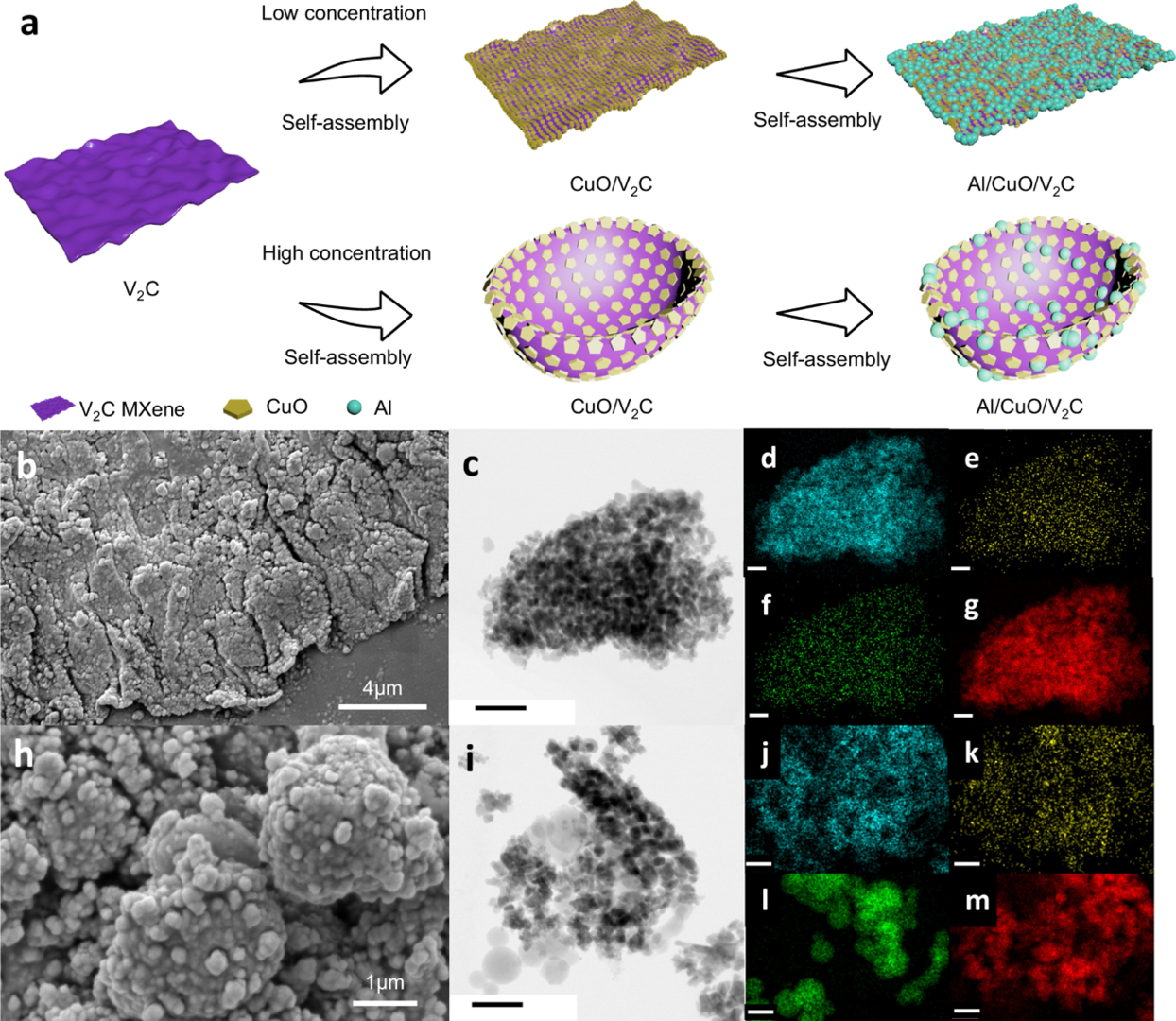
A recent study led by Professor Kaili Zhang has developed a novel hierarchical Al/CuO/V₂C nanothermite which solves the long-standing nanoparticle agglomeration issue, published in Nature Communications. The new nanocomposite achieves a heat release of 3156.2 J/g—seven times higher than traditional Al/CuO nanothermite—and offers tunable combustion performance, ranging from a 3-ms rapid deflagration to a 16-ms sustained combustion. It also reduces peak pressure by 44.5%, enhancing safety for microdevice applications.
This breakthrough lies in using V₂C MXene as a template for the ordered self-assembly of Al and CuO nanoparticles. Driven by electrostatic forces and covalent Cu-O-V bonds, CuO forms an inner layer on V₂C, while Al forms an outer layer that avoids random agglomeration. Adjusting V₂C concentration controls the structure: low concentrations (≤5 wt%) yield nanosheets for fast reactions, while high concentrations (>5 wt%) form microspheres for prolonged combustion. This "structure-by-concentration" approach ensures uniform component mixing and efficient oxygen diffusion.
Unlike conventional additives that only reduce agglomeration, V₂C MXene plays dual roles of both a structural template and an active reactant. This eliminates the need to sacrifice energy release for structural stability, a common tradeoff in nanothermite design. The material’s tunable performance also bridges a gap: it works for both high-speed initiators (low V₂C) and low-risk microdevices (high V₂C).
This study establishes a "template-guided self-assembly" paradigm for energetic materials, demonstrating how 2D MXenes can regulate nanostructure and reaction pathways. Technologically, it advances nanothermite applications in microelectromechanical systems (MEMS), pyrotechnics, and aerospace—where safe, high-efficiency energy release is universally critical. Further, the reduced gas release and lower pressure improve handling safety and the simple preparation enables scalable production, paving the way for more reliable microinitiators in medical devices and smart munitions.
For more details, please read the full article in Nature Communications.