

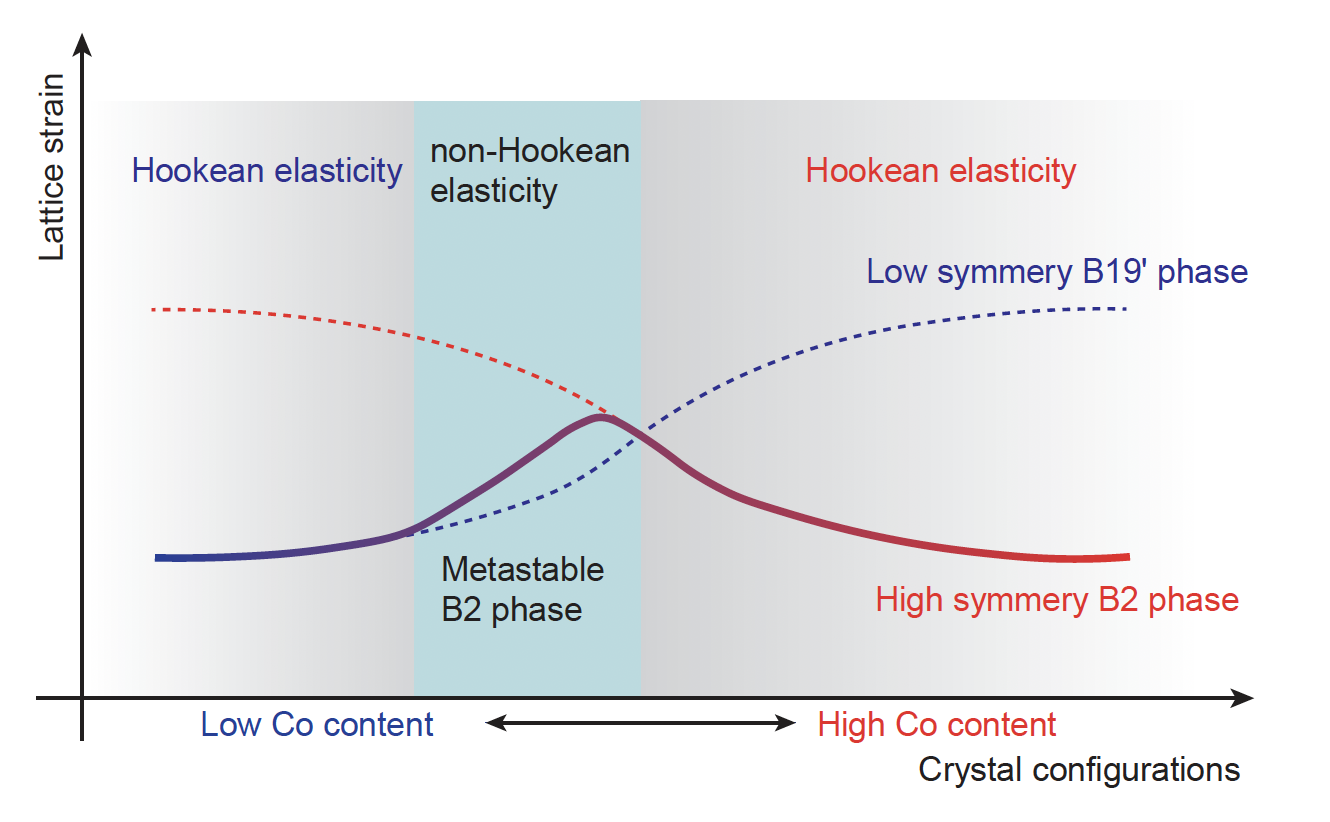
A breakthrough in high-entropy alloys (HEAs) has been achieved by Prof. Yong Yang and Prof. Shijun Zhao from City University of Hong Kong: reversible tuning of superelasticity between Hookean (linear) and non-Hookean (nonlinear) behaviors via subtle compositional adjustments. Published in Nature Communications, the (TiZrHf)₅₀Ni₅₀₋ₓCoₓ alloy system exhibits unprecedented versatility: low Co content (x≤15) shows linear superelasticity; intermediate compositions (15<x<23) deliver ~8% recoverable strain (nonlinear); high Co content (x≥25) restores linearity. Its damping figure of merit (1.1–1.2) outperforms conventional high-damping materials like CuAl-Ni alloys.
The novelty lies in a hidden strain order that governs phase stability. Through atomic-scale strain mapping and density function theory calculations, it is revealed that frustrated crystallization of competing B2 (cubic) and B19' (monoclinic) phases induces heterogeneous lattice distortion. The Co content modulates strain in both phases: at low/high Co, one phase is strain-minimized and stable (linear elasticity); intermediate Co creates balanced strain, forming a strain-glass state that enables stress-induced martensitic transformation (nonlinear superelasticity). This strain-centric mechanism differs from traditional chemical substitution approaches.
Fundamentally, this work establishes a new paradigm for tailoring elastic responses via strain order engineering, revealing a physical mechanism in which the hidden strain order modulating the Hookean and non-Hookean elasticity transition governs the composition-dependent superelasticity in HEAs. Furthermore, the alloy’s tunable elasticity and damping make it ideal for microelectromechanical systems (MEMS), high-precision actuators, and adaptive damping devices, advancing next-generation resilient materials and intelligent mechanical systems.
For more details, please read the full article in Nature Communications.