

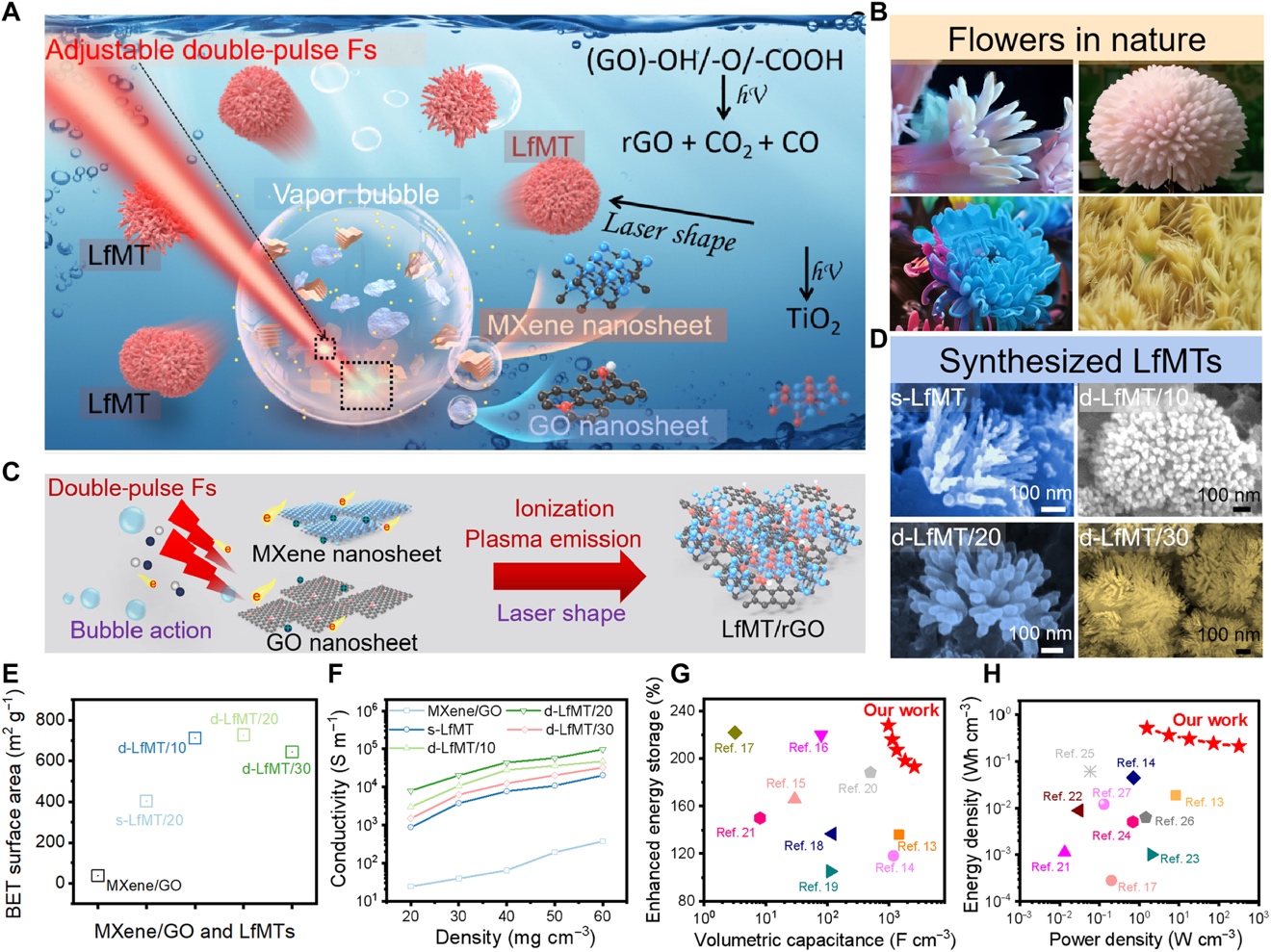
Recent research led by Professor Steven Wang (City University of Hong Kong) and Professor Lan Jiang (Beijing Institute of Technology) presents a breakthrough in solar energy conversion and storage: a laser-architected MXene-graphene composite that powers high-performance photoenhanced microsupercapacitors (MSCs). Published in Science Advances, this study addresses a longstanding challenge—seamlessly integrating solar harvesting with electrochemical energy storage—by developing a hierarchical flower-like MXene/TiO₂-reduced graphene oxide (rGO) composite (LfMT). Under illumination, the LfMT-based MSCs achieve a 228% capacitance boost, with record-breaking metrics: 2591.75 F/cm³ volumetric capacitance (1455.21 F/g gravimetric capacitance), 0.518 Wh/cm³ energy density, and 320.35 W/cm³ power density. The device also maintains 96.81% capacitance retention after 12,000 charge-discharge cycles, outperforming most MXene- or graphene-based MSCs reported to date.
The key to this breakthrough lies in using temporally shaped femtosecond laser pulses for morphology and reaction controls. A Michelson interferometer transforms a single Gaussian laser into a dual-pulse system (pulse delay: 0–30 ps), which induces nonequilibrium reactions in MXene-GO suspensions. Under laser irradiation, GO is photothermally reduced to rGO, while MXene undergoes partial oxidation to form TiO₂ nanoparticles—driven by electrostatic forces and Cu-O-V covalent bonds, these components self-assemble into flower-like structures mimicking natural daisies and chrysanthemums. Such biomimetic design boosts the Brunauer-Emmett-Teller (BET) surface area to 726.88 m²/g (far higher than the 37.52 m²/g of raw MXene-GO) and enhances electrical conductivity to 97,181 S/m for the optimal d-LfMT/20 variant, ensuring efficient ion transport and charge accumulation.
The LfMT composite features dual functionality and spectral versatility. Unlike conventional additives that only reduce nanoparticle agglomeration, MXene in the LfMT acts as both a structural template and an active reactant. The oxidized MXene participates in thermochemical reactions to release extra energy, while its heterojunction with rGO and TiO₂ creates a built-in electric field that suppresses charge carrier recombination. Density functional theory calculations confirm that Ti atoms dominate charge carrier supply near the Fermi level, and electron paramagnetic resonance detects Ti³⁺ ions (g=2.003) that create oxygen vacancies, further enhancing conductivity. The composite’s ultranarrow optical bandgap (0.77 eV) extends light absorption to the near-infrared region (200–800 nm), utilizing ~90% of solar photon energy—far more than traditional TiO₂ (3.02 eV bandgap, limited to UV light).
This work establishes a “template-guided self-assembly” paradigm for energetic materials, demonstrating how 2D MXenes can regulate nanostructure and reaction pathways for integrated photo-electrochemical systems. Technologically, the flexible LfMT-based MSCs (fabricated on PET substrates) retain over 97% capacitance after 180° bending or 720° twisting, making them ideal for microelectromechanical systems (MEMS), wearable electronics, and portable devices. Socially, the simple, scalable laser synthesis (ambient pressure, room temperature) and long-term stability (30-day storage with no performance loss) lower barriers for commercialization—two serially connected MSCs can power a high-brightness bulb under illumination, paving the way for sustainable, off-grid energy solutions in portable electronics and smart microdevices.
For more details, please read the full article in Science Advances.