

MSE Seminars (23 March 2026)
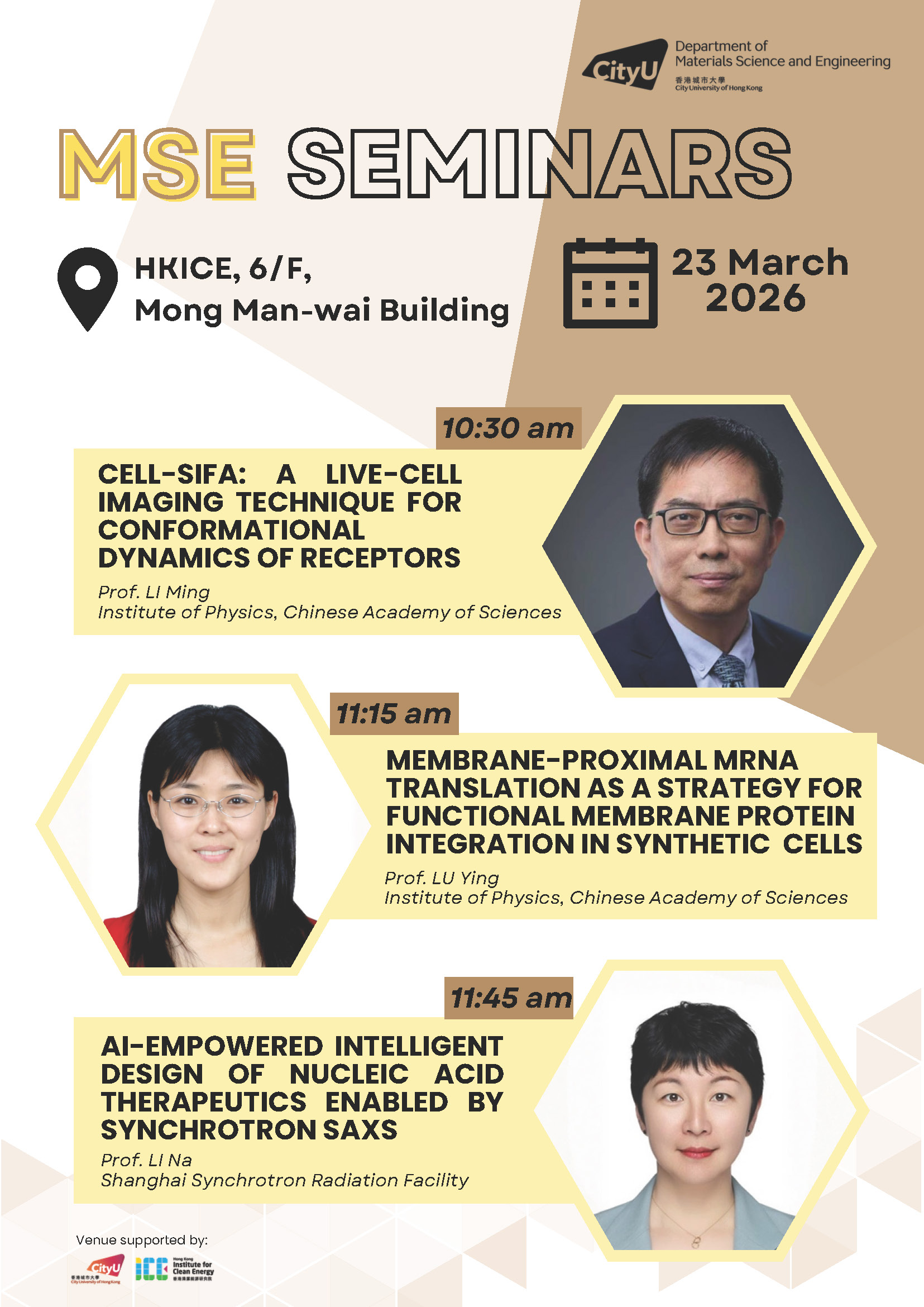
MSE Seminars (23 March 2026)
Date: 23 March 2026 (Monday) Venue: Hong Kong Institute for Clean Energy, 6/F, Mong Man Wai Building Time: 10:30 am 11:15 am 11:45 am Title: Cell-SIFA: A Live-Cell Imaging Technique for Conformational Dynamics of Receptors Membrane-Proximal mRNA Translation as a Strategy for Functional Membrane Protein Integration in Synthetic Cells AI-Empowered Intelligent Design of Nucleic Acid Therapeutics Enabled by Synchrotron SAXS Speaker: Prof. LI Ming Prof. LU Ying Prof. LI Na Abstract: The intrinsically disordered cytoplastic tails (C-tail) are key regulatory elements of membrane receptors. Imaging the dynamics of C-tails involved in different signal pathways in living cells is challenging due to their high flexibility and hence non-visibility in the structure biology. We developed a live-cell fluorescence imaging method to directly monitor the conformational dynamics of the C-tails. The single-molecule responses reveal how a GPCR transduces ligand binding into functional outcomes, while the cell-level responses display distinctive activation time courses. We established a quantitative kinetic model that evaluates pathway-specific ligand efficacy of GPCRs, enabling precise comparison of drug bias across various signaling trajectories. The CD3ζ chains in CARs (CAR-ζ) are in average stretched away from, rather than embedded in, the plasma membrane in resting T cells. Cognate antigens exert forces on the receptor to pull the ζ chains off the actin cytoskeleton, exposing the ITAM motifs to the Lck for phosphorylation. The actin cytoskeleton functions as a protective barrier for the CD3ζ chain phosphorylation in the absence of forces. Our findings established a mechanical licensing model for T cell activation. These works deepen our understanding of the cell receptor activation and implicate a versatile platform for quantitative evaluation of drugs avoiding interferences from exogenous sensors. A central challenge in constructing functional synthetic cells is the de novo synthesis and proper integration of hydrophobic membrane proteins, which are indispensable for transport, signaling, and energy conversion. Natural cells overcome this obstacle by coupling mRNA localization with co-translational membrane insertion, but such spatial regulation has been largely absent from bottom-up synthetic systems. Here, we present a membrane-proximal translation platform that anchors mRNAs at lipid bilayers via programmable hybridization, thereby recruiting ribosomes for localized protein synthesis directly at the membrane interface. This spatially controlled process ensures correct topology and functional integration of diverse classes of membrane proteins, including single-pass and multi-pass transmembrane proteins, as well as higher-order oligomeric assemblies. Importantly, by encoding spatial information into the untranslated regions of mRNAs, we achieve programmable stoichiometric control over protein expression, allowing rational design of membrane composition in synthetic cells. Functional validation using the multidrug transporter EmrE demonstrates selective substrate uptake, confirming that the synthesized proteins are not only integrated but also active. Together, these results establish a minimal yet versatile framework that connects spatial mRNA regulation with membrane protein biogenesis. Our strategy provides a broadly applicable route for endowing synthetic cells with membrane-based functions, advancing their potential as platforms for biosensing, artificial signaling networks, and engineered organelles. This presentation focuses on AI-empowered intelligent design of nucleic acid therapeutics enabled by synchrotron solution scattering (SAXS), with particular emphasis on the essential role of "formulation–structure–function" oriented intelligent design database in the development of next-generation nucleic acid drugs. High-throughput, multiscale structural information are acquired via synchrotron solution scattering. The collected scattering data are systematically integrated with formulation parameters, biophysical structural characterizations, and functional evaluation results to establish standardized database for nucleic acid drug delivery systems. Machine learning and intelligent reasoning approaches are introduced to build the relationship between drug formulation and function with characteristic scattering profile. The developed algorisms are ultimately integrated with synchrotron SAXS to develop a synchrotron scattering–based AI Agent for nucleic acid drug research, enabling coordinated intelligent decision-making for formulation optimization, structural prediction, and functional assessment. Enquiries:
Institute of Physics
Chinese Academy of Sciences
Institute of Physics
Chinese Academy of Sciences
Shanghai Synchrotron Radiation Facility