

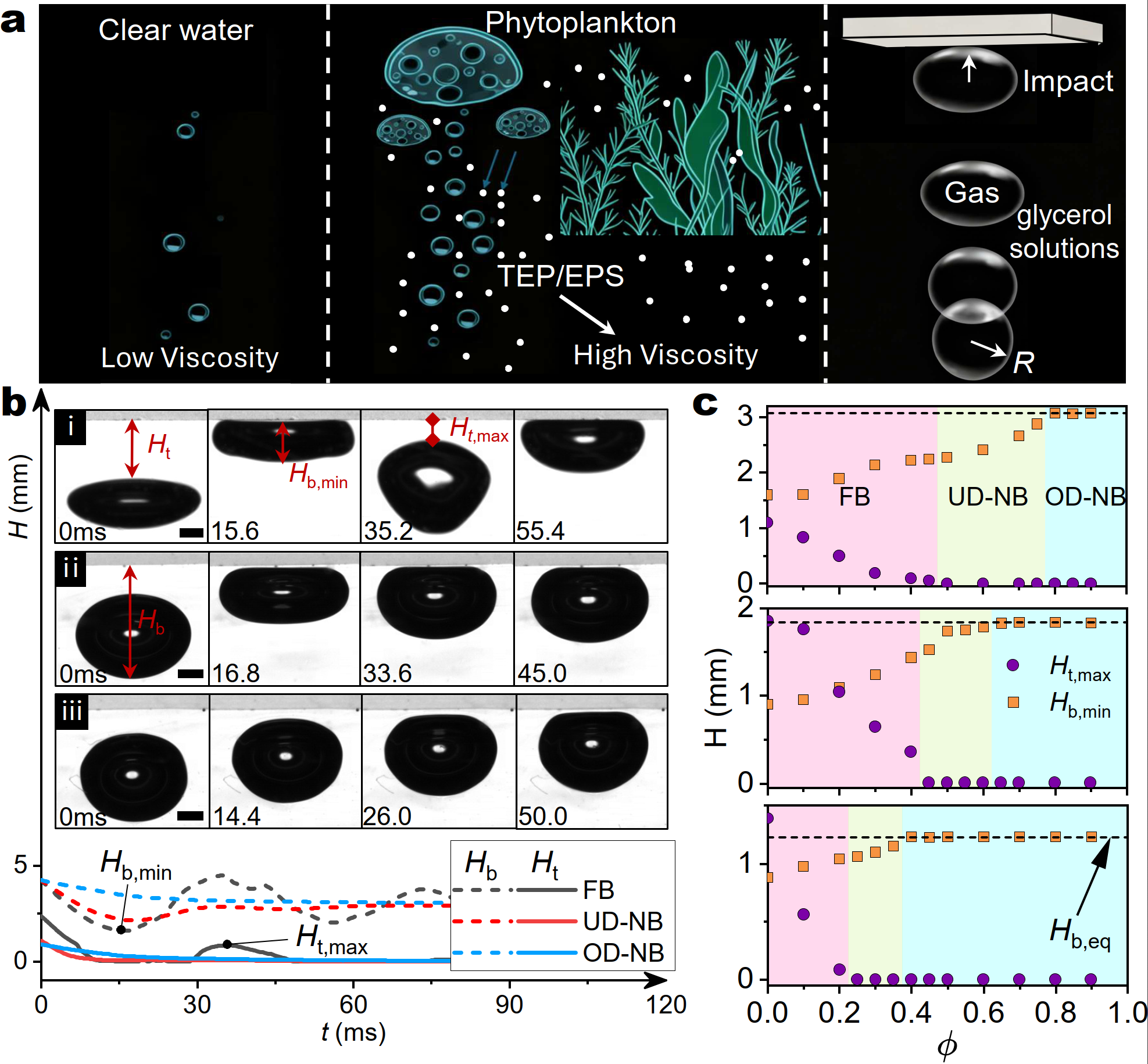
Research led by Prof. Steven Wang and Prof. Kim Meow Liew from City University of Hong Kong has cracked the long-unresolved physical rules of bubble-solid surface collisions that underlie various natural systems and industrial processes. Combining high-speed imaging and multi-dimensional numerical simulations, they mapped the full dynamic phase diagram of rising bubble impacts in Galilei (Ga)–Bond (Bo) parameter space, defining four distinct dynamic regimes, and created a universal double-mass-spring-damper model to predict full spectrum of bubble impact behaviors, with all experimental datasets and simulation codes being open-sourced.
This advance is rooted in precise, quantitative dissection of the force balances governing bubble dynamics. The transition from underdamped to overdamped dynamics is solely determined by Ga (critical threshold of ~5.5), while the bounce-adhesion boundary is coregulated by Ga and Bo, with bouncing fully suppressed above Bo=1. Bubble rise distance only alters regime transitions when shorter than 5 bubble radii. Unlike limited single-mass frameworks, the developed dual-mass model captures asymmetric motion of the bubble’s upper and lower interfaces, pinpointing viscous dissipation in the draining liquid film as the core driver of bounce suppression.
This pioneering work presents the first mechanism-driven, predictive framework for bubble-wall impact dynamics, settling decades of scientific debate in interfacial fluid mechanics. It replaces phenomenological, post-hoc models with actionable design rules for applications including green hydrogen electrolysis, bioreactor gas absorption, immersion cooling, and biomedical ultrasound contrast agents. The findings will drive transformative advances in clean energy, industrial thermal management, and clinical medicine.
For more details, please read the full article in Nature Communications.