

Sea Urchin Gradient Stereom Unlocks Novel Underwater Mechanoelectrical Sensing
Mar 2026
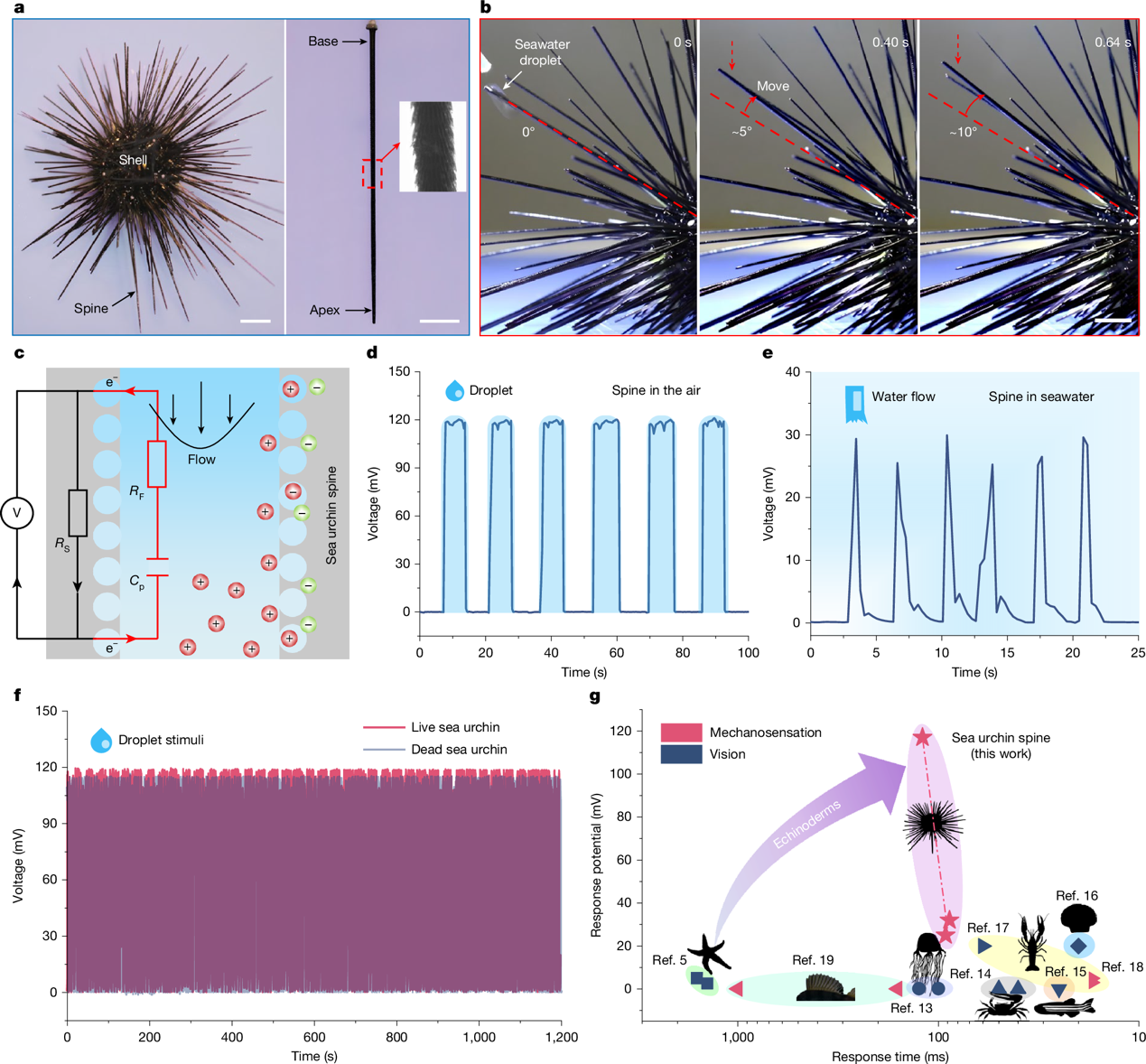
Pioneering research led by Prof. Jian Lu from City University of Hong Kong discovers an unknown mechanoelectrical perception mechanism in sea urchin spine stereom structures, published in Nature. The porous biomineralized stereom structures were long recognized solely for mechanical defense and load-bearing functions. This study reveals, for the first time, that these gradient cellular architectures possess an ultra-sensitive mechanoelectrical perception capability: a peak response potential of 116 mV and a response time of 88 ms, which are 1 to 3 orders of magnitude outperforming echinoderm visual systems. Translating this biological blueprint into engineering, the team fabricated 3D-printed artificial spine-like structures that achieve a 3-fold increase in voltage output and an 8-fold greater amplitude differential compared to gradient-free counterparts, and further developed a bioinspired metamaterial mechanoreceptor that enables battery-free, real-time underwater flow self-monitoring and spatial mapping without external sensors.
The uncovered sensory performance stems from the spine’s bicontinuous stereom gradient along its [001] longitudinal axis. From the base to the apex of the spine, the median void-phase diameter decreases, while porosity and specific surface area increase by 5.3% and 23% respectively. As liquid flows through this interconnected porous network, the gradient structure induces differential fluid velocity and pressure across the stereom surface; this shears the solid-liquid electric double layer (EDL), generating a substantial streaming potential and a marked differential charge density between the spine’s apex and base. Notably, this mechanoelectrical response is entirely driven by the structural gradient and independent of any living biological tissue, fundamentally rewriting our understanding of the functional capabilities of natural cellular solids.
This breakthrough resolves the long-standing mystery of how echinoderms exhibit acute sensory abilities without specialized sensory organs and fundamentally redefines natural cellular solids (e.g., trabecular bone, wood) that were previously thought to serve only mechanical purposes. Technologically, the gradient structure-enabled sensing mechanism is universally compatible with polymer and ceramic materials, and can be scaled across dimensions from micrometers to meters via 3D printing, offering unprecedented design flexibility for passive underwater sensing systems. For industry and global sustainability, this work unlocks transformative applications in marine environmental monitoring, intelligent underwater exploration, and smart water resource management, powering a new generation of sustainable, battery-free underwater sensing technologies.
For more information, please read the full article in Nature.
The uncovered sensory performance stems from the spine’s bicontinuous stereom gradient along its [001] longitudinal axis. From the base to the apex of the spine, the median void-phase diameter decreases, while porosity and specific surface area increase by 5.3% and 23% respectively. As liquid flows through this interconnected porous network, the gradient structure induces differential fluid velocity and pressure across the stereom surface; this shears the solid-liquid electric double layer (EDL), generating a substantial streaming potential and a marked differential charge density between the spine’s apex and base. Notably, this mechanoelectrical response is entirely driven by the structural gradient and independent of any living biological tissue, fundamentally rewriting our understanding of the functional capabilities of natural cellular solids.
This breakthrough resolves the long-standing mystery of how echinoderms exhibit acute sensory abilities without specialized sensory organs and fundamentally redefines natural cellular solids (e.g., trabecular bone, wood) that were previously thought to serve only mechanical purposes. Technologically, the gradient structure-enabled sensing mechanism is universally compatible with polymer and ceramic materials, and can be scaled across dimensions from micrometers to meters via 3D printing, offering unprecedented design flexibility for passive underwater sensing systems. For industry and global sustainability, this work unlocks transformative applications in marine environmental monitoring, intelligent underwater exploration, and smart water resource management, powering a new generation of sustainable, battery-free underwater sensing technologies.
For more information, please read the full article in Nature.