

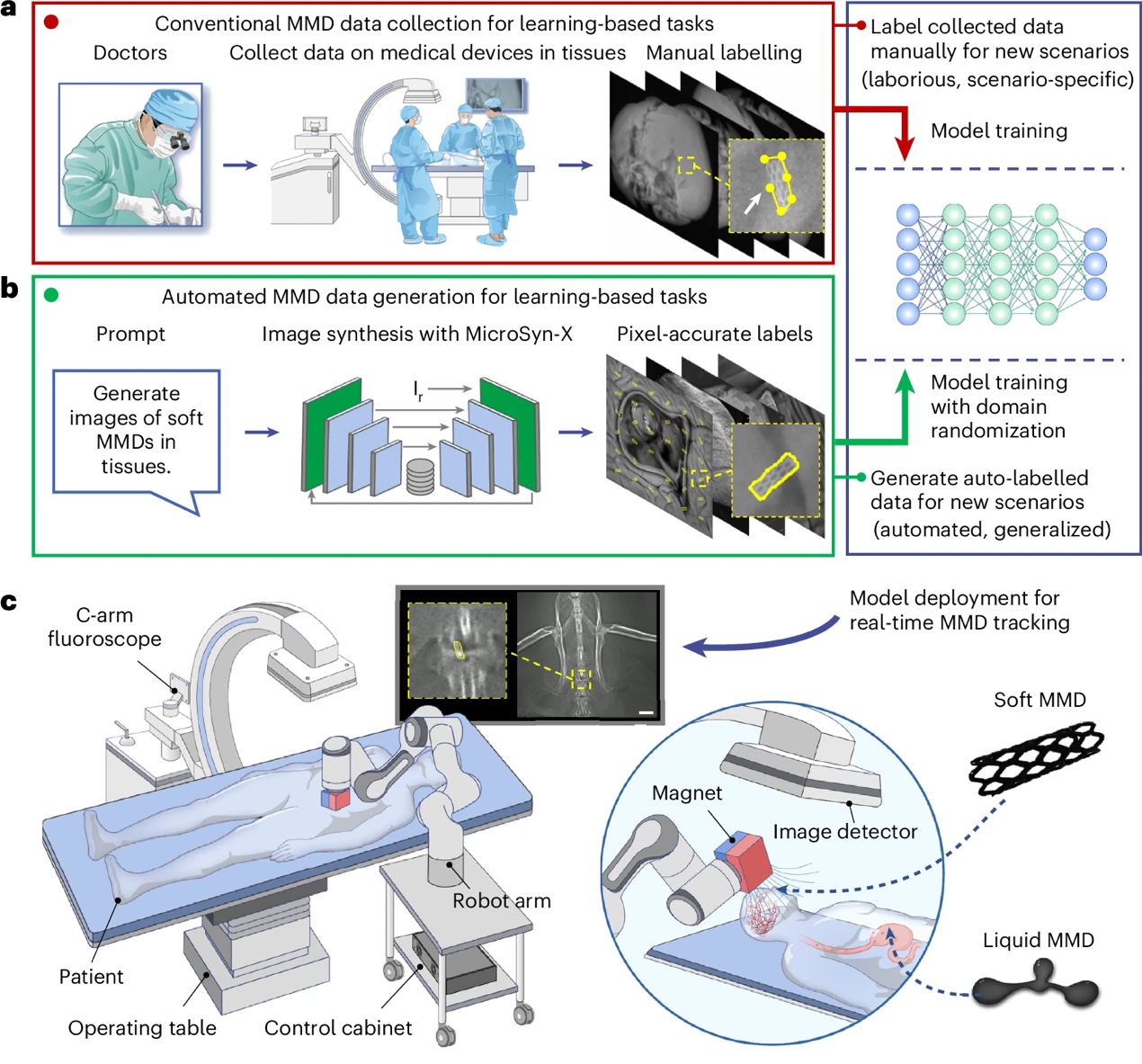
Published in Nature Machine Intelligence, a novel synthetic data framework, MicroSyn-X, which breaks the long-standing bottleneck in miniature medical device (MMD) clinical translation, is created by an international research team co-led by Prof. Wenbin Kang from City University of Hong Kong. MMDs for minimally invasive surgery have long been held back by scarce annotated X-ray datasets, operator fatigue from laborious manual operations, and unreliable tracking in low-contrast, high-noise, occluded clinical environments. MicroSyn-X eliminates manual data curation entirely, generating auto-annotated, high-fidelity X-ray images to train computer vision models. It enables real-time navigation of magnetic soft and liquid MMDs in both ex vivo and dynamic in vivo settings, with the team open-sourcing the first specialized X-ray MMD dataset for global research benchmarking.
At the heart of MicroSyn-X lies a three-stage, end-to-end synthetic data pipeline. A pix2pix stable diffusion model generates anatomically accurate tissue backgrounds from user prompts and masks. Real or algorithm-generated MMDs are seamlessly fused into these scenes with full domain randomization of contrast, noise, shape and occlusion, while automatically producing pixel-perfect labels. A patch-based training strategy optimizes tiny object localization, with the trained model integrated into a teleoperated robotic system for closed-loop X-ray-guided MMD control.
This landmark study reshapes the standard development workflow for image-guided medical robotics. Scientifically, it bridges the critical synthetic-to-real gap, proving that models trained exclusively on synthetic data can match or outperform clinical expert-level performance in complex in vivo environments. Technologically, it democratizes MMD research via its open-source dataset, slashing development costs and eliminating the burden of laborious manual annotation. Furthermore, it accelerates the clinical translation of life-saving MMDs for vascular, neurological, and oncological interventions, paving the way for next-generation precision minimally invasive surgery with reduced patient trauma, fewer human errors, and improved clinical outcomes.
For more details, please read the full article in Nature Machine Intelligence.