

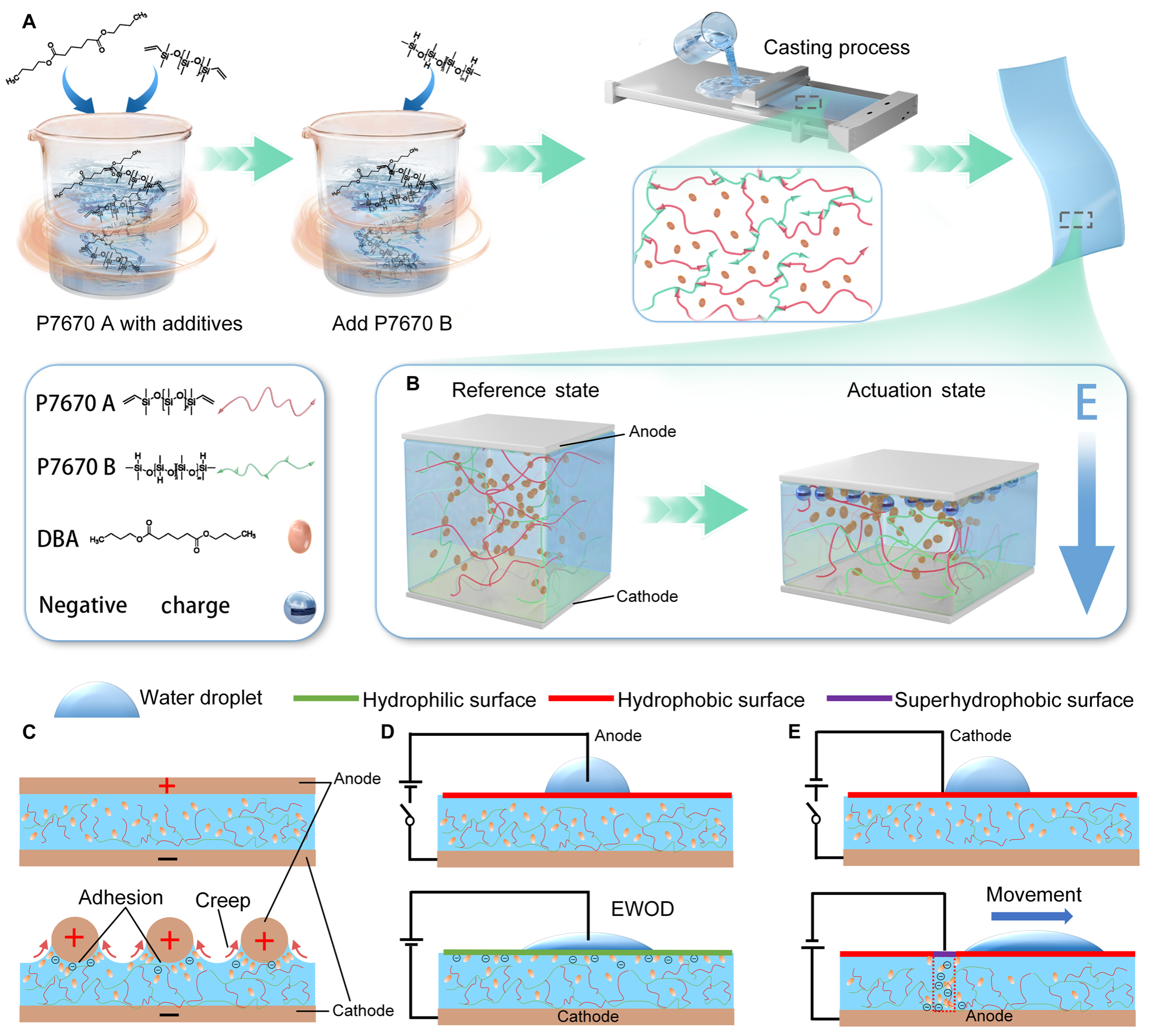
Published in Science Advances, a research team co-led by Prof. Jian Lu from City University of Hong Kong has developed an electroactive interface–enhanced dielectric elastomer (EIEDE), breaking the long-standing functional limits of conventional dielectric elastomers (DEs). Unlike traditional DEs that only enable electro-mechanical actuation, this novel material integrates three unprecedented core capabilities in a single system: a record electroadhesion strength of 31.75 kPa at 14 MV/m (488 times that of unmodified DE), a dramatic contact angle reduction from 83.15° to 9.92° (the best electric-field response among all reported DEs), and a 70% areal actuation strain at 55 MV/m (2.5 times that of commercial P7670 DE).
The breakthrough stems from a polar small-molecule additive modification strategy: the additives weaken intermolecular interactions between polymer chains, boosting dielectric constant while reducing elastic modulus to enhance actuation performance. Under applied electric fields, these polar molecules undergo reversible charge injection, oriented migration and surface aggregation, enabling dynamic, active tuning of the material’s surface energy to drive both ultrahigh solid-solid electroadhesion and reversible hydrophilic-hydrophobic switching for versatile droplet manipulation.
This landmark work for the first time integrates large-strain actuation, electroactive interfacial regulation and multifunctional droplet control in one DE material. Fundamentally, it unlocks the previously unexplored electric field-to-interfacial energy conversion mechanism in DEs. Technologically, it solves key bottlenecks of poor rough-surface electroadhesion and narrow electrowetting tunability, with a simple, scalable fabrication process. Furthermore, it enables transformative advances in soft wall-climbing robotics, industrial adaptive gripping, programmable microfluidics and biomedical sensing, accelerating the clinical and industrial translation of next-generation intelligent soft machine technologies.
For more details, please read the full article in Science Advances.