

Neuromorphic Hardware Enables Ultrafast Visual Perception Surpassing Human Capabilities
Feb 2026
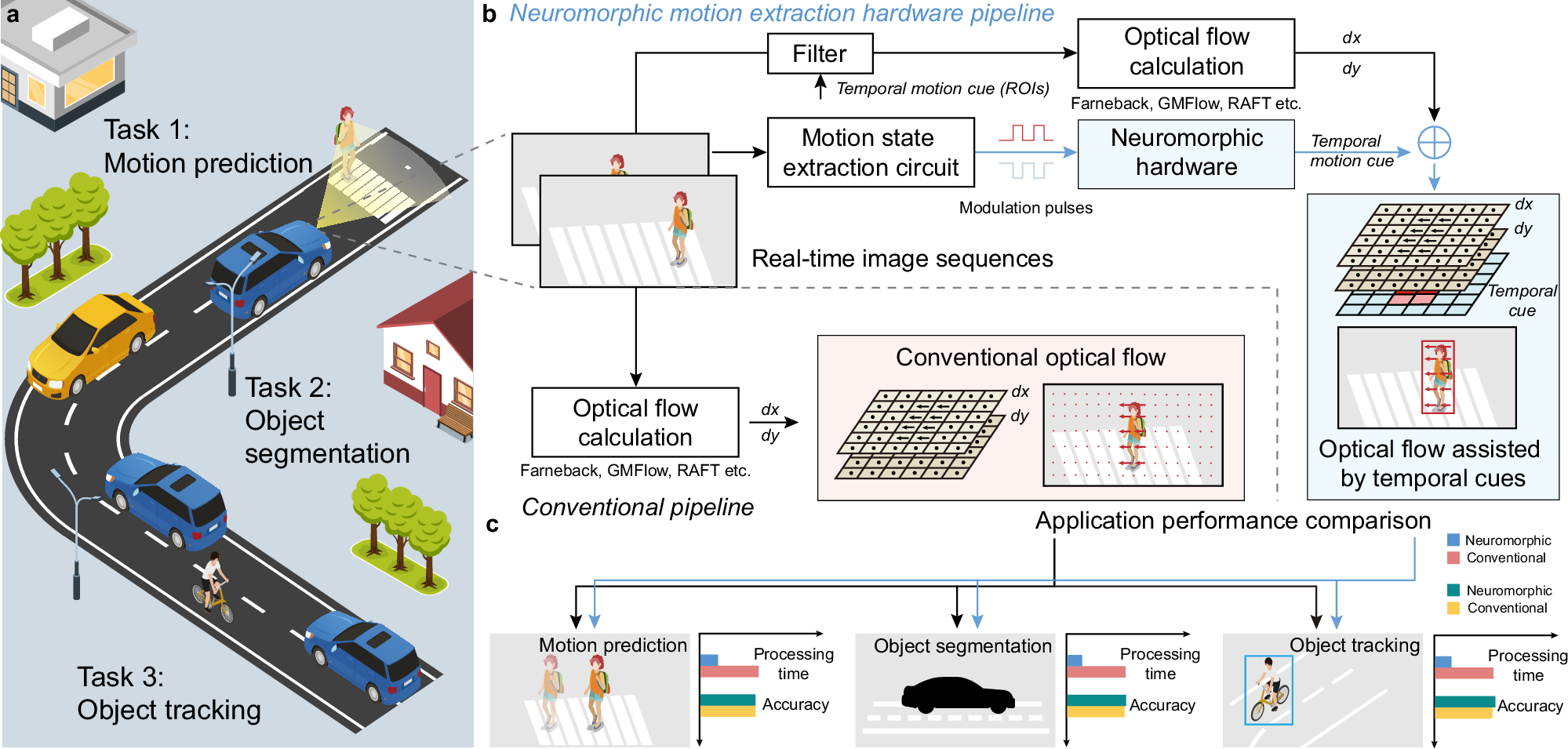
A collaborative research team involving City University of Hong Kong, Beihang University, Beijing Institute of Technology, and University of Cambridge has developed a neuromorphic temporal-attention hardware that achieves ultrafast motion analysis, outperforming human visual processing. Published in Nature Communications, the system uses a 2D synaptic transistor array to extract motion cues directly in hardware, boosting speed of optical flow-based tasks (motion prediction, object segmentation/tracking) by 400% compared to state-of-the-art computer vision algorithms. It maintains or improves accuracy (e.g., 213.5% better in autonomous driving scenarios) while processing visual data in ~150 ms—surpassing human-level speed—with applications in autonomous driving, UAVs, and robotics.
The innovation lies in systematic mimicry of the biological visual pathway using high-performance hardware. Inspired by the retina-LGN interaction in biological vision, the synaptic transistors (MoS₂/h-BN/MLG heterostructure) encode brightness changes into analog non-volatile states, generating compact regions of interest (ROIs). These transistors offer 100 μs response, >10⁴s retention, and >8000 cycles endurance. Downstream algorithms (Farneback, GMFlow, RAFT) process only ROIs instead of entire images, slashing latency without sacrificing precision. Fundamentally, it establishes a spatiotemporal fusion paradigm for visual processing.
In terms of technological advance, it integrates seamlessly with existing algorithms, enabling scalable deployment. It has the potential to enhance safety in autonomous driving (reducing braking distance by 4.4 m at 80 km/h) and improve responsiveness in UAVs and human-robot interaction. This work, receiving coverage from media including Chinanews, Xinhua News, and South China Morning Post, paves the way for real-time intelligent perception in dynamic environments, advancing next-generation robotics and autonomous systems.
For more details, please read the full article in Nature Communications.
The innovation lies in systematic mimicry of the biological visual pathway using high-performance hardware. Inspired by the retina-LGN interaction in biological vision, the synaptic transistors (MoS₂/h-BN/MLG heterostructure) encode brightness changes into analog non-volatile states, generating compact regions of interest (ROIs). These transistors offer 100 μs response, >10⁴s retention, and >8000 cycles endurance. Downstream algorithms (Farneback, GMFlow, RAFT) process only ROIs instead of entire images, slashing latency without sacrificing precision. Fundamentally, it establishes a spatiotemporal fusion paradigm for visual processing.
In terms of technological advance, it integrates seamlessly with existing algorithms, enabling scalable deployment. It has the potential to enhance safety in autonomous driving (reducing braking distance by 4.4 m at 80 km/h) and improve responsiveness in UAVs and human-robot interaction. This work, receiving coverage from media including Chinanews, Xinhua News, and South China Morning Post, paves the way for real-time intelligent perception in dynamic environments, advancing next-generation robotics and autonomous systems.
For more details, please read the full article in Nature Communications.