

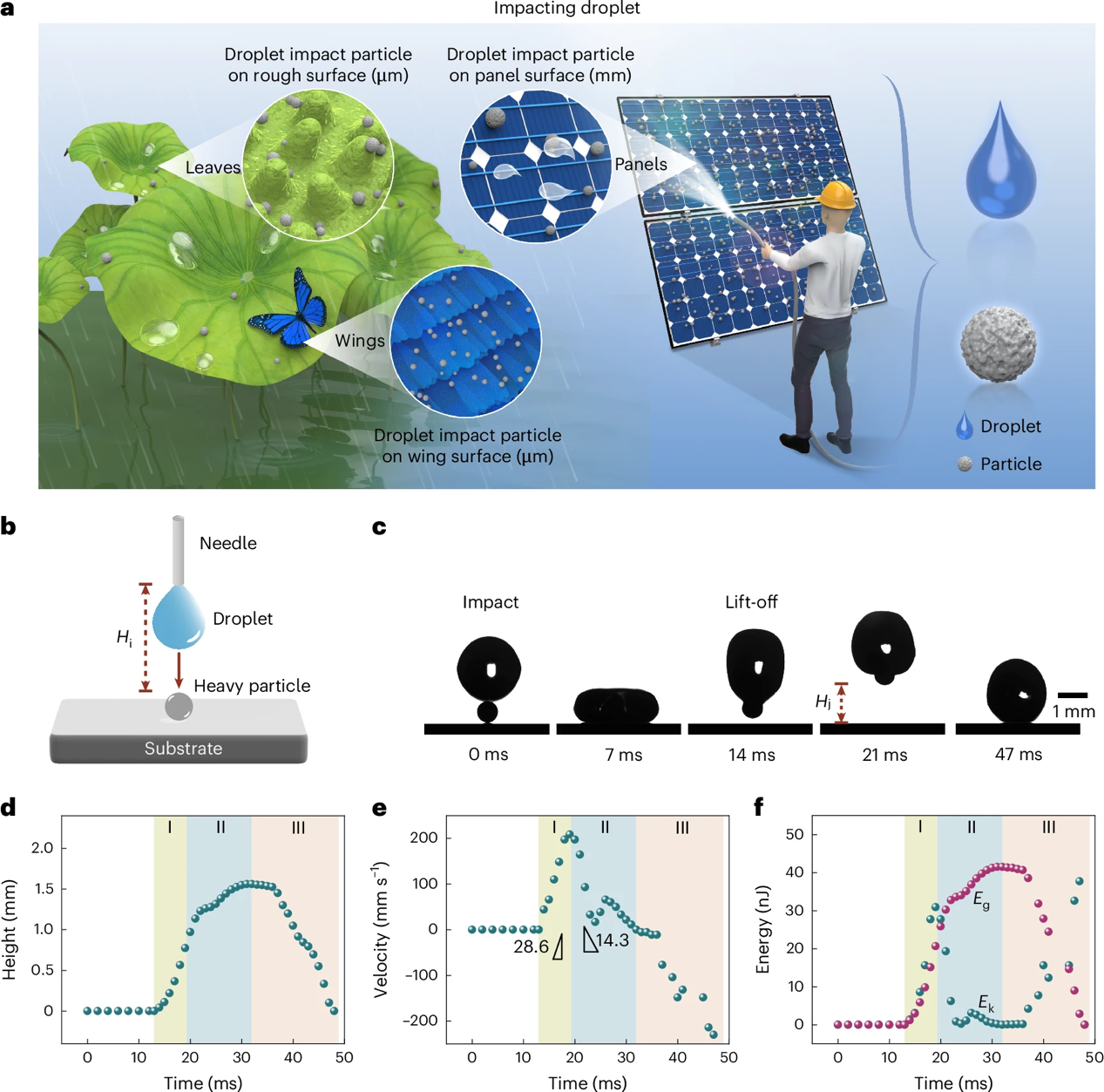
A research team led by Professor Steven Wang of City University of Hong Kong, in collaboration with Professor Omar Matar of Imperial College London and Professor Chao Yang of the Institute of Process Engineering, Chinese Academy of Sciences, has developed an innovative technology known as liquid droplet mops (LDMs), offering a simple and efficient solution for solar panel cleaning. The findings were published in Nature Sustainability. The team found that cleaning efficiency has a non-monotonic relationship with droplet impact energy, with peak cleaning performance achieved at intermediate energy levels. The study showed that the LDMs technology developed by the team requires only about 10% of the water used in standard liquid-jet cleaning methods and achieves a contaminant removal rate of 99.9%.
At the heart of this breakthrough is the team’s discovery of the mechanism underlying the removal of particle contaminants. The study found that whether particles can detach from a surface depends mainly on droplet impact velocity and the interaction between the droplet and the particle surface. The team further established a theoretical model that identifies three distinct dynamic regimes, showing how droplets produce different effects under different conditions. Based on this mechanism, the researchers were able to remove particle contaminants ranging in size from 10 µm to 2 mm from superhydrophobic surfaces, across a wide range of densities and wetting properties.
This work pioneers a new direction for droplet-based cleaning paradigm, filling critical gaps in existing superhydrophobic self-cleaning mechanisms limited to droplet coalescence and rolling. At the fundamental science level, the team established predictive theoretical models for droplet impact cleaning, advancing scientific understanding of liquid-solid interface dynamics. In terms of practical application, the low-cost LDMs system maintains a removal efficiency of over 99% even at a wind speed of 3.5 metres per second and did not damage solar panels, demonstrating its potential for use in real-world solar power stations. Furthermore, the technology could help ease the water-use pressure associated with the development of renewable energy. It could not only enhance the sustainability of solar power generation, but also provide a water-saving solution for industrial surface cleaning with strong potential for wider adoption.
For more details, please read the full article published in Nature Sustainability.