

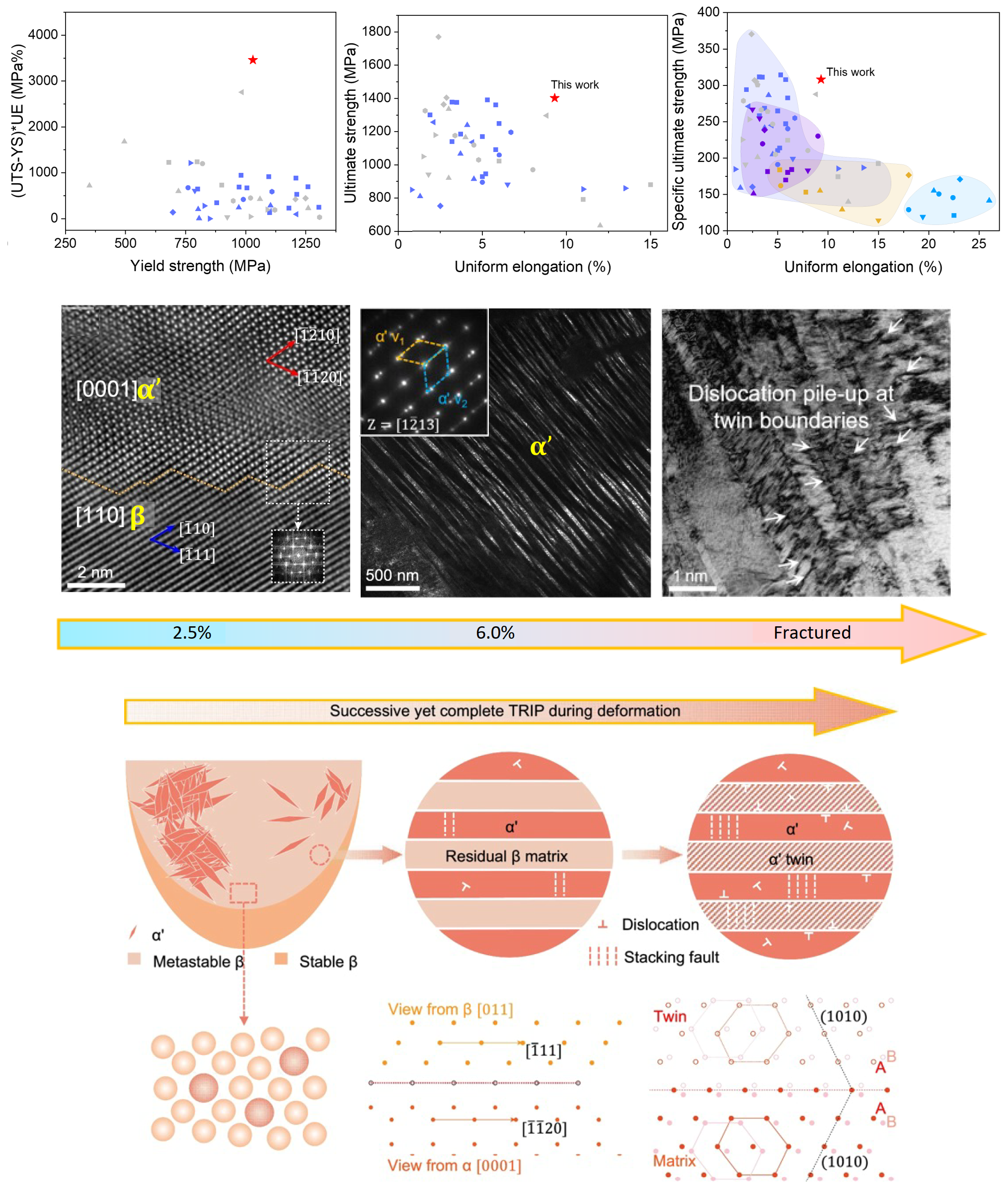
A research team led by Prof. Jian Lu from City University of Hong Kong has developed an advanced titanium alloy by additive manufacturing (AM), resolving the longstanding dilemma of yield strength, work hardening and ductility via optimizing metastability-solid solutioning efficiency. Published in Nature Communications, the Ti-6Al-4V + 5 wt.% CoCrNi alloy, fabricated by laser powder bed fusion (LPBF), achieves a remarkable combination of properties: 1030 MPa yield strength (YS), a record work hardening rate of 5.7 GPa (over 4 GPa higher than base Ti-6Al-4V), 9.3% uniform elongation (triple the base alloy), and enhanced fracture toughness. The developed titanium (Ti) alloy outperforms existing AM Ti alloys, steels, and nickel superalloys in specific strength, making it ideal for aerospace and 3C (computer, communication, consumer electronic) applications.
The core breakthrough lies in a metastability-strengthening synergy and unique deformation mechanisms. The metastability-strengthening synergy optimizes the required β-stabilizer content for metastable phase formation and the solid solution strengthening efficiency per unit stabilizer content. CoCrNi additives play three key roles: refining prior β grains (from 97.6 μm to 28.3 μm) and α' martensite laths (to 143 nm), providing dominant solid-solution strengthening, and precisely tuning the metastability of β phases. During deformation, the alloy undergoes a complete two-step martensitic transformation (β → β/α' → α'/α' twin) during deformation, achieving both dislocation motion restriction for strengthening and stress concentration release for high deformability. This sequential transformation, coupled with hetero-deformation induced (HDI) strengthening from phase heterogeneities, sustains continuous work hardening—unlike conventional metastable alloys with incomplete phase transformation.
In basic science, this work initiates a new paradigm for designing high-performance metastable alloys, bridging strengthening and metastability to overcome strength-ductility-work hardening trade-offs. Technologically, the in-situ alloying via LPBF avoids complex post-processing, enabling scalable production. Moreover, the alloy’s superior specific strength and damage tolerance will advance lightweight, durable components in aerospace (reducing fuel consumption) and 3C products. This work further provides a universal framework for optimizing other work-hardening-limited materials (e.g., ultrahigh-strength steels), promoting sustainable manufacturing by maximizing material performance without excessive alloying or processing complexity.
For more details, please read the full article in Nature Communications.