Exhibits
Reimagining Senet
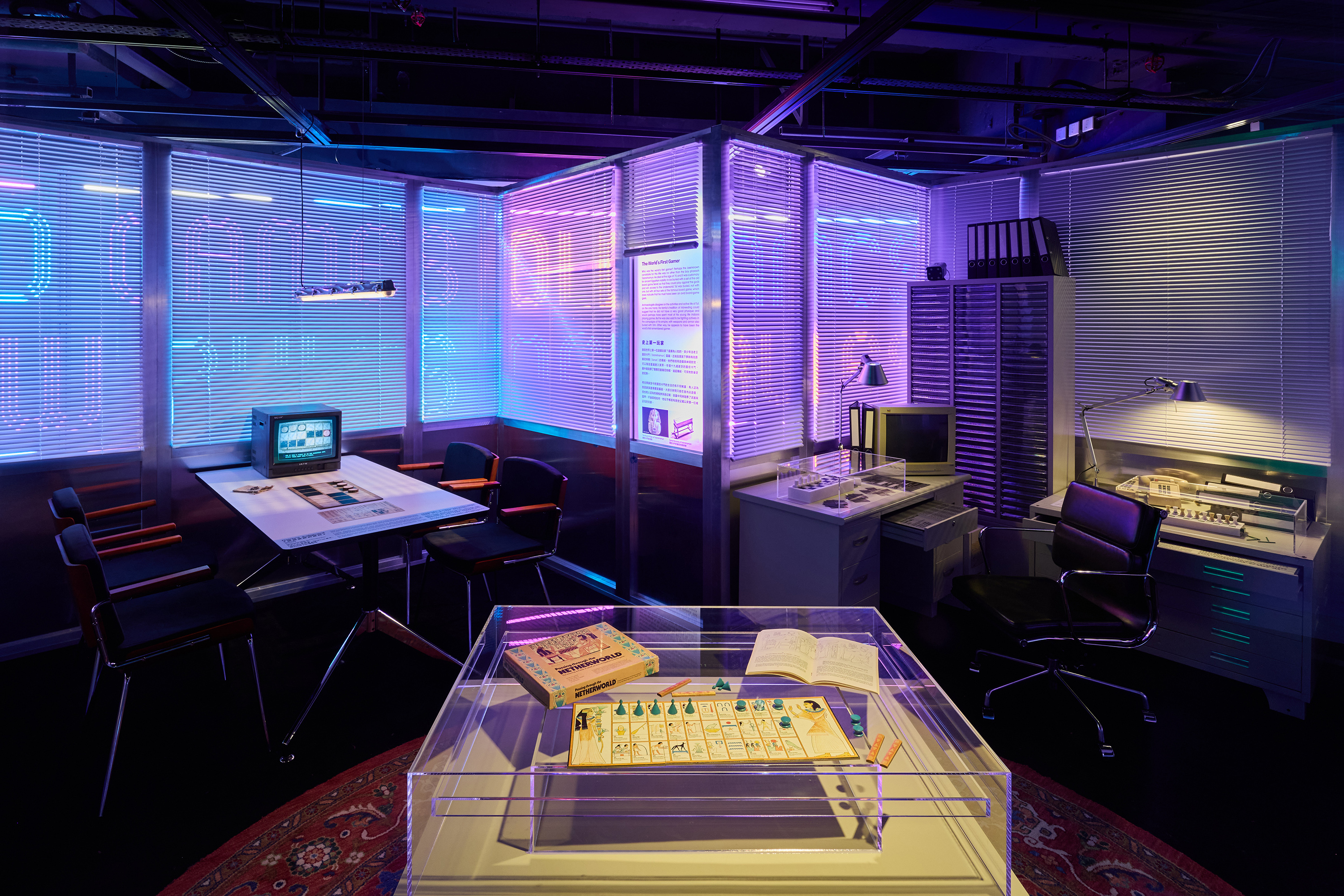
For more than five millennia, Senet has occupied a unique place in cultural history: a game, a ritual object, and a symbolic model of the passage between life and death. Archaeological evidence and tomb paintings suggest that Senet was deeply entangled with ancient Egyptian beliefs about fate, judgement, and the afterlife. Movement across the board came to represent the soul’s journey through uncertainty toward transcendence, transforming play into a reflection on cosmic order and human destiny.
 
This section presents both a historically grounded reconstruction of Senet and three contemporary reinterpretations created as part of the postgraduate course Art and Activist Games Workshop at the School of Creative Media. Together, these works explore how ancient games can continue to function as living cultural forms rather than static historical artefacts.
 
Each redesign approaches Senet as a game system capable of expressing contemporary concerns. Journey Through Duat amplifies the game’s ritual and moral dimensions through systems of judgement, virtue, and punishment, foregrounding questions of ethical accounting and institutional authority. Osiris’s Judgement transforms the game into an asymmetrical struggle of concealment and interpretation, where surveillance, suspicion, and divine scrutiny become central themes. Help Me Find a Job reimagines Senet as a satire of contemporary labour systems, exposing the hidden operations of nepotism, unequal opportunity, and performative meritocracy.
 
Although radically different in tone and theme, all three works preserve something fundamental about Senet itself: movement through uncertain systems of judgement. In ancient Egypt, that movement concerned the fate of the soul. In these contemporary reinterpretations, the same procedural structures are redirected toward modern systems of morality, bureaucracy, surveillance, and social inequality.
 
The juxtaposition of historical reconstruction and speculative redesign invites a broader reflection on games as cultural technologies. Games do not merely entertain; they model worlds, encode values, and represent conflicts about how societies organize power, chance, justice, and human aspiration. Senet survives because its underlying structures remain culturally resonant. Across millennia, the board still asks the same essential question: how does one successfully navigate the systems that govern existence?

Reimagining Senet 
pop-senet-s_Banga
 
Passing through the Netherword / 1978
Version Publisher: The Kirk Game Company Inc

Osiris Judgment / 2026
Game Design and Production: Lijun Su, Ping Luo, Jinming Liu, Zhiwen Tan

Help me Find a Job / 2026
Game Design and Production: Ruojin Li, Tao Sun

Journey Through Duat / 2026
Game Design and Production: Zhongling Xu, Youran Zhang, Yuxin Zhang

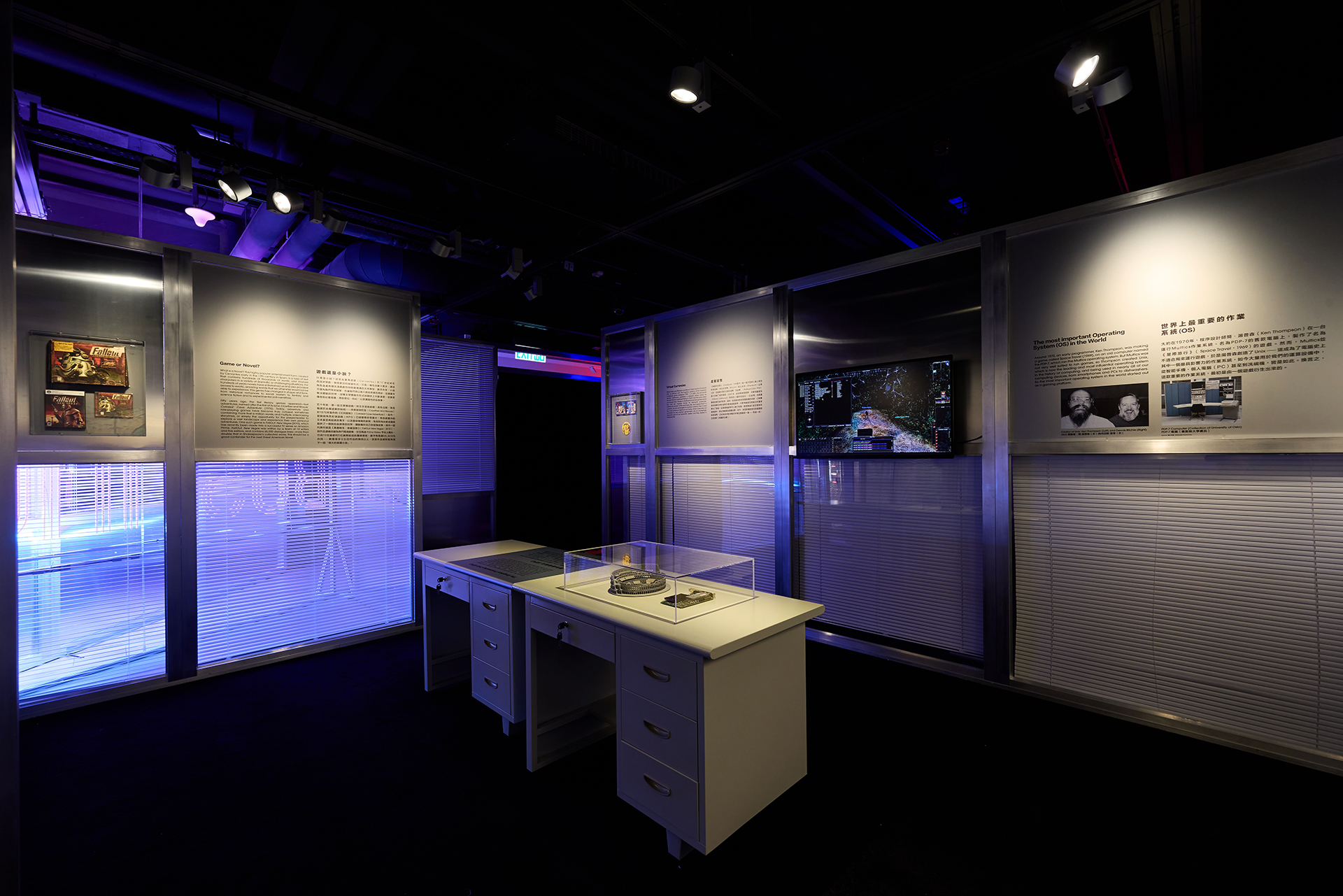
What is an Indie Game?
Originally, all games were either indie games, or, before that, folk games. Folk games are games without named creators, and that have survived for maybe hundreds or thousands of years in the local or even glocal tradition. An Indie game is a modern successor to folk games, made by individuals, sometimes without commercial interests, and always without the support of major publishers or investors.
 
From the 1960s to the 1980s, most of the really innovative computer games were indie games, self-published or at least self-developed by individuals or small groups. Important examples are Spacewar! (Russell et al. 1962), Colossal Cave Adventure (Crowther and Woods 1975–1977), Multi-User Dungeon (Trubshaw and Bartle 1979), and Elite (Bell and Braben 1984). Only when the game industry grew big and powerful in the 1980s and later did it make sense to talk about indie games as a label, to distinguish them from game-company-funded games. Today, Indie games are thriving, thanks to crowdfunding and cheap internet distribution (the first game to use this was Doom by Id Software, 1993).

With the new AI game development tools, it will be very exciting to follow indie games in the future – the financial threshold for making high-quality games has been increasingly rising based on the demand for higher quality graphics. But now, the new tools make it possible for one individual to be much more productive, replacing a whole team of specialists.

The two games on display here are quite different from each other, and demonstrate the large span possible between games that don’t have, or don’t need, big investors at their back. Enjoy!

Future? No Thanks! (2026)

pop-future-no-thanks-s_Banga  

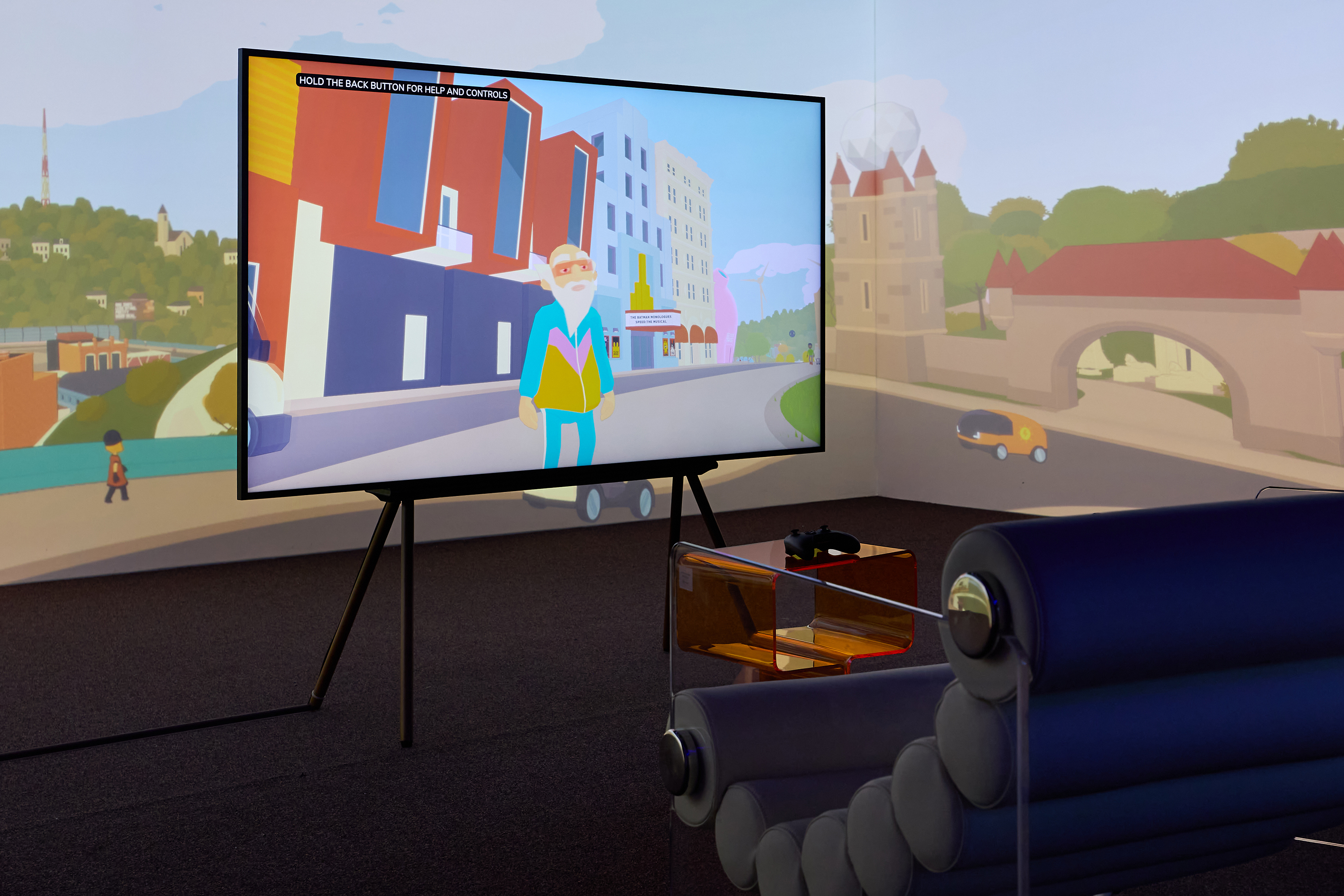
Future? No Thanks! is a narrative-driven, open-world adventure set in an ecosocialist utopia. The year is 2045, and society has never been better: climate change is finally being tackled, democracy thrives, and technology serves the public good. You are Harvey Huffstone, a grumpy elder who no longer fits in, and today is the last day of your life. Your final mission is to complete a nostalgic bucket list before your self-scheduled euthanasia.

This game draws from utopian traditions of the past as well as contemporary speculative fiction, solarpunk, degrowth, and fully automated luxury communism. Through the eyes of a deeply flawed character, the player explores a new world being built within the shell of the old. This vision does not rely on far-out technologies or ideological homogeneity, but rather on different social relationships and more democratic institutions. In a medium dominated by heroic dystopias, the game proposes utopia as an actionable political project for the present.


Guest Exhibitor: Molleindustria
Concept, Game Design, and Development: Molleindustria

Calm Cast (2026)

calmcast_Banga-s  

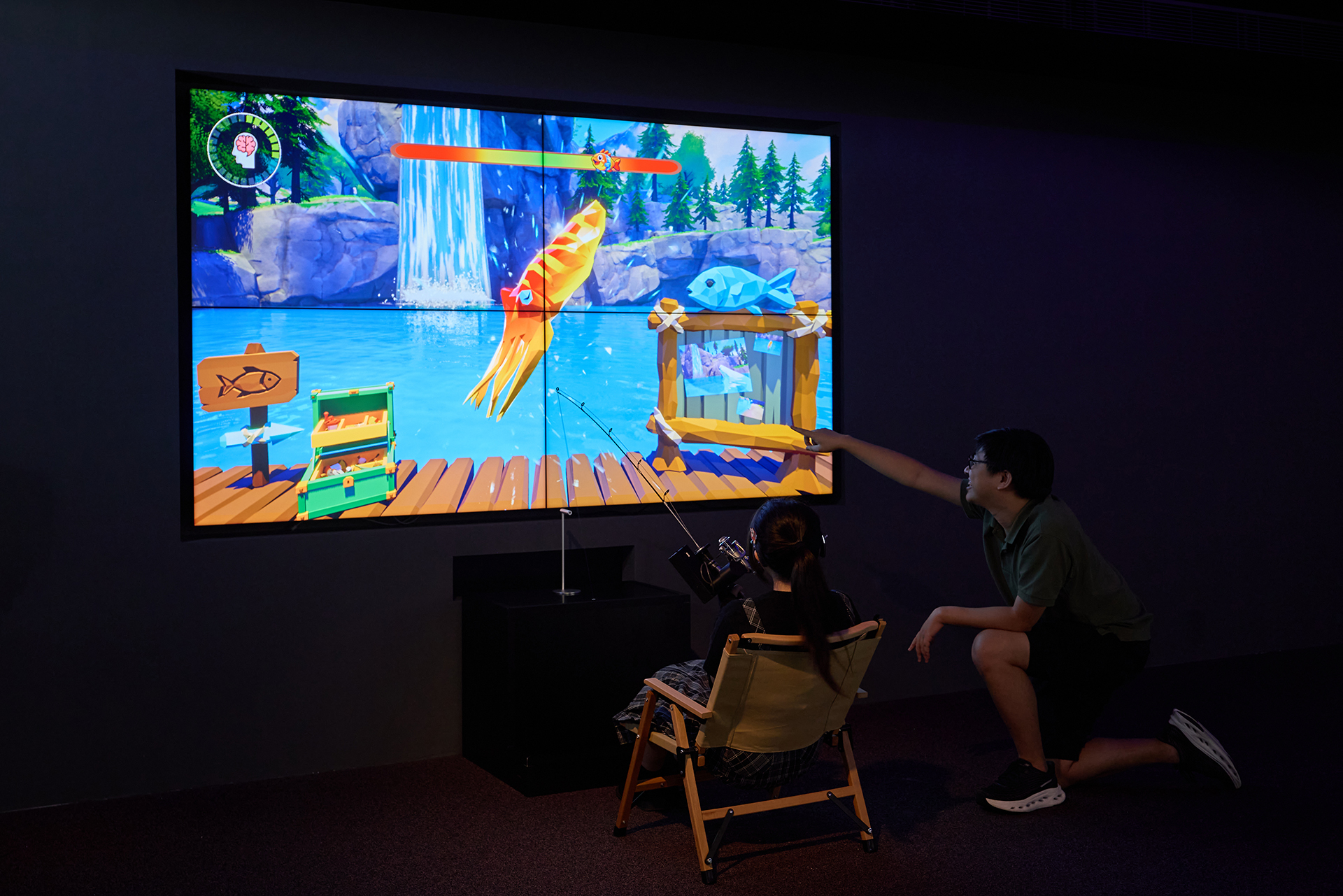
This game challenges the player to catch a fish calmly. The more nervous the player is, the harder the game becomes, and the lower score they can achieve.

The game draws inspiration from BrainBall, the iconic early Brian-Computer Interface (BCI) game experiment where players competed through relaxation rather than speed, aggression, tactical mastery, or hand-eye coordination. It highlights the strange drama of trying to win by doing nothing. Calm Cast brings that provocation into the language of video games.


Game Design: Yiqing Shi, Yuxin Zhang
Development: Things That Move
Lost? In the Labyrinths
Labyrinths and mazes are some of the oldest games and archetypal structures we know and have had many different cultural functions up through the millennia. They are found as physical structures such as buildings or roofless hedges, wooden or stone walls; or pictured in old manuscripts, floor decorations, or described in texts and myths. They were often religious or mythical in their uses, and even today they are metaphors for the strife and hardship we go through in life.
 
There are two fundamentally different types: unicursal labyrinths are the oldest, and consist of a single, winding path. All the labyrinth walker needs is patience. Multicursal labyrinths or mazes have forking paths and force the walker to make choices. Here you can and probably will get lost.
 
Until the Renaissance, all drawings of labyrinths were unicursal, but stories and myths such as the tale of Theseus and the Minotaur on Crete clearly tell us that there were multicursal labyrinths, at least conceptually, in ancient and medieval times as well. Otherwise, why would Ariadne give Theseus her thread so he could find his way back again?

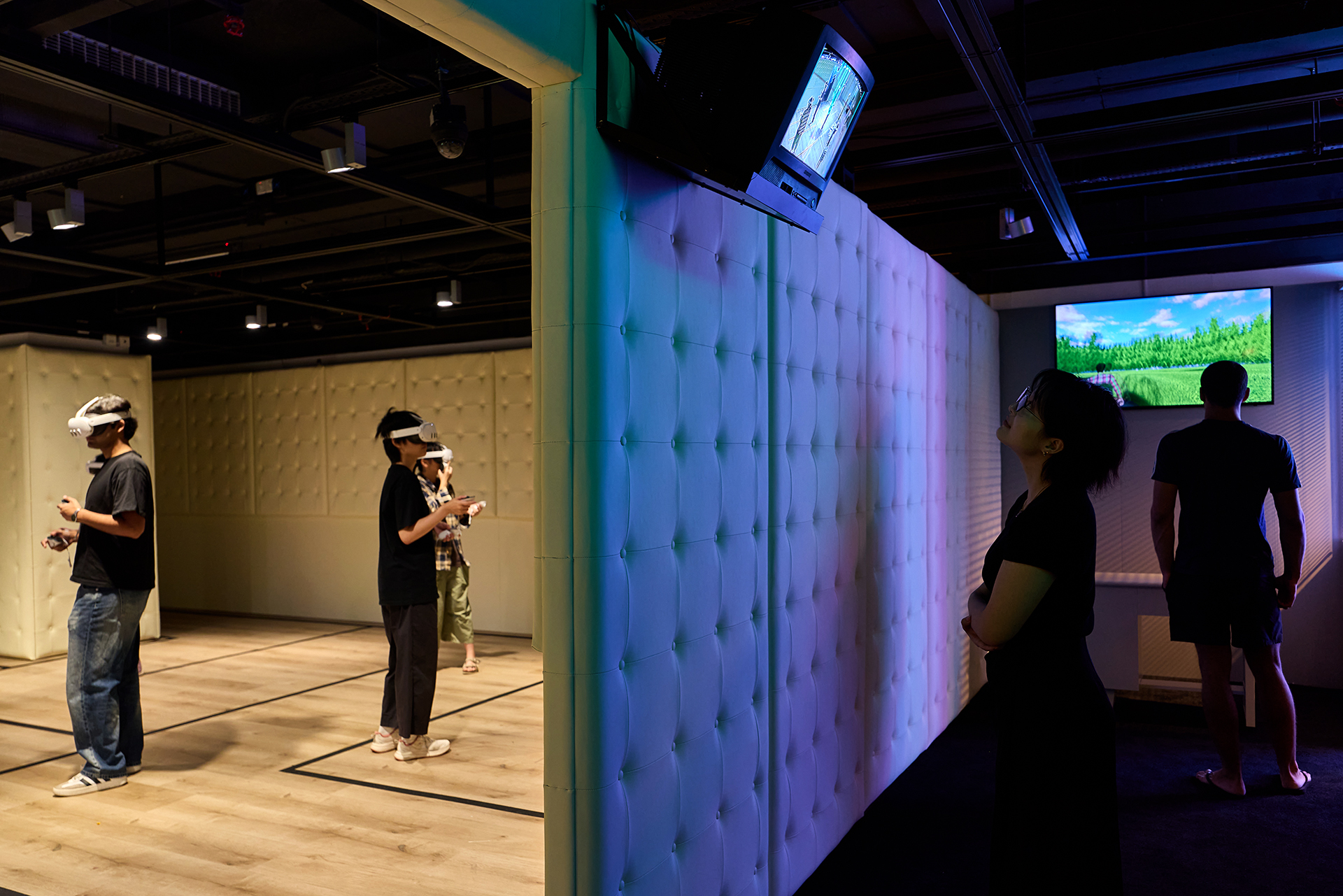
There is also more than one type of maze or multicursal labyrinth: some are much harder to navigate than others. You will find three classic labyrinths to choose from here: one is a linear labyrinth, based on the floor in Chartres Cathedral, and the other two are mazes of different difficulty, one from Hampton Court Palace outside London, and the other from the Villa Pisani in northern Italy. You can always find your way out of a multicursal maze, by using a special technique. But some mazes have “islands” where this technique does not work when you want to go to the innermost secret center of the maze. Best of luck!

VR Maze

pop-vrmaze-s_Banga  
maze_Banga-s  

VR Maze
Created by MetaObject

Retro Room
retroroom_Banga-s 

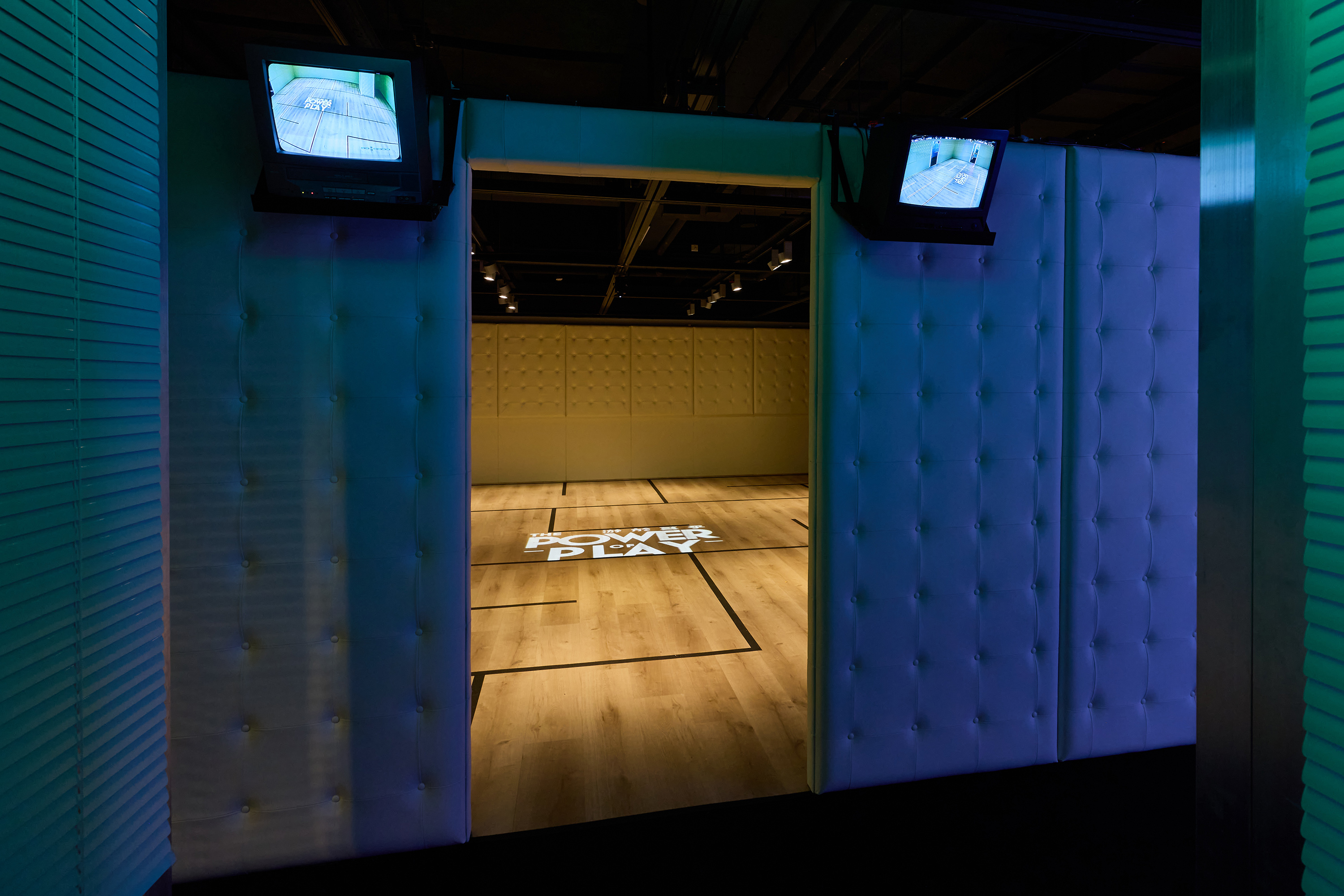
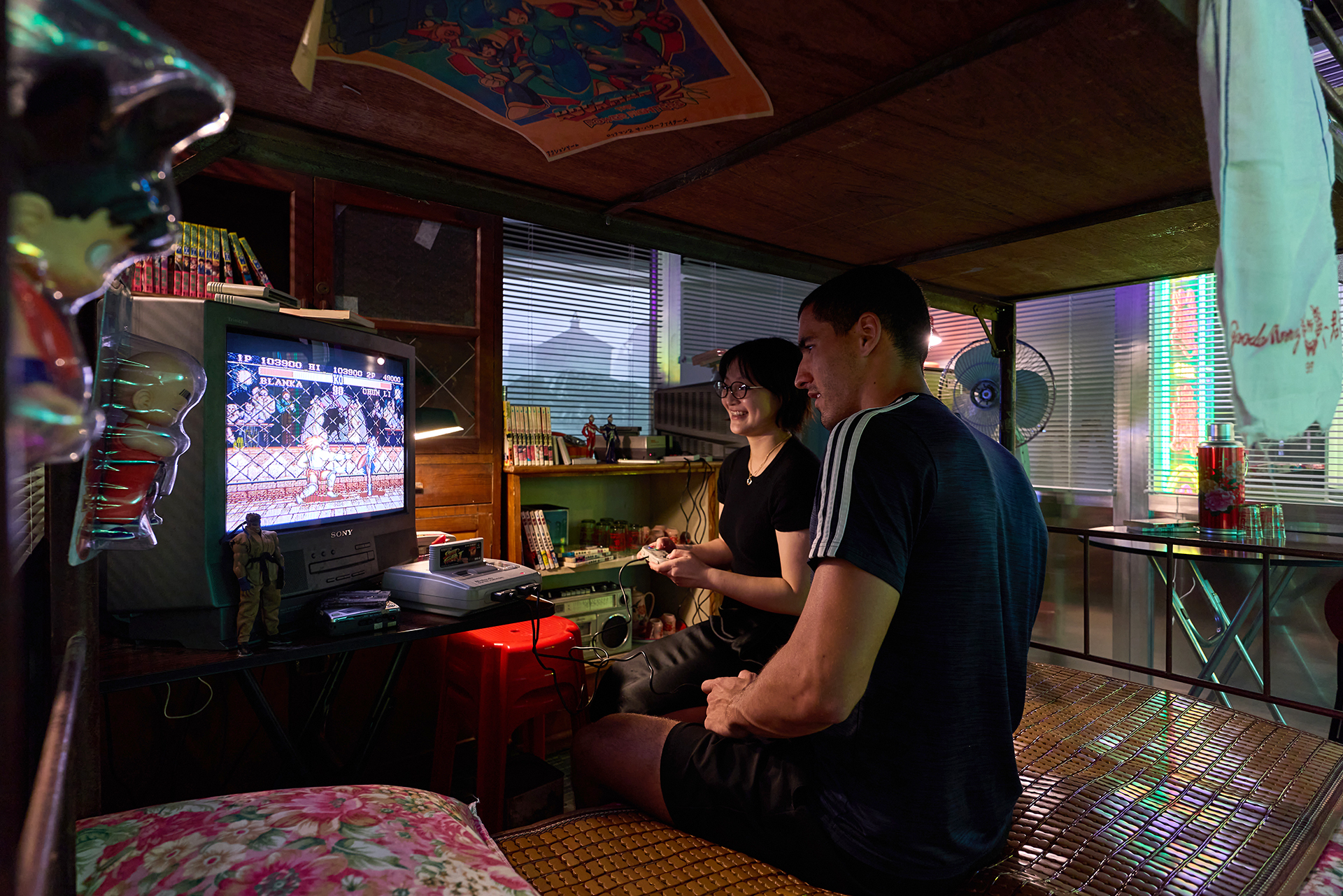
Forty years ago, when video games were young—

Take a trip down memory lane to the 1980s, or, if you were not born yet, this is how your parents used to play games.


Good, Bad, or Innocent Fun?
Games have always been a cultural underdog, seen as a corrupting waste of time and sometimes money, making children forget their homework and sleep. In the Middle Ages, gambling was tightly controlled by the sovereigns and lawmakers. In ancient Rome, the satirist Juvenal complained that where the people once had been upright and participating citizens, now they were being pacified by bread and games (“circuses”), much like today’s internet entertainment and social media. Starting in the 70s, arcade games like Death Race also got blamed for making people desensitised and potentially murderous.
 
At the same time, there was a growing belief that games would revolutionise education, and make us smarter, healthier, and better informed about important political issues. Edutainment, serious games, games for health, games for change, and gamification. Can games save the world? How can games best be used for learning?
 
The research does not bear this out. So what is the truth about games? Are they useful or impactful at all? This part of the exhibition will discuss some of the myths and claims made, and also show the real impact of games on culture, technology, and society. Games are powerful, but perhaps not in the way you would have guessed.

Buckets of Fun

pop-robotic-s_victorleung_Banga  

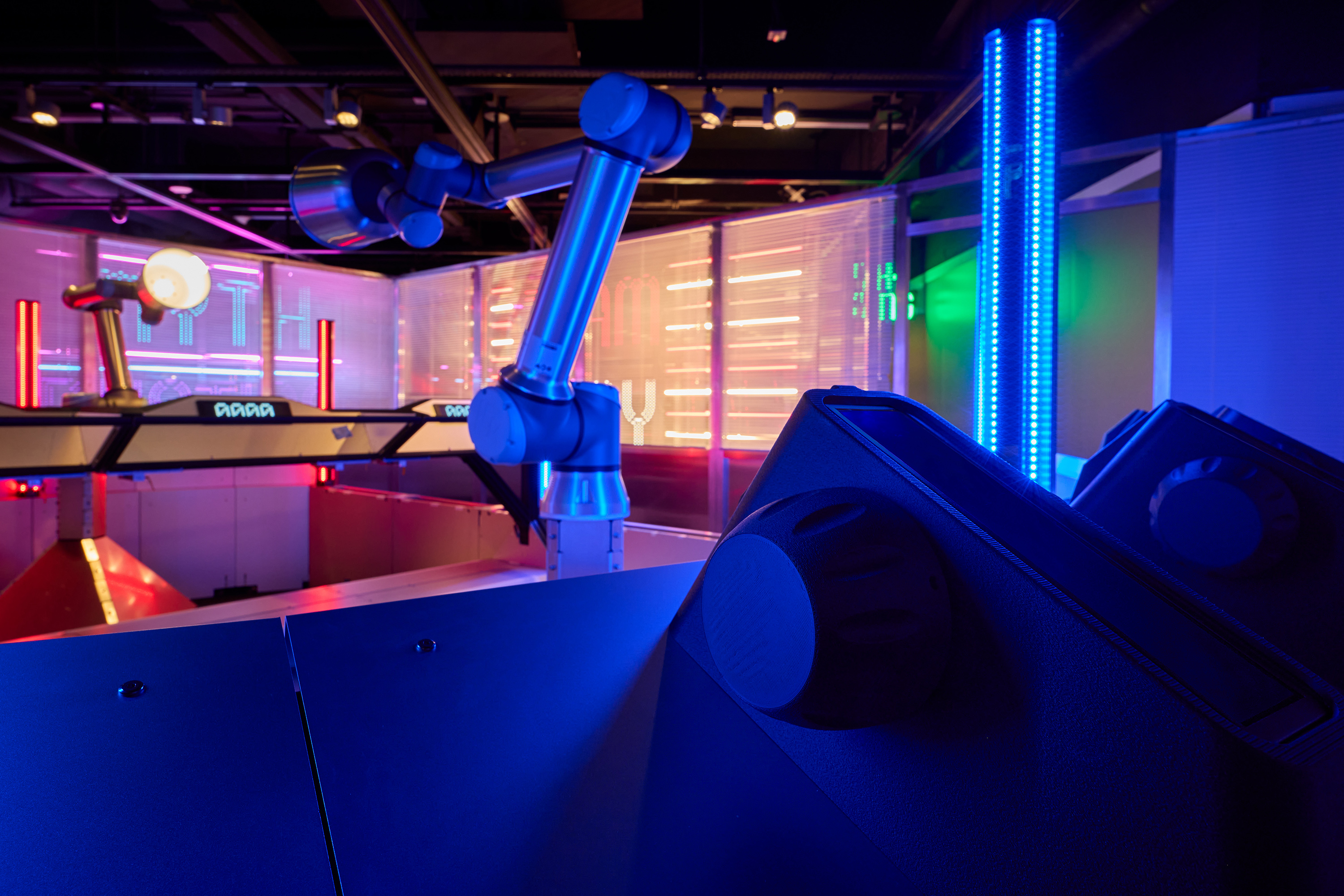
The game challenges each team to scoop balls from a shared pool and deposit them into scoring buckets within a limited time.

Buckets of Fun is a real-time collaborative robotic game in which two teams of six players compete to control two industrial robot arms. Rather than giving one player full control, the system distributes each arm across six participants, with each player responsible for a single joint. The robot therefore becomes a shared body: no action can succeed without coordination between multiple people acting together as a team.

The game is meant to be frustrating; to show the real challenge of teamwork under pressure in a situation where communication between players and understanding your own role becomes the key to success or failure. There is no such thing as a star solo player, everyone’s effort is equally important.

What makes the experience distinctive is the custom haptic dial interface. Each player controls a joint through a motorised dial that acts both as an input device and as a feedback mechanism. Because the dial can be turned faster than the physical robot can safely accelerate, the robot lags behind the player’s command. This lag is not hidden; it is felt directly through the dial, which pulls back toward the robot’s actual position and teaches players to anticipate the machine’s limits. Behind the scenes, a real-time control pipeline processes all six inputs, constrains motion, and applies collision avoidance so the robot cannot strike itself or the surrounding arena. The work turns advanced robotic control into a tactile, collective, and highly visible form of play. .


Concept: Espen Aarseth
Game Design: Espen Aarseth, Pok Yin Victor Leung
Development: Pok Yin Victor Leung
 thematic_Banga-s   
From Gaming to eSport
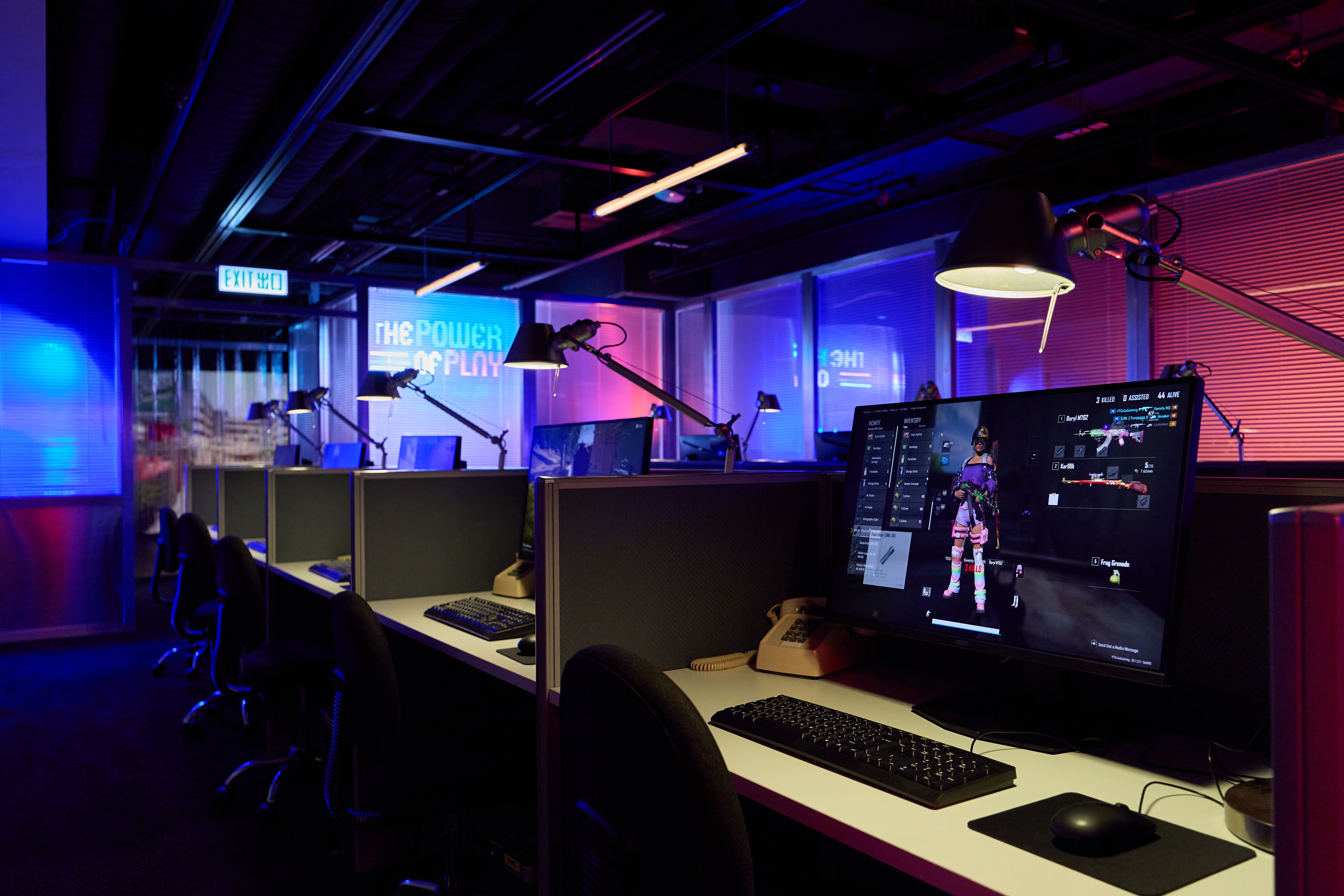
Is there a difference between gaming and sport? Yes and no. Games are time-wasters, sport builds character. Games corrupt the young, Sport develops team spirit, discipline, and leadership. Or so the conventional wisdom goes. But hang on, what about eSport?
 
Esports is gaming, socially organized as a sport. If you play Counter-Strike and Quake III Arena, the two games in this eSport arena, you are gaming if you play on your own, but you’re doing eSport if you play as part of an organized team. There have been game competitions as long as there have been games, but eSport as gaming organised as a sport, took off around the year 2000, with teams and leagues, sponsors, stars, coaches, fans, broadcasts, big prizes for the winners, and everything we see in regular sport.

The best eSport players are famous like the best gladiators 2,000 years ago, they have their own merchandise (just like then), and they have the envy and admiration of millions of spectators. Here, you can try two of the classic games from the period that started it all; best of luck!

From Gaming to eSport

pop-esport-s_Banga  
Minecraft — a one-of-a-kind game
Minecraft, released by Mojang Studios in 2011, is a sandbox, builder, and open-world game that has become one of the most unique, influential, and widely played games in history. The world of Minecraft is as large as the surface of the gas giant Neptune, or seven times larger than Earth.
 
Built around simple, block-based graphics, the game allows players to explore, create, and survive in procedurally generated worlds, offering an extraordinary level of freedom that encourages highly interactive and creative expression. Using special blocks called ‘Redstone’, players could also create and program their own devices and machines in the game. Some players made their own, working versions of Pong, and even Pokémon, inside Minecraft.

Beyond entertainment, Minecraft has had a significant cultural impact. It has inspired a global community of players who share creations, develop modifications, and collaborate across digital spaces. Minecraft is not just a game but a cultural phenomenon that lets people express themselves through engineering, landscaping, and architecture within a modifiable virtual environment.

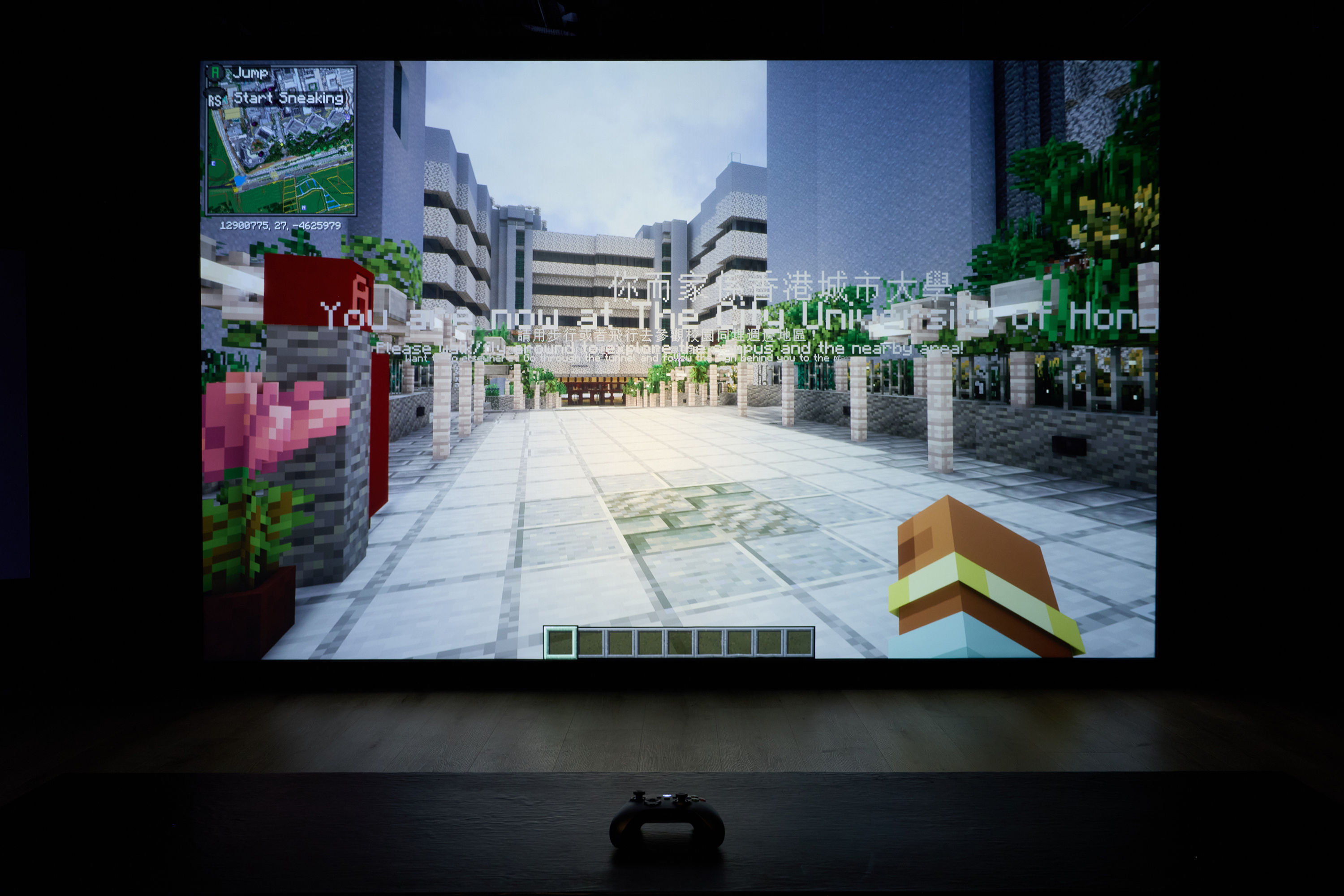
BuildTheEarth: Hong Kong in Minecraft(2020 –)
pop-minecraft-s_Banga  

BuildTheEarth (BTE) is an international project that aims to recreate the entire Earth at a 1:1 scale within the popular sandbox game Minecraft. Since its launch in March 2020, thousands of contributors from across the world have spent the past six years toward this goal, building their homes, favourite streets, restaurants, schools, and even trees—one block at a time.

The Hong Kong portion of BTE is led by the Hong Kong and Macau team. This ongoing, building‑by‑building effort has already brought numerous districts to life, including Central, Wan Chai, Tsim Sha Tsui, Tsuen Wan, Tseung Kwan O, as well as parts of Macau. Their craftsmanship goes beyond just skyscrapers: even the smallest details—fire hydrants, road signs, and the brick patterns of pedestrian sidewalks—are carefully reimagined in the virtual world.

Some buildings that have been demolished or damaged in the real world have also been restored within the BTE universe, serving as tokens of memory and preservation. Players are invited to immerse themselves in this virtual city, beginning their exploration at the newly constructed City University of Hong Kong in Minecraft.


Guest Exhibitor: BuildTheEarth (Hong Kong & Macau)

We use cookies to ensure you get the best experience on our website.

More Information