

From Table to Text: Rethinking Chinese Cuisine Through Translation
Conference examines what it means to “translate” cuisine—exploring how Chinese food culture is interpreted, represented and reimagined across disciplines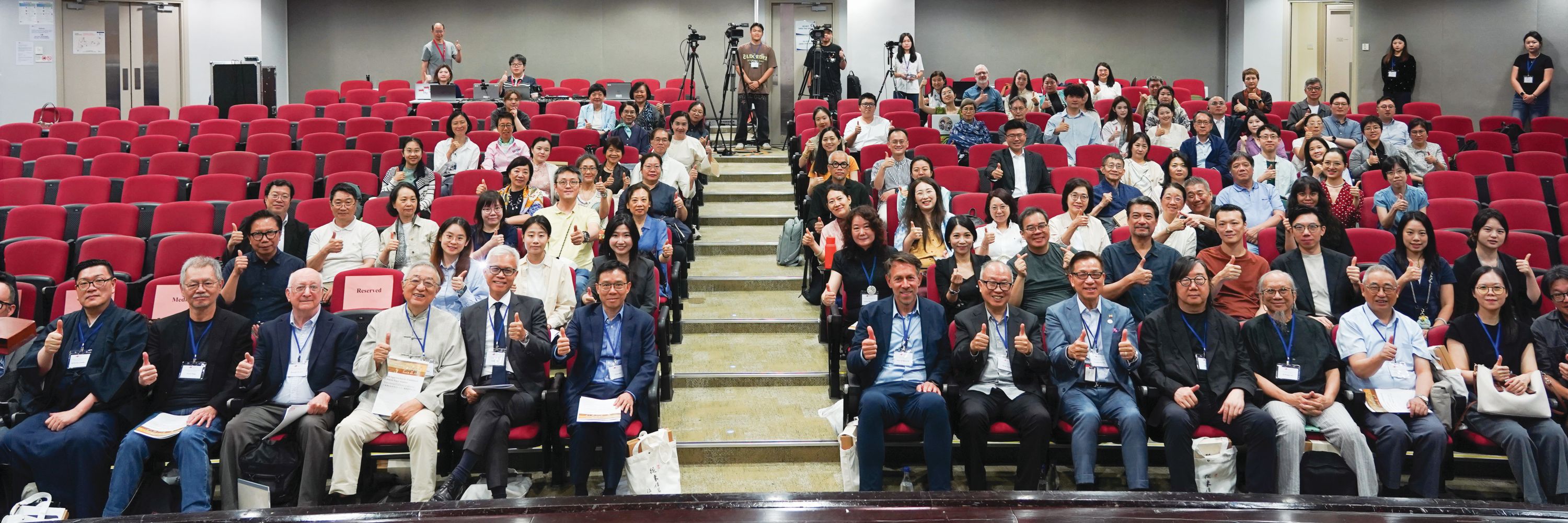
Scholars, artists and cultural practitioners gather for the conference on rethinking Chinese food.
The Department of Linguistics and Translation (LT) at City University of Hong Kong (CityUHK) recently hosted an international conference that invited audiences to rethink Chinese food in an unexpected way—not just as cuisine, but as culture in translation.
Titled “New Approaches to Traditional Chinese Food Studies: Translating Culinary Traditions”, the event ran from 1 to 3 June 2026 and brought together scholars, artists and cultural practitioners from across the US, the UK, the Chinese Mainland, Hong Kong and Taiwan.
Opening the conference, Professor Alfred Tat-Kei HO, Dean of CLASS, pointed out that this conference was truly a meaningful gathering, especially in the AI era, when the humanities and social sciences have been asked, more urgently than ever, to demonstrate not only their intellectual value, but also their social purpose. Professor Niels SCHILLER, Head of LT, emphasised that academic research should remain closely connected to human life and social practice. He also highly commended Professor Jackie Xiu YAN’s team for its long-standing collaboration with the Hong Kong Blind Union, underscoring the department’s commitment to research that engages meaningfully with the wider community.
Dr Louis NG, Director of the Hong Kong Palace Museum; Mr MAK Po Tai, Chair of the PT Collection and conference sponsor; Professor Frankie YEUNG, Chairman of the Xiqu Centre Advisory Panel at the West Kowloon Cultural District; and Ms Elaine LAM, Manager of the Jockey Club Vocational and Educational Resources Centre at the Hong Kong Blind Union, also delivered strong and supportive speeches at the opening ceremony.
At the heart of the conference lay a deceptively simple question: what does it mean to “translate” food? Moving far beyond the literal translation of recipes or culinary terminology, participants explored how Chinese food culture is interpreted, represented and reimagined across disciplines—from literature and history to archaeology, art, accessibility studies and artificial intelligence.
The programme reflected this breadth. Panels ranged from Song-dynasty dining aesthetics and the role of food in classical literature, to the shifting boundaries between food and medicine, cultural geography and even the evolving aesthetics of tea in the AI era. Scholars revisited texts such as the Book of Odes, unpacked the multisensory meanings of concepts like qing in Song gastronomy, and experimented with ways to reconstruct and understand historical culinary practices today.
For Yan, one of the conference organisers, the diversity of perspectives was crucial. “Translation is not only about interlingual conversion—it is communication between cultures,” she explained.
Culinary traditions carry layers of meaning, from historical memory and social hierarchy to regional identity and sensory experience. Examining them reveals that translation operates not only at the level of language, but also through concepts, practices and lived experience.
Yan’s own presentation, “Culture, History and Craftsmanship: Background Knowledge for Audio Description in a Tea Ware Museum”, exemplified this approach. Drawing on her collaboration with the Hong Kong Blind Union, she showed how audio description can “translate” visual experiences of tea ware into rich verbal narratives for visitors with visual impairment. By integrating cultural context, the history of tea and tea ware production, tea rituals and porcelain craftsmanship—such as materials like kaolin clay, overglaze and underglaze colours, and production dates—audio describers can replace vague terms with precise sensory and functional descriptions that turn objects into meaningful stories.
Her talk demonstrated how understanding manufacturing procedures, aesthetic criteria and the relationship between tea ware and tea itself enables more accurate, engaging and emotionally resonant descriptions that situate museum pieces within broader historical and cultural narratives.
This emphasis on exchange also underscored translation as an inherently interdisciplinary endeavour. The conference highlighted how meaningful translation training must engage with myriad disciplines. Food, with its rich interplay of taste, aroma, texture and ritual, provided an especially vivid medium for such dialogue.
In an era increasingly shaped by AI, these questions have gained new urgency. While technology can speed up translation, it cannot fully capture cultural nuance or ensure equitable representation. The conference therefore explored new methods that preserve cultural depth while responding to these challenges. By bringing together culinary culture and translation studies, it aimed to generate academic insight and foster broader public understanding, showing how the act of translating food can bridge cultures in meaningful and tangible ways.