
English / 简体
Gender Patterns in International Scholar Mobility
Recent research shows that while more women are participating in international academic mobility than ever before, deep and persistent gender inequalities continue to shape who moves, when they move, and how much they benefit from doing so.
In one of the largest studies of its kind, researchers analyzed the international career trajectories of 55 million scholars across 19 disciplines between 2000 and 2023. Using large-scale bibliometric data from Microsoft Academic Graph and ORCID, the study tracked changes in researchers’ institutional affiliations across countries to examine how gender shapes global academic mobility over time.
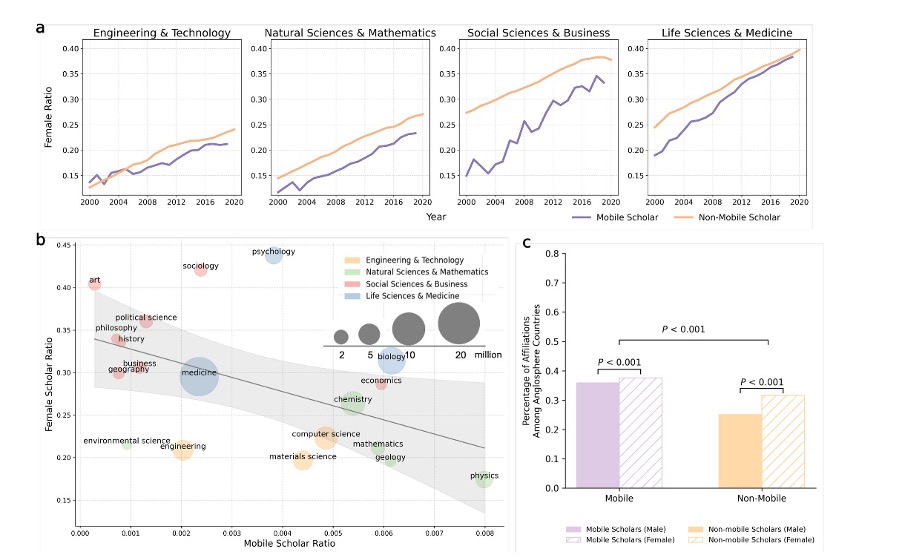
The findings reveal a mixed picture of progress and stagnation. On the surface, the proportion of internationally mobile female scholars has steadily increased over the past two decades, reflecting broader gains in women’s participation in higher education and research. Yet women remain less likely than men to move across national borders at any point in their careers.

Mobility also pays off unevenly. According to the analysis, female scholars gain fewer professional benefits from international moves than men do. After relocating abroad, women see smaller increases in publication output and experience more limited growth in international collaboration networks. This suggests that mobility, often framed as a universal accelerator of academic success, does not translate into equal returns.

The study further highlights how external shocks can magnify existing inequalities. During the COVID-19 pandemic, international academic mobility dropped sharply worldwide—but the decline was significantly steeper for women. Travel restrictions, caregiving responsibilities, and disrupted research networks disproportionately constrained female researchers, widening gender gaps that had already taken decades to narrow.

Taken together, the findings point to a structural problem rather than individual choice. Gender disparities in international mobility are not static; they evolve across career stages and intensify during crises. The researchers argue that policies promoting academic mobility must move beyond gender-neutral assumptions and adopt targeted interventions, particularly to support mid- and late-career women scholars and to build resilience during global disruptions.
As universities and governments continue to promote international mobility as a pillar of academic excellence, the study serves as a reminder that without deliberate action, global knowledge exchange risks reproducing—and deepening—long-standing gender inequalities.