
English / 简体
A Typology and Validation of Academic Mobility
Recent research shows that academic mobility is far more complex—and unequal—than conventional classifications suggest. While the movement of scholars across institutions and countries is widely regarded as a cornerstone of global knowledge circulation, most existing typologies rely on coarse categories that lack both theoretical grounding and empirical validation. A new large-scale study revisits academic mobility through a multidimensional lens, offering a more precise framework for understanding how scholars move, who benefits, and where inequalities persist.
Drawing on social capital theory, the research conceptualizes academic mobility not merely as physical movement, but as a resource that is unevenly distributed and differentially convertible into career advantages. The study proposes a three-dimensional framework that distinguishes mobility along (1) geographic scope—including immigration, visiting positions, and joint appointments; (2) institutional prestige, captured as upward versus downward moves; and (3) career stage, differentiating early-career from late-career mobility. By treating these dimensions as analytically distinct rather than interchangeable, the framework challenges one-size-fits-all approaches to studying scholarly movement.
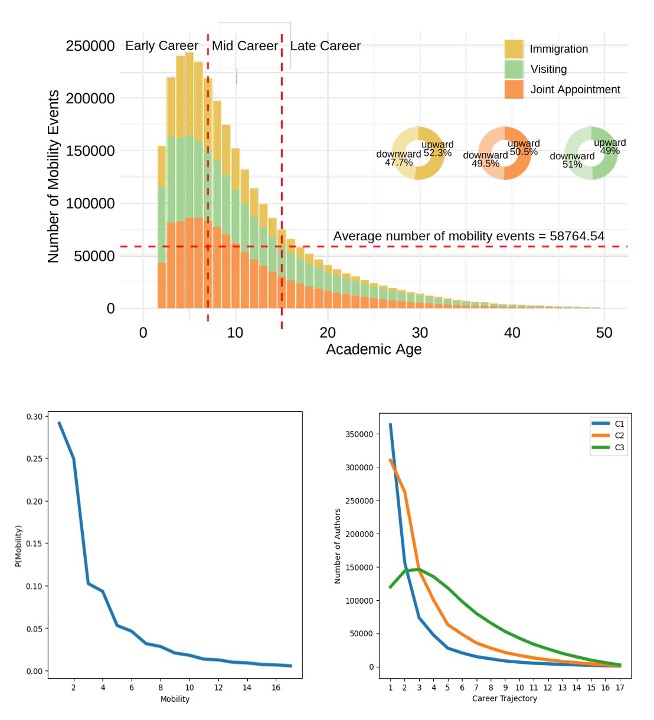
Empirically, the study is among the most comprehensive to date. Using longitudinal data from Microsoft Academic Graph and SciSciNet covering the period from 1800 to 2020, the authors constructed a dataset of 793,158 scholars and 2,938,227 mobility events. The proposed classification scheme was rigorously validated using manually annotated data, ensuring that the typology reflects actual academic trajectories rather than administrative artifacts.
The findings reveal striking heterogeneity across mobility dimensions. Geographic mobility and career-stage mobility exhibit clearly differentiated distributional patterns, suggesting that when and where scholars move are governed by distinct mechanisms. In contrast, prestige-based mobility—whether scholars move to higher- or lower-ranked institutions—shows no significant differentiation across the population, calling into question its widespread use as a standalone indicator of career advancement.
Crucially, the study uncovers dimension-specific inequalities. Discipline and country of origin strongly shape geographic mobility opportunities, underscoring the structural constraints faced by scholars from certain fields and regions. Gender, meanwhile, emerges as a key determinant of mobility across career stages, indicating that men and women experience fundamentally different mobility trajectories over the academic life course. These patterns would remain obscured without disaggregating mobility into its constituent dimensions.

Taken together, the research demonstrates that academic mobility cannot be treated as a singular phenomenon. Instead, it is a multidimensional process shaped by social capital, institutional structures, and individual characteristics, with inequalities manifesting in different ways depending on how mobility is defined. By validating a theoretically grounded typology at scale, the study provides a robust foundation for future research and offers policymakers a more nuanced evidence base for addressing inequities in global academia.