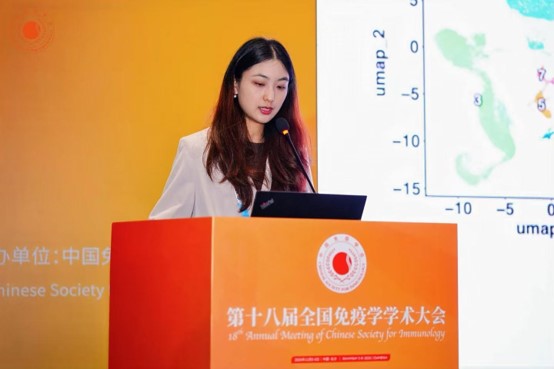
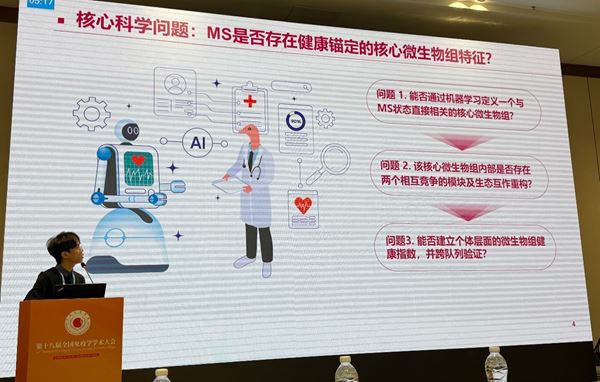
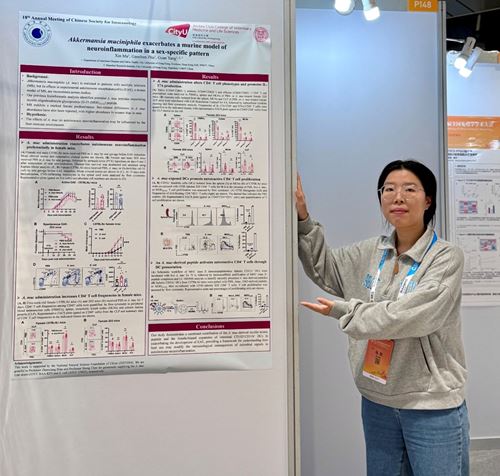
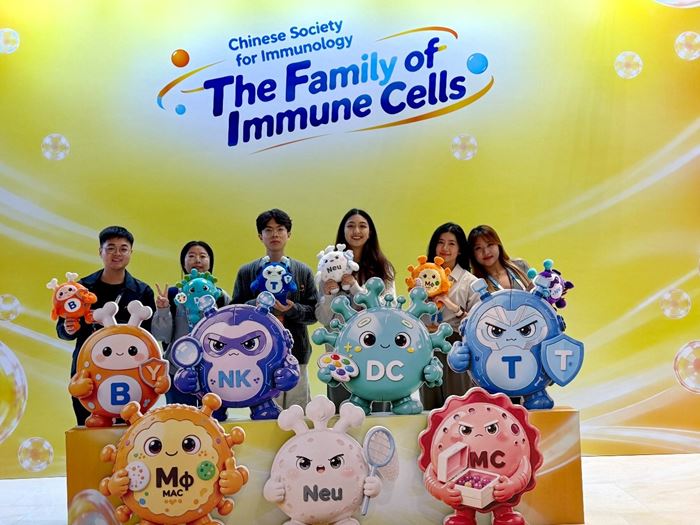
PH PhD Students and Postdoctoral Researcher Selected for Three Oral Presentations and One Poster Presentation at the 18th Annual Meeting of the Chinese Society for Immunology A group of PhD students and a postdoctoral researcher under the supervision of Prof. YANG Guan in the Department of Infectious Diseases and Public Health attended the 18th Annual Meeting of the Chinese Society for Immunology (CSI2026), held in Changsha, China, from 5 to 8 November 2026. Four abstracts from Prof. Yang’s group were presented in the meeting, showcasing the group’s research on neutrophil heterogeneity in immune regulation and the role of gut microbiome in autoimmune responses. These presentations were well received by the immunology community and prompted lively discussion. Dr. JIANG presents her research at the conference. Dr. Jiang Qianling, a former PhD student in Prof. Yang’s group and now a postdoctoral researcher, presented her research on how neutrophil-specific MyD88 deficiency alleviates experimental autoimmune encephalomyelitis, a mouse model of multiple sclerosis. The study identified a regulatory pathway involving STAT3 and PU.1 that promotes the differentiation of an immunosuppressive CD300ld⁺ neutrophil subset, highlighting a potential approach to modulating autoimmune neuroinflammation by targeting neutrophils. Mr. ZHU presents his research at the conference. Mr. Zhu Gaochen, a final-year PhD student, delivered an oral presentation entitled “A health-anchored microbiome signature of multiple sclerosis”. Drawing on faecal metagenomic data from 1,960 participants across six geographically diverse cohorts, the study identified microbial communities and functional changes associated with multiple sclerosis. The team also developed a microbiome health score that distinguished patients from healthy individuals, offering a basis for further investigation into microbiome-based disease assessment. Miss FANG presents her research at the conference. Miss Fang Xiang, a third-year PhD student, presented “Single-cell Atlas Reveals Neutrophil Heterogeneity in Hypervirulent Klebsiella Pneumoniae Infection-induced Sepsis”. Using single-cell RNA sequencing, the study identified four lung neutrophil subsets with distinct functional characteristics in infected mice. The findings offer insights into how neutrophil diversity may contribute to inflammation and immune suppression during severe bacterial infection. Miss MA presents her poster at the conference. Miss Ma Xin, a final-year PhD student, presented a poster. Her research investigated how a gut bacterium influences autoimmune neuroinflammation, revealing stronger disease exacerbation in female mice and implicating autoreactive CD4⁺ T cell responses. These findings underscore the importance of considering host sex when studying interactions between the microbiome and immune-mediated disease. Mr. Li Weizhao, a third-year PhD student, and Miss Zhang Xinyu, a first-year PhD student also attended the CSI2026 and exchanged ideas with fellow researchers. Participation in the conference gave the students an opportunity to share their findings with the national immunology community and engage with peers. Their presentations reflect the group’s ongoing efforts to understand how innate immune cells and the gut microbiome shape infection and central nervous system autoimmunity. Organized by the Chinese Society for Immunology, the meeting brings together approximately 5,000 researchers to share advances across basic, translational and clinical immunology. CSI2026 provided a platform for discussing emerging developments in the field and offered young researchers opportunities to present their work and connect with the wider scientific community. Congratulations to the students on their presentations and participation!