
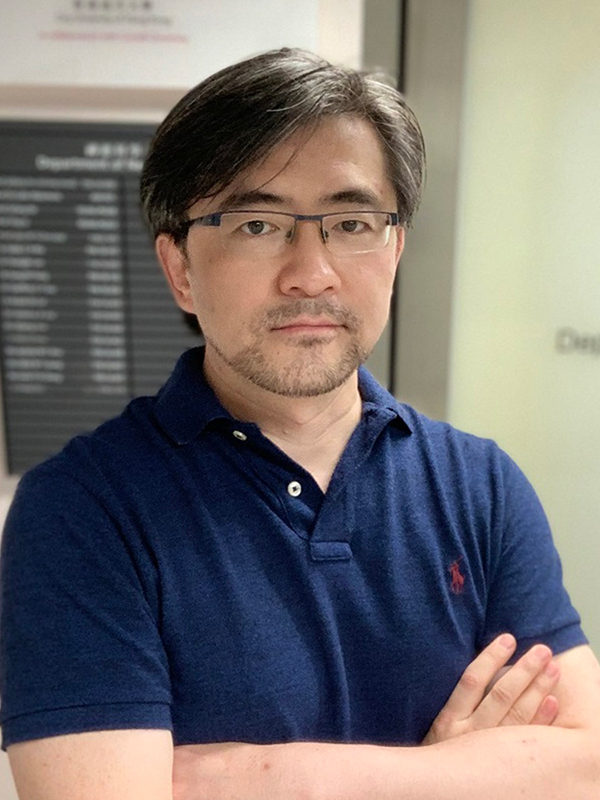
- 1A-404, 4/F, Block 1, To Yuen Building
- +852 3442-5842
- +852 3442-0128
- qiangliu@cityu.edu.hk
- CityU Scholars
- Lab Website
Prof. Liu received his B.M. in Basic Medical Science from Beijing Medical University (now Peking University Health Science Center) and an M.Sc. in Neuroscience from the University of Toronto, where he trained with Dr. Xian-min Yu at the Centre for Addiction and Mental Health (CAMH). He received his postdoctoral training with Dr. Zhao-wen Wang at the University of Connecticut Health Center and with Dr. Erik Jorgensen at the University of Utah and the Howard Hughes Medical Institute (HHMI). From 2013 to 2021, Prof. Liu served as a Research Assistant Professor in the laboratory of Dr. Cori Bargmann at Rockefeller University. He joined the Department of Neuroscience at the City University of Hong Kong in late 2021. Prof. Liu has received multiple honors, including a Grass Fellowship (2010), two Kavli Neural Systems Institute Pilot Grants (2017, 2020), a Collaborative Research in Computational Neuroscience (CRCNS) Award from the U.S. National Science Foundation (2021), and an Early Career Award from the Hong Kong Research Grants Council (2022).
Research Interests
The integrated function of the human brain allows each individual to have unique thoughts, perceptions, memories, and actions. These complex abilities arise from interconnected neurons that acquire information about the world, integrate it with ongoing knowledge and motivational states, and drive subsequent decisions and actions. Mechanistically understanding how the brain accomplishes these remarkably sophisticated functions — or ultimately simulating the brain computationally — remains one of the grand challenges of our time. This daunting task requires a comprehensive understanding of the brain at every level of complexity, from molecules to neurons, circuits, systems, and the underlying computational principles.
Compared with the human brain, which contains approximately 86 billion neurons and 100 trillion synapses, the nervous system of the nematode worm Caenorhabditis elegans comprises only 302 neurons and several thousand synapses. To achieve the ultimate goal of understanding the human brain, it is essential to first comprehend and model much simpler nervous systems. At the scale of C. elegans, scientists have mapped the complete physical wiring of the nervous system, known as the connectome, in an effort to reconstruct the worm brain. However, it soon became clear that structure alone is insufficient to explain function. Without detailed knowledge of the cell-type-specific biophysical properties of individual neurons and the activity patterns they generate, theorists have been unable to produce a unifying model that explains how this seemingly “simple” brain operates.
The Liu lab seeks to address this challenge by comprehensively characterizing the biophysical properties of every neuronal cell type in C. elegans and constructing highly constrained models at the single-neuron and circuit levels. The lab’s long-term goal is to generate a biophysical map of the entire worm brain, reproduce neural activity patterns across neuron types and circuits, and ultimately simulate how brain dynamics give rise to behavior.
Specifically, the research of the Liu lab focuses on the following four fronts:
- Systematic electrophysiological recordings from all C. elegans neuron types to establish a comprehensive biophysical atlas.
- Investigation of how diverse biophysical properties shape cellular physiology, circuit dynamics, neural computation, and behavior.
- Construction of conductance-based single-neuron models and anatomically accurate, biophysically realistic network models of the C. elegans nervous system.
- Dissecting the mechanisms of gut–brain oscillations and motor pattern generation underlying the C. elegans enteric clock.
Position Available
We are seeking talented PhD students, Research Assistants, and Postdoctoral Fellows to join our team. Interested candidates are encouraged to contact qiangliu@cityu.edu.hk.
Selected Publications
- Zhao, H., Shi, G., Qin, R., Sun, Y., Guo, W., Shi, R., Peng, M., Yang, J., Zhao, J., Liu, Q., Xiao, J., Zhang, K., Liu, Q., Yang, W. and Liu, H. (2025). Hungry for Knowledge: Octopamine Signaling Regulates Hunger-Enhanced Olfactory Learning. Adv Sci (Weinh), e13842. doi.org/10.1002/advs.202513842
- Wang, X., Qin, R., Zhang, K., Di, Z., Liu, Q., and Liu, H. (2025). Prediction of functional neural circuits in Caenorhabditis elegans based on overlapping community detection. Neural Networks. 190, 107654.doi.org/10.1016/j.neunet.2025.107653.
- Liu, Q.# and Tao, L. (2025). What keeps Caenorhabditis elegans precise: The spatiotemporal regulation of defecation. Journal of Biosciences 50, 29. doi.org/10.1007/s12038-025-00534-2.
- Wang, X., Liu, H., Yang, W., Yang, J., Sun, X., Liu, Q., Zhu, Y., Sun, Y., Liu, C., Shi, G., Liu, Q., Zhang, K., Di, Z., Yang, W., and Liu, H. (2025). Dimorphic Neural Network Architecture Prioritizes Sexual-related Behaviors in Male C. elegans. eLife, doi.org/10.7554/eLife.102309.1
- Kim, J., Peng, M., Chen, S., Liu, Q.#, and Shlizerman E.# (2025). Generation of biophysical neuron model parameters from recorded electrophysiological responses. eLife, 13:RP95607. doi.org/10.7554/eLife.95607.4
- Nicoletti, M., Chiodo, L., Loppini, A., Liu, Q., Folli, V., Ruocco, G., and Filippi, S. (2024). Biophysical modeling of the whole-cell dynamics of C. elegans motor and interneurons families. PLoS One 19, e0298105. 10.1371/journal.pone.0298105.
- Bergs, A.C.F., Liewald, J.F., Rodriguez-Rozada, S., Liu, Q., Wirt, C., Bessel, A., Zeitzschel, N., Durmaz, H., Nozownik, A., Vierock, J., et al. (2023). All-optical closed-loop voltage clamp for precise control of muscles and neurons in live animals. Nature Communications 14, 1939. 10.1038/s41467-023-37622-6.
- Jiang, J.*, Su, Y.*, Zhang, R., Li, H., Tao, L., and Liu, Q.# (2022). C. elegans enteric motor neurons fire synchronized action potentials underlying the defecation motor program. Nature Communications 13, 2783. 10.1038/s41467-022-30452-y.
- Naudin, L., Jimenez Laredo, J.L., Liu, Q., and Corson, N. (2022). Systematic generation of biophysically detailed models with generalization capability for non-spiking neurons. PLoS One 17, e0268380. 10.1371/journal.pone.0268380.
- Dobosiewicz M., Liu, Q., and Bargmann, C.I. (2019). Reliability of an interneuron response depends on an integrated sensory state. ELife 8, 50566
- López-Cruz A., Sordillo A., Pokala N., Liu, Q., McGrath P.T., and Bargmann C.I. (2019). Parallel multimodal circuits control an innate foraging behavior. Neuron 102(2), 107-419 e8.
- Liu, Q., Kidd P.B., Dobosiewicz M., and Bargmann, C.I. (2018). C. elegans AWA olfactory neurons fire calcium-mediated all-or-none action potentials. Cell 175, 57-70 e17.
- Larsch, J., Flavell, S.W., Liu, Q., Gordus, A., Albrecht, D.R., and Bargmann, C.I. (2015). A circuit for gradient climbing in C. elegans chemotaxis. Cell Rep 12(11), 1748-60.
- Liu, Q., Frerck M.J., Holman H.A., Jorgensen, E.M., and Rabbitt R. (2014). Exciting cell membrane with a blustering heat shock. Biophys J 106(8) 1570-7.
- Pokala, N., Liu, Q., Gordus, A., and Bargmann, C.I. (2014) Inducible and titratable silencing of C. elegans neurons in vivo with histamine-gated chloride channels. Proc Natl Acad Sci U S A 111(7):2770-5.
- Ailion, M., Hannemann, M., Dalton, S., Pappas, A., Watanabe, S., Hegermann, J., Liu, Q., Han, H.F., Gu, M., Goulding, M.Q., Sasidharan, N., Schuske, K., Hullett, P., Eimer, S., and Jorgensen, E.M. (2014). Two Rab2 interactors regulate dense-core vesicle maturation. Neuron 82(1), 167-80.
- Watanabe, S., Liu, Q., Davis M.W., Hollopeter, G., Thomas, N., Jorgensen, N.B., and Jorgensen, E.M. (2013). Ultrafast endocytosis at Caenorhabditis elegans neuromuscular junction. Elife 2, e00723.
- Gu, M., Liu, Q., Watanabe, S., Sun, L., Hollopeter, G., Grant, B., and Jorgensen, E.M. (2013) AP2 hemicomplexes contribute independently to synaptic vesicle endocytosis. Elife 2, e00190.
- Hobson, R.J.*, Liu, Q.* (Co-first authorship), Watanabe, S., and Jorgensen, E.M. (2011). Complexin maintains vesicles in the primed state in C. elegans. Curr biol 21, 106-113.
- Liu, Q., and Jorgensen, E.M. (2011). Muscle memory (Commentary). J Physiol 589, 775-776
- Comment on: Liu, P., Ge, Q., Chen, B., Salkoff, L., Kotlikoff, M.I., and Wang, Z.W. (2011). J Physiol 589, 101-117.
- Liu, Q., Hollopeter, G., and Jorgensen, E.M. (2009). Graded synaptic transmission at the Caenorhabditis elegans neuromuscular junction. Proc Natl Acad Sci U S A106, 10823-10828.
- Gu, M., Schuske, K., Watanabe, S., Liu, Q., Baum, P., Garriga, G., and Jorgensen, E.M. (2008). Mu2 adaptin facilitates but is not essential for synaptic vesicle recycling in Caenorhabditis elegans. J Cell Biol183, 881-892.
- Chen, B.*, Liu, Q.* (Co-first authorship), Ge, Q.*, Xie, J., and Wang, Z.W. (2007). UNC-1 regulates gap junctions important to locomotion in C. elegans. Curr Biol17, 1334-1339.
- Commentary: Norman, K.R., and Maricq, A.V. (2007). Innexin function: minding the gap junction. Curr Biol 17, R812-814.
- Liu, Q., Chen, B., Hall, D.H., and Wang, Z.W. (2007). A quantum of neurotransmitter causes minis in multiple postsynaptic cells at the Caenorhabditis elegans neuromuscular junction. Dev Neurobiol 67, 123-128.
- Liu, Q.*, Chen, B.*, Ge, Q.*, and Wang, Z.W. (2007). Presynaptic Ca2+/calmodulin- dependent protein kinase II modulates neurotransmitter release by activating BK channels at Caenorhabditis elegans neuromuscular junction. J Neurosci27, 10404-10413.
- Liu, Q.*, Chen, B.*, Gaier, E., Joshi, J., and Wang, Z.W. (2006). Low conductance gap junctions mediate specific electrical coupling in body-wall muscle cells of Caenorhabditis elegans. J Biol Chem281, 7881-7889.
- Mahoney, T.R., Liu, Q., Itoh, T., Luo, S., Hadwiger, G., Vincent, R., Wang, Z.W., Fukuda, M., and Nonet, M.L. (2006). Regulation of synaptic transmission by RAB-3 and RAB-27 in Caenorhabditis elegans. Mol Biol Cell17, 2617-2625.
- Liu, Q., Chen, B., Yankova, M., Morest, D.K., Maryon, E., Hand, A.R., Nonet, M.L., and Wang, Z.W. (2005). Presynaptic ryanodine receptors are required for normal quantal size at the Caenorhabditis elegans neuromuscular junction. J Neurosci25, 6745-6754.
- Deken, S.L., Vincent, R., Hadwiger, G., Liu, Q., Wang, Z.W., and Nonet, M.L. (2005). Redundant localization mechanisms of RIM and ELKS in Caenorhabditis elegans. J Neurosci 25, 5975-5983.
- Lei, G., Xue, S., Chery, N., Liu, Q., Xu, J., Kwan, C.L., Fu, Y.P., Lu, Y.M., Liu, M., Harder, K.W., et al. (2002). Gain control of N-methyl-D-aspartate receptor activity by receptor-like protein tyrosine phosphatase alpha. EMBO J 21, 2977-2989.
# Corresponding authorship
* Equal authorship
4 February 2026