

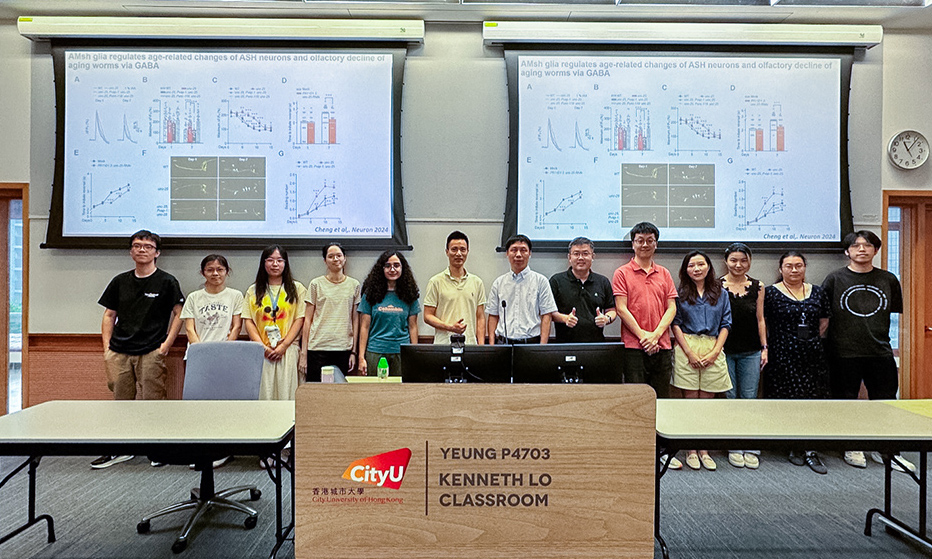
On 21 August 2026, Prof. Lijun Kang from Zhejiang University School of Medicine visited our department and delivered a seminar titled “Phasic/Tonic Glial GABA Differentially Transduce for Sensory Encoding and Neuronal Aging”. His seminar highlighted emerging evidence that glial cells are not simply supporting partners of neurons, but can actively sense environmental information, communicate with sensory neurons, and shape neural function and behavior across remarkably different timescales.
Using C. elegans as an experimentally tractable model, Prof. Kang focused on the amphid sheath (AMsh) glia, which closely associate with sensory neurons in the worm’s major sensory organ. His group has shown that AMsh glia can directly respond to environmental stimuli and use GABAergic signaling to modulate neighboring sensory neurons. In olfactory circuits, AMsh glia and ASH sensory neurons detect aversive odorants through distinct receptors. Glial GABA then acts on ASH neurons to regulate sensory adaptation, demonstrating that glia can participate directly in sensory information processing rather than merely responding to neuronal activity.
A particularly interesting aspect of the seminar was how the same glial transmitter can operate over very different timescales. Prof. Kang described two distinct modes of GABA signaling from AMsh glia. Fast, phasic GABA signaling acts through the ionotropic GABA receptor LGC-38 to regulate rapid olfactory adaptation, whereas slower, tonic GABA signaling engages the metabotropic GABA receptor GBB-1 to regulate age-associated changes in ASH neurons and preserve sensory function during aging. These findings illustrate how a single glial cell can use different release and receptor mechanisms to influence both immediate sensory processing and long-term neuronal health.
Prof. Kang also presented recent work extending this concept to thermosensation. AMsh glia can themselves detect both heat and cold, using GCY-28 and GLR-3 as heat- and cold-sensing molecules, respectively. Rather than simply relaying this information uniformly, AMsh glia act as a sensory hub that differentially regulates multiple neuronal pathways. Glial GABA enhances warmth responses in AFD neurons through EXP-1 while suppressing cold responses in ASH neurons through LGC-38. This “hub-and-spoke” organization enables a single glial cell to integrate environmental temperature information and coordinate behaviors including thermal nociception, tolerance, and preference.
Prof. Kang’s seminar provided a compelling view of glia as active components of sensory circuits. By functioning as environmental sensors, releasing GABA through distinct signaling modes, and communicating with different neurons through cell-specific receptors, glial cells can contribute to rapid sensory adaptation, long-term neuronal maintenance, and behavioral responses to the environment. Prof. Kang’s work demonstrates how studies in a compact nervous system can uncover fundamental principles of neuron-glia communication with broader implications for understanding sensory processing and nervous-system aging.