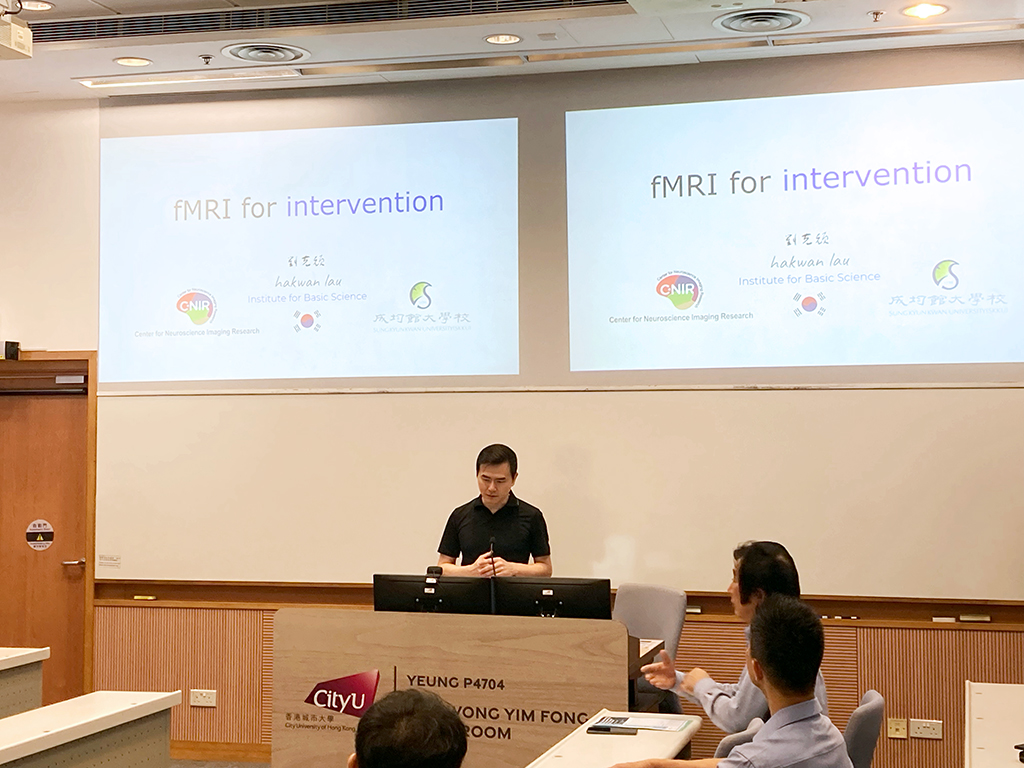
On 11 August 2025, Prof. Hakwan Lau of the Sungkyunkwan University (SKKU) visited City University of Hong Kong lecture titled “Hemodynamic Pattern Reinforcement: Using fMRI for Causal Intervention” where he shared his research on human fMRI.
Prof. Lau’s lecture focused on the real-time fMRI detects spatial patterns of activity in the human brain. Functional magnetic resonance imaging (fMRI) offers a powerful tool for developing targeted interventions, particularly in nonconscious exposure therapy. Unlike traditional methods, fMRI enables real-time decoding of neural activity, allowing interventions without conscious awareness. A key paradigm involves presenting stimuli (e.g., 3,600 images across 40 categories, including animals and objects) in rapid sequences (induction: 6s, rest: 6s, feedback: 2s, ITI: 6s), ensuring complete unawareness. Hyperalignment and voxel-level analysis help map neural responses across participants, with ventral temporal cortex activity distinguishing categories.
In addition to the above conclusions, reward-based protocols (randomized, double-blinded) and surrogate modeling (e.g., amygdala BOLD, skin conductance) validate efficacy. Replication in patients shows reduced fear responses (pre-post amygdala activity, Stroop task RT changes), though the amygdala is not a mere "fear center"—decoders also incorporate insula and vmPFC activity. Predictive models (trained on 6,939–9,000 images) link deep convolutional neural network (DCNN) features (e.g., CLIP image encoder) to brain responses (y = W· F + b + c). Representational similarity analysis (RS-MVPA) reveals neural coding patterns (single/pair colors: 250ms; voxel RDMs, cosine similarity).
Lastly, Prof. Lau said: his lab future directions include causal interventions (e.g., MION in NHPs/rodents), dynamic manifold learning to predict hemodynamics, and refining neurovascular coupling models. This approach bridges computational neuroscience and clinical therapy, offering precise, nonconscious modulation of maladaptive responses.
Prof. Lau’s talk was enthusiastically received by the audience including a rich discussion following the seminar.