


The Leidenfrost effect, which is the levitation of drops on hot solids, is known to deteriorate heat transfer at high temperature. The Leidenfrost point can be raised by texturing materials to favour solid–liquid contact and by arranging channels at the surface to decouple the wetting phenomena from vapour dynamics. However, maximizing both the Leidenfrost point and thermal cooling across a wide range of temperatures can be mutually exclusive.
We have devised a rational design of structured thermal armour that inhibits the Leidenfrost effect up to 1,200 °C, or 600 °C more than previously attained, while preserving heat transfer. Our design consists of steel pillars that serve as thermal bridges, an embedded insulating membrane that wicks and spreads the liquid, and U-shaped channels for vapour evacuation. The coexistence of materials with contrasting thermal and geometrical properties cooperatively transforms normally uniform temperatures into non-uniform ones, generates lateral wicking at all temperatures, and enhances thermal cooling. Structured thermal armour is limited only by its melting point, rather than by a design failure. The material can be made flexible, and can therefore be attached to substrates that are otherwise challenging to structure. Our strategy can potentially enable the implementation of efficient liquid cooling at ultra-high solid temperatures, which is to date, an uncharted property.
Structured Thermal Armour
The Leidenfrost effect, which is the levitation of drops on hot solids, is known to deteriorate heat transfer at high temperature. The Leidenfrost point can be raised by texturing materials to favour solid–liquid contact and by arranging channels at the surface to decouple the wetting phenomena from vapour dynamics. However, maximizing both the Leidenfrost point and thermal cooling across a wide range of temperatures can be mutually exclusive.
We have devised a rational design of structured thermal armour that inhibits the Leidenfrost effect up to 1,200 °C, or 600 °C more than previously attained, while preserving heat transfer. Our design consists of steel pillars that serve as thermal bridges, an embedded insulating membrane that wicks and spreads the liquid, and U-shaped channels for vapour evacuation. The coexistence of materials with contrasting thermal and geometrical properties cooperatively transforms normally uniform temperatures into non-uniform ones, generates lateral wicking at all temperatures, and enhances thermal cooling. Structured thermal armour is limited only by its melting point, rather than by a design failure. The material can be made flexible, and can therefore be attached to substrates that are otherwise challenging to structure. Our strategy can potentially enable the implementation of efficient liquid cooling at ultra-high solid temperatures, which is to date, an uncharted property.
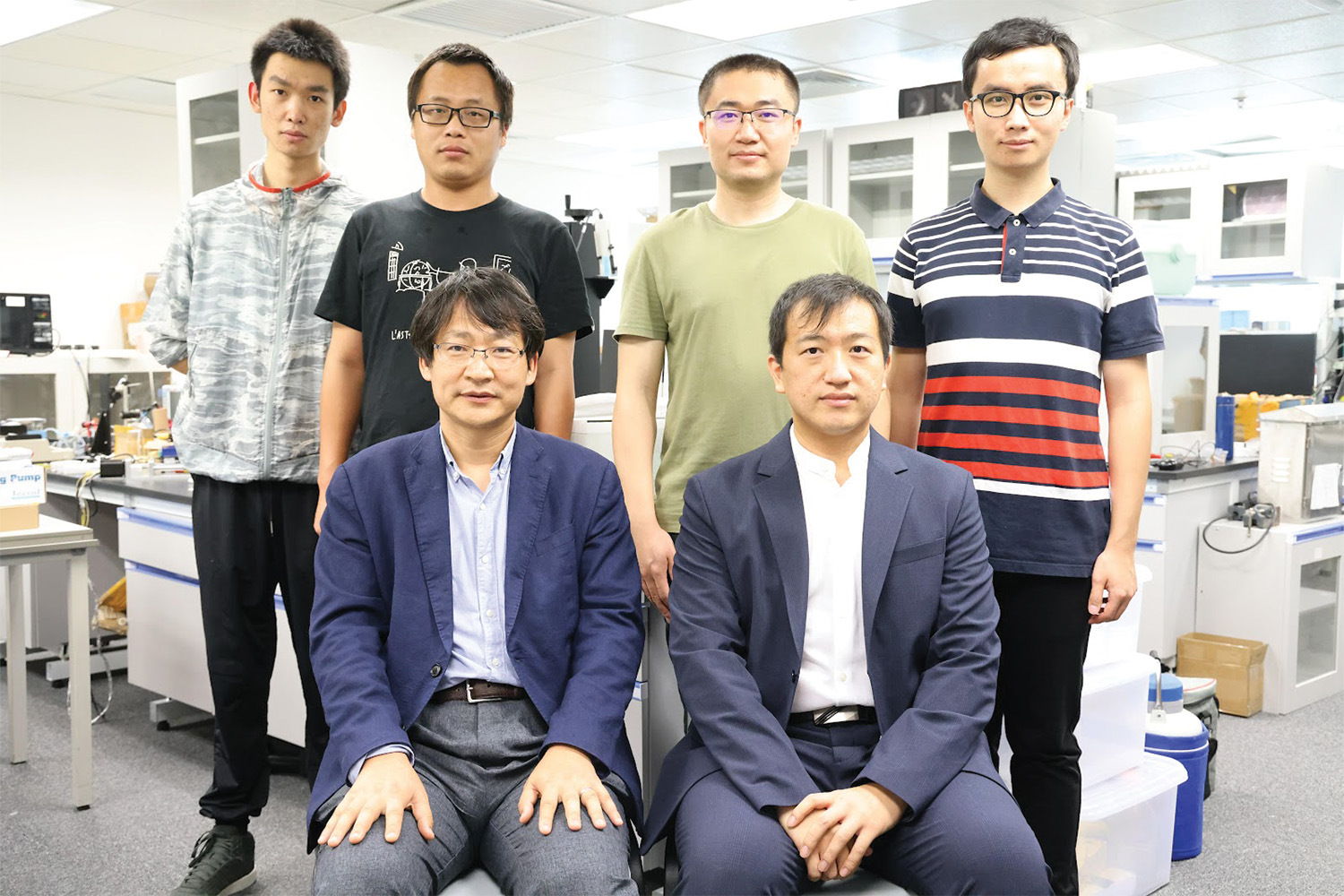
Team member(s)
Dr Wang Yang (Jilin University)
Mr Liu Fayu (PhD student, Dept. of Mechanical Engineering, CityU)
Mr Zeng Yijun (PhD student, Dept. of Mechanical Engineering, CityU)
Mr Li Mingyu (PhD student, Dept. of Mechanical Engineering, CityU)
Mr Li Yuchao (Research Assistant, Dept. of Mechanical Engineering, CityU)
Mr Wang Jinpei (PhD student, Dept. of Mechanical Engineering, CityU)
* Person-in-charge
(Info based on the team's application form)
Achievement(s)
- CityU HK Tech 300 Seed Fund (2022)
- The Gold Prize, International Exhibition of Inventions of Geneva, Swiss Federal Government, World Intellectual Property Organization (2022)
- The Grand Prize, The 8th Hong Kong University Student Innovation and Entrepreneurship Competition, HKNGCA Innovation & Entrepreneurship Centre (2022)
- The First Prize, The 8th Hong Kong University Student Innovation and Entrepreneurship Competition, HKNGCA Innovation & Entrepreneurship Centre (2022)