|
India's rich diversity of history, peoples, cultures, languages,
art, and religions has deeply influenced the significance, production, and
decoration of ceremonial arms and armour. These objects vary widely, from indigenous
creations like the iconic katar, a type of punch dagger, to those introduced through
trade, travel, warfare, and invasion.
Hindu and Muslim kingdoms, particularly that of the Mughals (r. 1526–1858) used
elaborately ornamented weapons and other martial objects to hold court—in weddings,
parades, processions, formal receptions, and diplomatic affairs—and for social
customs, like the royal hunt. The decoration of such objects also had notable
significance, conveying ideals, such as strength and resilience, as well as shedding
light onto trends in fashion and art. India's ethnic communities also used weapons
to demonstrate power, authority, and heritage. The Kodavas, who reside in the
modern-day state of Karnataka, continue to carry weapons to establish hierarchies
within their society and symbolise ties to their warrior culture.
Beyond matters of the state, ceremonial weapons played a vital role in India's
religious practices. The gods and goddesses of Hinduism, for instance, are depicted
with multiple weapons that signify not only their slaying of powerful demons but
also the victory of good over evil, knowledge over ignorance, and light over
darkness. In the Indo-Islamic world, verbal and visual motifs associated with Allah
(God) as well as the prophet Muhammad and his family were used on arms and armour to
avert danger and bring blessings to the wielder.
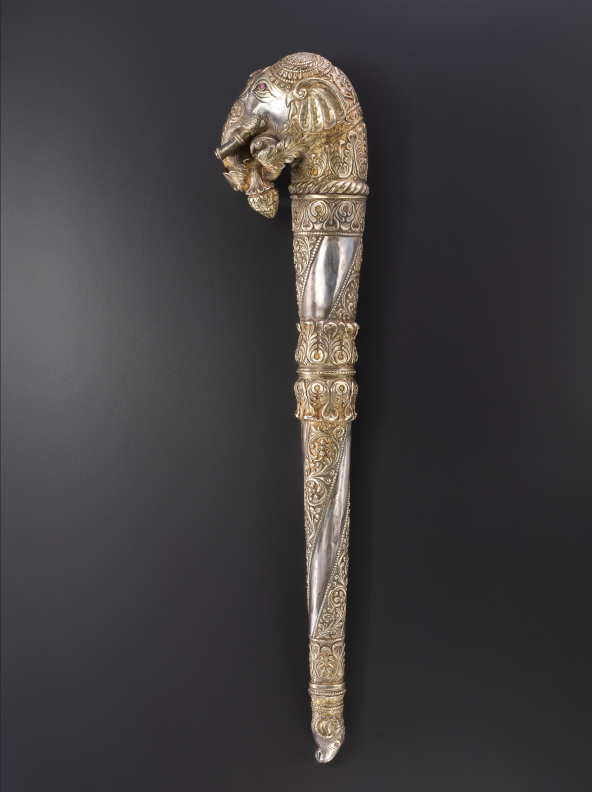
Similarly, in Sri Lanka, ceremonial arms and armour carry a deep sense of reverence,
embodying the island nation's proud martial heritage and serving as integral
components of cultural and courtly rituals. Its indigenous sword, the kastane, and
dagger or knife, the piha kaetta, transcended from their utilitarian purposes to
meticulously decorated, ceremonial versions that were crafted by master artisans who
belonged to one of the four royal guilds of the kingdom of Kandy (1469–1815).
Reserved for the king and his courtiers, these weapons symbolised honour and
distinction and were at times exchanged as diplomatic gifts.
The objects in this section offer a glimpse into the breadth and depth of the types
and significance of ceremonial arms and armour in India and Sri Lanka. They are true
testaments to the vibrancy and complexity of this region, reflecting historical,
cultural, and religious dynamics spanning centuries.
|