

Overview
Introduction
The University of Lancashire, through the School of Continuing and Professional Education (SCOPE), City University of Hong Kong (CityUHK), is offering a part-time programme leading to the award of BEng (Hons) Fire Engineering.
BEng (Hons) Fire Engineering is an exempted programme under the Non-local Higher and Professional Education (Regulation) Ordinance (ref. number:451418). It is a matter of discretion for individual employers to recognize any qualification to which this programme may lead.
- QF level: 5
- QR Registration number: 25/000990/L5
- Validity period: 1 Sep 2025 to 31 Aug 2028
Important Notes:
While the standard duration for this final intake of the programme is from September 2025 to August 2027, we are committed to providing support to students who may face challenges during their course of studies. In case of extenuating circumstances that hinder your ability to complete the programme on schedule, support will remain available until December 2027 to help you achieve your academic goals.
Please note that applications for deferral of study will generally not be considered, and the decisions made by CityUHK SCOPE and University of Lancashire regarding such applications will be final.
CityUHK and University of Lancashire reserves the right to cancel the programme in the event of being insufficient enrolled students. In such case, the programme fee/acceptance fee paid will be refunded to you accordingly.
Module Descriptors
Module Title: Introduction to Combustion and Fire
This module introduces the learner to the fundamental scientific principles of combustion and fire. The primary goal is to provide students with general understanding and knowledge of combustion, fire and explosion phenomena. The main definitions, approaches and techniques developed in combustion and fire science and engineering are introduced to set the scene for the further in-depth studies through all other fire related modules in the Fire Curriculum. Alongside the introduction to fires and combustion, the module provides basic information and knowledge from related disciplines (chemical kinetics and thermodynamics, fluid dynamics, heat and mass transfer). This introduces all necessary elements, which are required to start a consistent further education in the diverse and multidisciplinary area of fire safety.
Module Title: Fluid Dynamics of Fire
This module aims to enable the students to assimilate the fundamental principles underlying fluid flow and to apply these to flames, fires, and explosions. The module is designed to develop theoretical and practical themes introduced in Level 1. The aim of this module is to further improve qualitative understanding of combustion, fire and explosion phenomena and develop skills in their quantification.
Module Title: Fire and Built Environment
This module aims to develop an awareness and understanding of the impact of fires on the built environment, including building construction methods and materials used, smoke movement and control, law, regulations and standards. It explores different types of fire behaviour in the built environment. The module provides students with case studies of the impact of fires on buildings nationally (UK/HK) and internationally. Through the learning and teaching strategy, the module will also enhance students’ employability skills such as independent working, analysis, problem solving and presentations.
Module Title: Accidents and Catastrophes
This module aims to develop an awareness and understanding of accident and catastrophe phenomena and their impact on society. It explores different types of natural and technological accidents and catastrophes and their effect on the built environment. The module provides students with case studies of the impact of fires on buildings nationally (UK/HK) and internationally. Through the learning and teaching strategy, the module will also enhance students’ employability skills such as independent working, analysis, problem solving, presentations and working with others.
Module Title: Project Management
This module aims to focus on the role and responsibilities of the project manager, together with the leadership and organisation skills essential to the discharge of this function. The application of the role of the professional project manager and associated analytical, monitoring and controlling techniques will be developed.
Module Title: Computational Engineering
The module aims to provide students with fundamental knowledge and skills of using computing in fire hazard analysis. This includes both essential numerical programming skills required to carry out basic engineering computations within generic programming environments and application of specialist software to solve typical computational problems of fire engineering.
Module Title: Engineering Analysis 2
To establish fundamental mathematical skills and provide a framework of mathematical techniques with which to analyse engineering problems; thence to apply them in the analysis and solution of common engineering problems. Students are required to practice solving applied mathematical problems.
Module Title: Enclosure Fire Dynamics
This module builds upon and develops a deeper technical foundation of the fire-science skills and knowledge gained at Level 4 and Level 5 to establish the students’ competence in the understanding of enclosure fires and the dominant mechanisms controlling enclosure fires. The module will also enhance students’ employability skills such as critical thinking, independent research, problem solving.
The module includes a wide range of commonly used relationships, solutions and models as well as information and knowledge across related disciplines (chemical kinetics and thermodynamics, fluid dynamics, heat and mass transfer, etc.).
Module Title: Fire Protection Engineering
This module will look at the principles of fire protection, standard test procedures and methods of solving fire safety problems using active and passive fire safety systems. In particular the focus will be towards innovative/engineered solutions to fire safety problems.
The module aims to develop the student’s skills of numerical analyses and critical evaluation in appropriate fire protection applications.
Module Title: Fire Investigation
The module will develop student’s ability to undertake a scientific fire investigation of a fire scene while ensuring the requirements with respect to safety, scene preservation, evidence collection and presentation are fully achieved.
Module Title: Probabilistic Risk Analysis
This module aims to develop mainstream engineering analysis techniques for engineering students. The emphasis is in application to probabilistic risk modelling. The module will enhance students’ skills of analysis, modelling and problem solving. Such mathematical methods are ‘expected’ across engineering programs throughout the world.
Amongst the methods taught it is intended to focus on matrix and calculus methods:
Matrices to include Markov chains and linear programming (simplex)
Calculus to include properties of probability distributions and their application in reliability engineering (MTTF), Laplace transforms. The relationship between Laplace and Markov chains will be reviewed.
Network methods including reliability, Markov and probabilistic trees.
Applications in fire research will be reviewed.
Module Title: Engineering Design Project
The Engineering Design Project module is designed to provide students with the opportunity to extend and demonstrate engineering design skills both as team members and as individuals. The project will enable students to develop their critical thinking, problem solving and key skills in application to a case study example using appropriate tools of analysis and communication. The module acts as the vehicle for integrating the study themes of design, ICT and technology, in a practical context.
Module Title: Engineering Dissertation
This module aims to provide the students with the opportunity to develop independent research and evaluation skills. On an individual basis the student will be required to carry out an in-depth study involving theoretical, computational, experimental or investigative analysis, or a combination of these. Through the learning and teaching strategy, the module will also enhance students’ employability skills such as written communication skills, independent planning, execution and dissemination of research outcomes.
Professional Recognition
Accredited by the Energy Institute on behalf of the Engineering Council for the purposes of fully meeting the academic requirement for registration as an Incorporated Engineer and partly meeting the academic requirement for registration as a Chartered Engineer.
QF Level : 5
QR Registration No. : 25/000990/L5
Validity Period: 1 Sep 2025 to 31 Aug 2028
This is an exempted programme under the Non-local Higher and Professional Education (Regulation) Ordinance (ref. number: 451418). It is a matter of discretion for individual employers to recognize any qualification to which this programme may lead.
Programme Structure
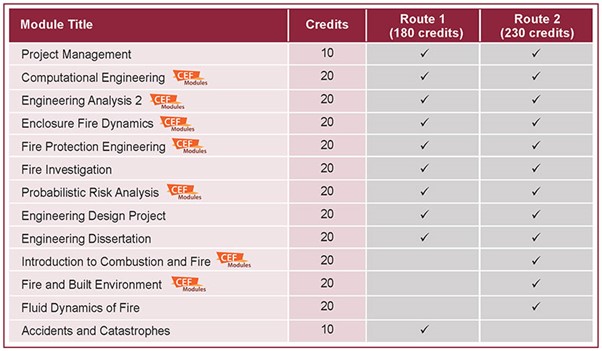
* The module combination and teaching sequence are subject to revision by University of Lancashire.
These courses have been included in the list of reimbursable courses for Continuing Education Fund purposes. The mother programme BEng (Hons) Fire Engineering of these courses is recognised under the Qualifications Framework (QF Level 5).
Medium of Instruction
English
Classes and Venue
Modules are arranged on weekday evenings and / or Saturday afternoons / or Sunday afternoons. Classes will be held at CityUHK SCOPE Learning Centres in Kowloon Tong and/or other designated venues.
Commencement
September 2025
Admission Requirements
There are 2 entry points for eligible applicants with different qualifications:
• Route 1 (students have to complete 180 credits in 2 years)
• Holders of Foundation Degree in Science in Fire Safety Engineering (FDSc), or equivalent qualification.
• Route 2 (students have to complete 230 credits in 2 years)
• Holders of Higher Diploma (HD) / Associate Degree (AD) / Higher National Diploma (HND), or equivalent qualification, in building services or mechanical engineering with mathematics courses studies; or
• Holders of HD / AD in a relevant discipline (other than building services or mechanical engineering) who can demonstrate competence in mathematics and have a minimum of 3 years of experience in a relevant profession.
Applicants whose qualifications were not taught and assessed in English may be required to demonstrate their English proficiency as equivalent to IELTS 6.0.
Fees
| Application Fee | HK$160 (Waived until Further notice) |
| Programme Fee* |
HK$161,000 for Route 2 (230 credits), payable in 6 instalments
HK$126,000 for Route 1 (180 credits), payable in 5 instalments |
* Additional fees will be charged in the case of retaking. All fees paid are non-refundable.
In the case of re-assessment, additional fees will be charged. All fees paid are non-refundable.
Education Loan
Successful applicants are eligible to apply for the Extended Non-means-tested Loan Scheme (ENLS) administered by the Student Finance Office (SFO) of the HKSAR government. The maximum financial assistance under the ENLS is equivalent to the total tuition fees payable for the programme.
Enquiries: 2150 6223
Website: www.wfsfaa.gov.hk
Important Notes for applying IFE discounts
The 5% of IFE discounts are only applicable for non-CEF reimbursable modules (i.e. NOT applicable for CEF reimbursable modules). You can refer to the “Continuing Education Fund” section for the list of CEF reimbursable and non-CEF reimbursable modules of your programme.
Students who wish to apply for 5% discount on the non-CEF reimbursable modules from the first instalment of 2025-2026 have to submit a copy of valid proof of IFE membership to cefire@cityu.edu.hk on or before 30 June 2025. Submission of valid proof of IFE membership during the period of 1 July 2025 to 31 October 2025 will fall into the final round process with discount effective starting from the second instalment of 2025-2026. All submission of valid proof of IFE membership after 31 October 2025 will not be handled.
Continuing Education Fund (CEF)*
Below modules are included in the list of reimbursable courses under the Government’s Continuing Education Fund (CEF). The mother programme BEng (Hons) Fire Engineering of the below modules are recognised under the Qualifications Framework (QF Level 5). For application details, please refer to the Office of CEF website.
36Z109028 Introduction to Combustion and Fire
36Z109052 Fire and Built Environment
36Z109060 Computational Engineering
36Z109079 Engineering Analysis 2
36Z109087 Enclosure Fire Dynamics
36Z109095 Probabilistic Risk Analysis
36Z109109 Fire Protection Engineering
Enquiries: 3142 2277
Website: www.wfsfaa.gov.hk/cef
The information stipulated in this website is subject to continuous reviews and updates of the universities. Changes, additions or deletions may occur throughout the application period and the delivery of the programme.
Department of ACE, CityUHK
B6301, Blue Zone,
6/F Yeung Kin Man Acad Bldg,
83 Tat Chee Road, Kowloon Tong