

Professor Jian Wang Publishes Seawater Electrolysis Research in Energy & Environmental Science
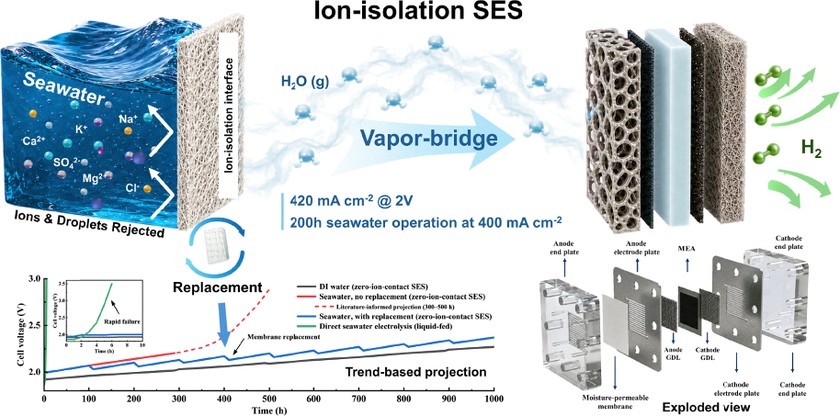
The School of Energy and Environment (SEE) at City University of Hong Kong (CityUHK) proudly shares that Prof. Jian Wang, Associate Professor at SEE, in collaboration with Prof. Ronghui Qi from the South China University of Technology, has published groundbreaking research in Energy & Environmental Science (EES), a top-tier international journal in energy and environmental field. The study, titled “Vapor-bridge ion-isolation enables high-durability seawater electrolysis” introduces an innovative vapor-bridge ion-isolation technology to produce green hydrogen directly from seawater, overcoming long-standing bottlenecks that have troubled seawater hydrogen production for decades.
For many years, turning seawater into clean hydrogen has faced a major, stubborn challenge: seawater contains chloride ions. When liquid seawater touches the core electrolysis components, these ions cause severe electrode corrosion, poison key membranes, and block gas flow. This leads to short device lifespans and poor stability, making direct seawater electrolysis hard to use in real-world applications.
The research team developed a creative “vapor-bridge ion-isolation” strategy to tackle this fundamental problem. Instead of allowing seawater to flow into the electrolyzer, the team uses a moisture-permeable membrane. Seawater turns into water vapor on one side of the membrane; only this water vapor passes through to feed the electrolysis reaction, while salt, chloride ions, and other impurities are completely trapped on the seawater side. This creates an “ion-isolated” system in which only water vapor reaches the core membrane electrode assembly, thereby shielding it from salt damage. This new design successfully solves the chloride corrosion issue. Using real seawater feed, the system delivers a current density of 420 mA cm-2 at 2 V, with a low power consumption of 4.79 kWh per cubic meter of hydrogen. It runs stably for 200 continuous hours and cuts exergy loss along the water supply pathway by over 90%, greatly reducing energy waste.
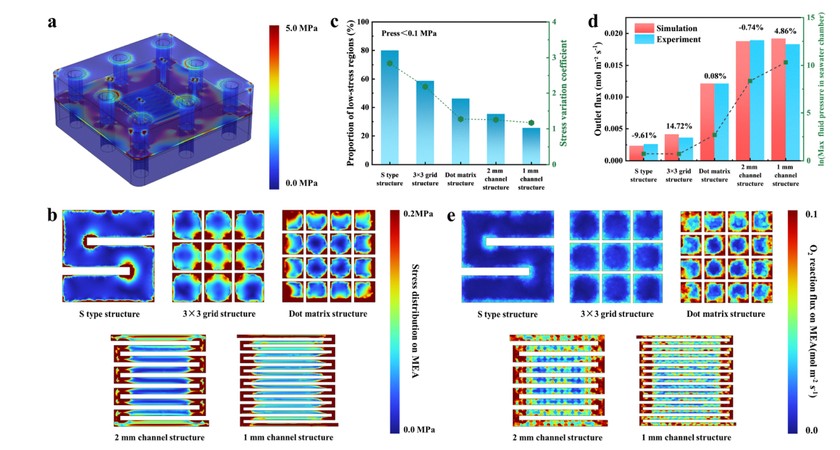
This innovation unlocks a practical route to make green hydrogen using abundant seawater resources along coastlines, without relying on precious freshwater. Green hydrogen produced this way can help decarbonize heavy industry and power systems, supporting global carbon neutrality goals and the transition away from fossil fuels. The modular, maintainable design also lowers future operating costs for coastal renewable hydrogen projects.
This milestone publication highlights the research team's excellence in developing practical, sustainable energy solutions and underscores SEE's strong commitment to solving real-world clean-energy challenges through impactful cross-institutional collaboration.
The full research article is published in Energy & Environmental Science and is accessible here: https://doi.org/10.1039/d6ee03526d