


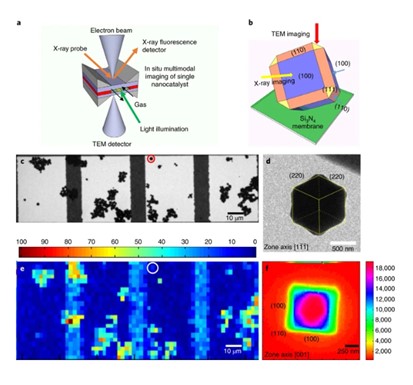
Atomic-level understanding of the active sites and transformation mechanisms under realistic working conditions is a prerequisite for rational design of high-performance photocatalysts. Here, by using correlated scanning fluorescence X-ray microscopy and environmental transmission electron microscopy at atmospheric pressure, in operando, we directly observe that the (110) facet of a single Cu2O photocatalyst particle is photocatalytically active for CO2 reduction to methanol while the (100) facet is inert. The oxidation state of the active sites changes from Cu(i) towards Cu(ii) due to CO2 and H2O co-adsorption and changes back to Cu(i) after CO2 conversion under visible light illumination. The Cu2O photocatalyst oxidizes water as it reduces CO2. Concomitantly, the crystal lattice expands due to CO2 adsorption then reverts after CO2 conversion. The internal quantum yield for unassisted wireless photocatalytic reduction of CO2 to methanol using Cu2O crystals is ~72%.
Read more at Nature Energy:
https://www.nature.com/articles/s41560-019-0490-3
22 Nov 2019