

MSE Seminar – Prof. Anita HO-BAILLIE (23 January 2026)
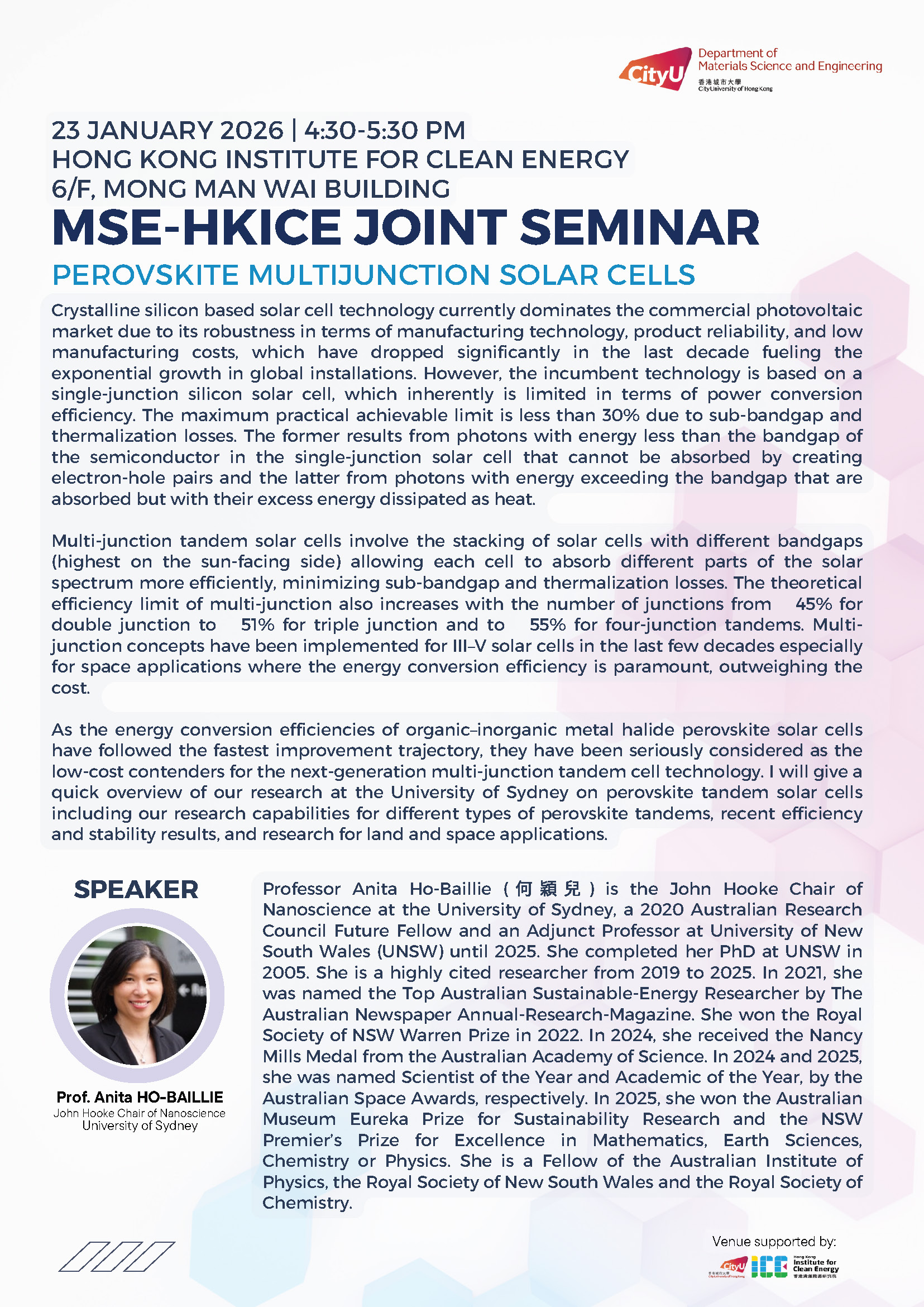
MSE-HKICE Joint Seminar – Prof. Anita HO-BAILLIE (23 January 2026)
| Title: | Perovskite Multijunction Solar Cells |
| Speaker: | Prof. Anita HO-BAILLIE John Hooke Chair of Nanoscience University of Sydney |
| Date: | 23 January 2026 (Friday) |
| Time: | 4:30 - 5:30 pm |
| Venue: | Hong Kong Institute for Clean Energy, 6/F, Mong Man Wai Building |
| Abstract: |
Crystalline silicon based solar cell technology currently dominates the commercial photovoltaic market due to its robustness in terms of manufacturing technology, product reliability, and low manufacturing costs, which have dropped significantly in the last decade fueling the exponential growth in global installations. However, the incumbent technology is based on a single-junction silicon solar cell, which inherently is limited in terms of power conversion efficiency. The maximum practical achievable limit is less than 30% due to sub-bandgap and thermalization losses. The former results from photons with energy less than the bandgap of the semiconductor in the single-junction solar cell that cannot be absorbed by creating electron-hole pairs and the latter from photons with energy exceeding the bandgap that are absorbed but with their excess energy dissipated as heat. |
| Enquiries: | mse@cityu.edu.hk |