

CENG Young Engineering Leaders Distinguished Lecture Series
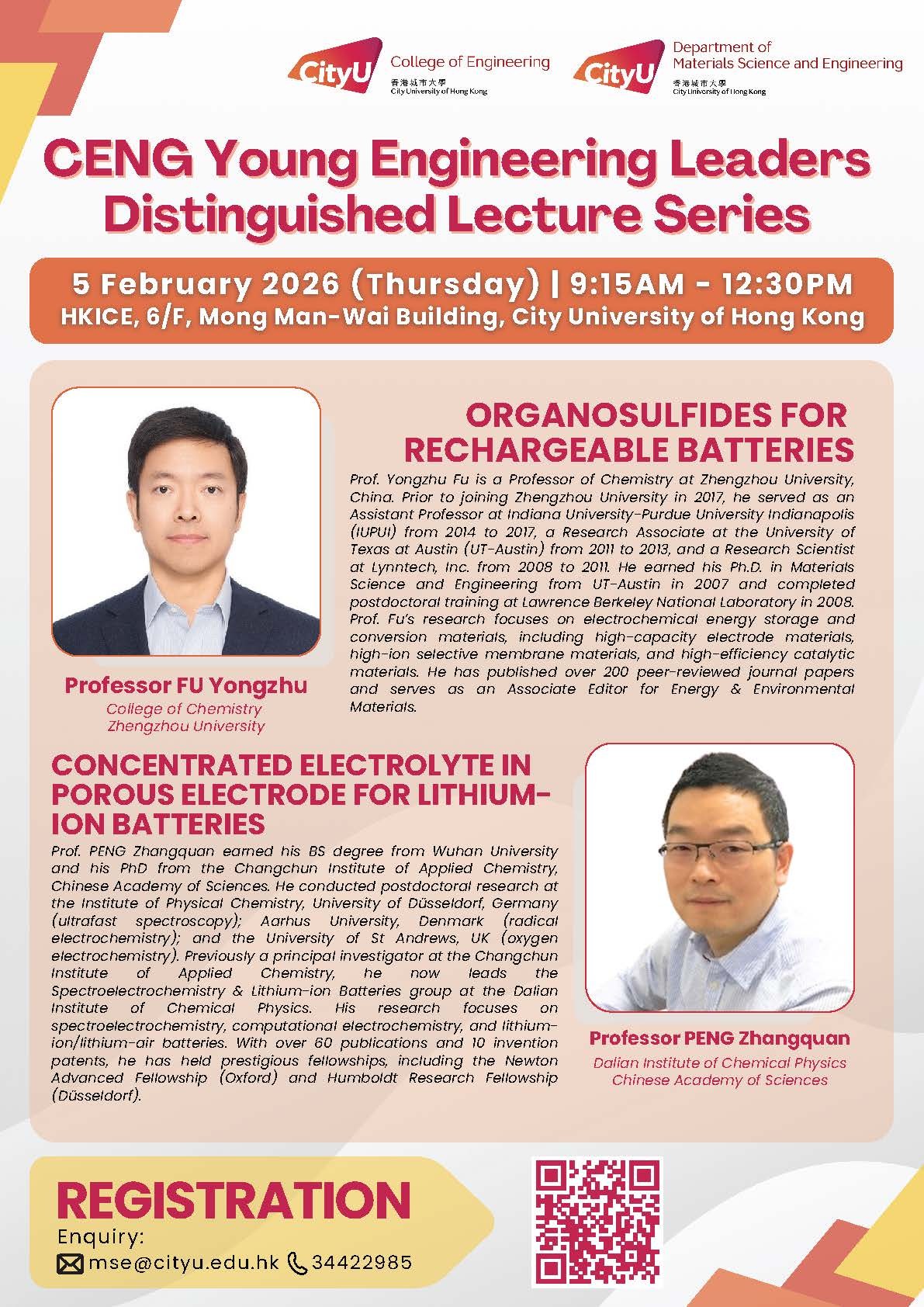
CENG Young Engineering Leaders Distinguished Lecture Series (5 February 2026)
|
Date: |
5 February 2026 (Thursday) |
|
|
Time: |
9:15 am -12:30 pm |
|
|
Title: |
Organosulfides for Rechargeable Batteries |
Concentrated Electrolyte in Porous Electrode for Lithium-ion Batteries |
|
Speaker: |
Prof. FU Yongzhu |
Prof. PENG Zhangquan |
|
Venue: |
HKICE, 6/F, Mong Man-Wai Building, City University of Hong Kong |
|
|
Abstract: |
Organosulfide molecules containing sulfur-sulfur bonds are a class of potential high-capacity cathode materials for batteries. However, most of them are soluble in liquid electrolytes, making it challenging to maintain their electrochemical reversibility in rechargeable batteries. In 2016, our group reported the first study of liquid dimethyl trisulfide as a cathode material in rechargeable lithium batteries, utilizing a binder-free carbon nanotube paper as the current collector. Subsequently, we reported several organosulfide cathode materials, such as diphenyl polysulfides and dipyridyl trisulfide. In addition to serving as cathode materials, these organosulfide molecules can also function as electrolyte additives, components of deep eutectic electrolytes, and active materials for redox flow batteries. In this talk, I will introduce our approach to enabling the electrochemical reversibility of these soluble molecules and reveal their redox mechanisms. These intriguing redox mechanisms provide a broad platform for developing advanced cathodes and batteries for electrochemical energy storage devices. |
The theory and practice of porous electrode in conjunction with concentrated electrolye made possible the modern lithium-ion battery technology, in which the electrode kinetics is often a function of time and spatial location. In the context of lithium-ion batteries, this talk will present the basic electrochemistry of porous electrode, covering (1) mass transfer and reaction kinetics in dilute solution, (2) the structural characteristics of porous electrode, (3) mass transfer in concentrated solution, (4) pseudo-two-dimensional (P2D) model and (5) transmission line model for porous electrode. The information contained in this talk could be beneficial to both beginners and veterans in the field of lithium-ion batteries and beyond. |
|
Registration: |
https://forms.gle/rprfhUzzRmpqLyZi6 (Deadline: 3 February 2026) |
|
|
Enquiries: |
||