

Researchers at City University of Hong Kong (CityUHK) have made a groundbreaking discovery, significantly reducing energy loss in metal nanostructures. By altering the geometrical dimensions of these structures, researchers have unlocked their full potential, paving the way for the development of more powerful and efficient nanoscale optical devices.
The research team is co-led by Professor Tsai Din-ping, Chair Professor in the Department of Electrical Engineering at CityUHK, and Professor Yuri Kivshar, from Australian National University. Professor Kivshar also served as a visiting research fellow at the Hong Kong Institute for Advanced Study at CityUHK in 2023.

“This breakthrough resolves the longstanding issue of energy loss, allowing for high-performance nanoscale optical devices,” said Dr Liang Yao, from the Department of Electrical Engineering at CityUHK, who is the first author of the research article titled “From Local to Nonlocal High-$Q$ Plasmonic Metasurfaces”, published in the scientific journal Physical Review Letters.
A new universal rule, the inverse square root law, has been discovered, showing how adjusting the dimensions of plasmonic nanostructures can significantly reduce energy loss. This discovery bridges the gap between localised surface plasmon resonances (LSPRs) and surface plasmon polaritons (SPPs), resulting in a two-order-of-magnitude improvement in resonance quality in metal arrays. This breakthrough opens exciting possibilities for stronger light-matter interactions at the nanoscale.
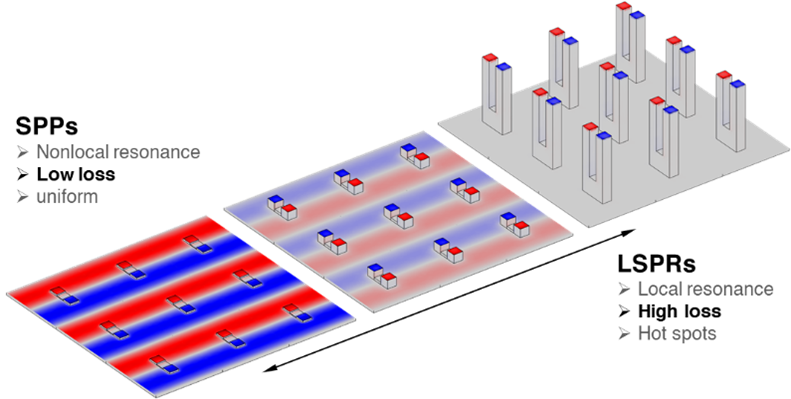

Bridging high-loss localised surface plasmon resonances (LSPR) with low-loss surface plasmon polaritons (SPP) was a formidable challenge, demanding innovative thinking and a departure from conventional approaches.
This groundbreaking discovery has the potential to revolutionise various fields, including sensing, imaging and solar energy. With this new technique, researchers are poised to develop even more powerful and innovative optical devices, ushering in a new era of technological advancement.
For inquiries, please contact Dr Liang Yao, in the Department of Electrical Engineering at CityUHK, by email at yaoliang@cityu.edu.hk.
This article originated from CityUHK Research Stories.
Other Research Stories


