

Professor Edwin Tso’s Team Publishes Breakthrough in Aesthetic Radiative Cooling in Nature Sustainability
Prof. Edwin Chi-Yan TSO, Associate Dean (Internationalisation and Outreach) and Associate Professor at the School of Energy and Environment (SEE), City University of Hong Kong (CityUHK), continues to make significant strides in passive radiative cooling technology. Building on his team’s earlier innovations in cooling ceramics (Science) and bio-inspired smart metafilm (Science Advances), Prof. Tso’s group, in collaboration with Prof. Wei LI, Professor from the Changchun Institute of Optics, Fine Mechanics and Physics (CIOMP), Chinese Academy of Sciences, has published a new study in the prestigious journal Nature Sustainability titled, “Photoluminescent Radiative Cooling for Aesthetic and Urban Comfort”.
Led by Dr. Yang FU, postdoctoral researcher in Prof. Tso’s group and first author of the paper. This groundbreaking research addresses key limitations of traditional PRC materials, which often rely on high-reflectance white surfaces that cause glare and exacerbate urban thermal discomfort.
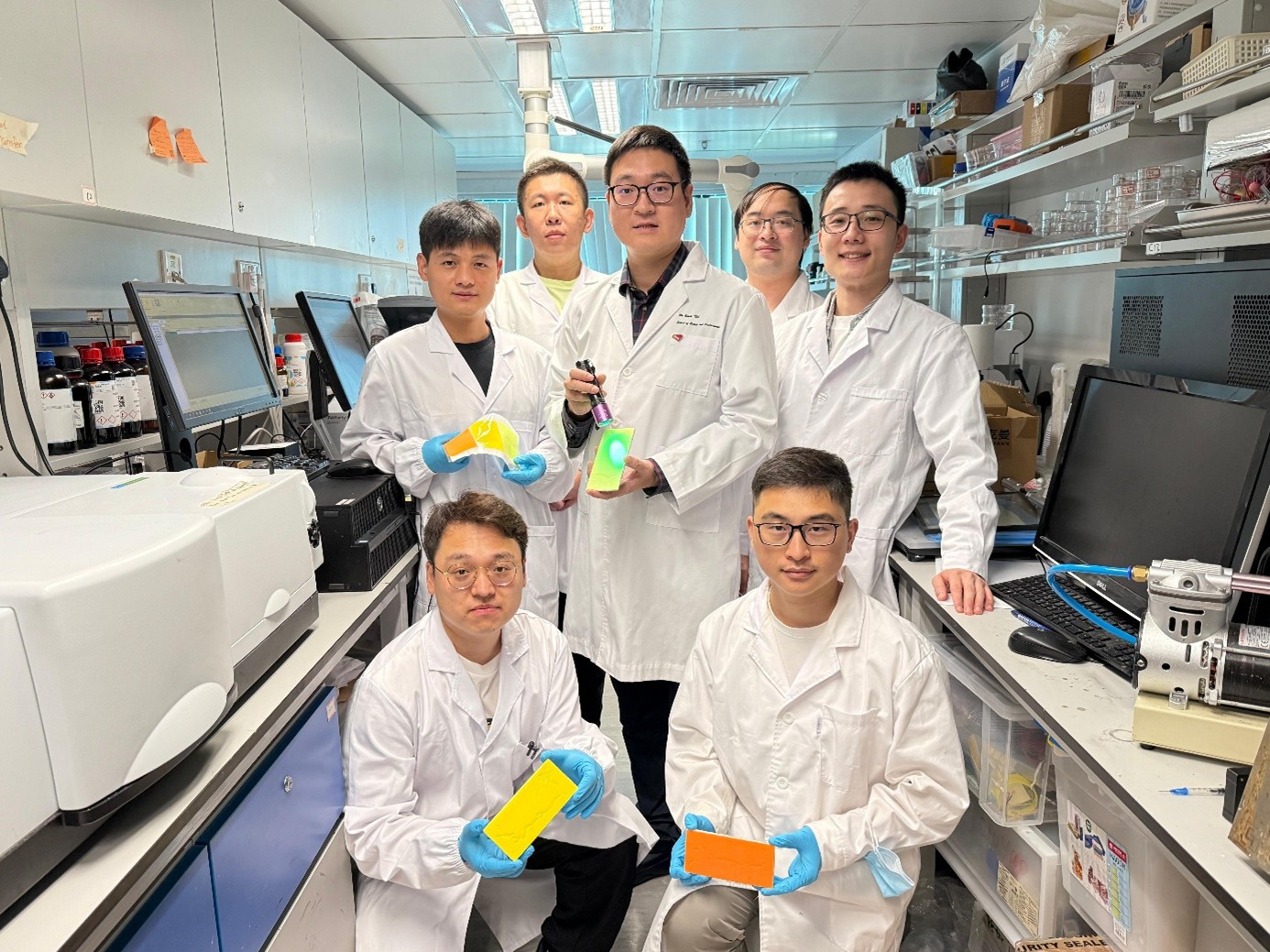
Prof. Edwin Chi-Yan TSO and his research team members at CityUHK. (From left: Dr. Xin LI, Dr. Wenqi WANG (front row); Dr. Yang FU, Prof. Edwin Chi-Yan TSO, Prof. Kaixin LIN (middle row); Mr. Ze LI, Dr. Tsz Chung HO (back row))
Inspired by coral polyps, the team developed Photoluminescence-based Aesthetic Composites (PLACs)—a novel material that combines vibrant, angle-insensitive colors with high cooling performance. These PLACs tackle urban compatibility challenges by reducing glare and mitigating sunlight trapping in urban canyons. Additionally, they exhibit excellent durability, flexibility, and substrate compatibility, making them suitable for diverse applications, from building façades to wearable cooling systems.
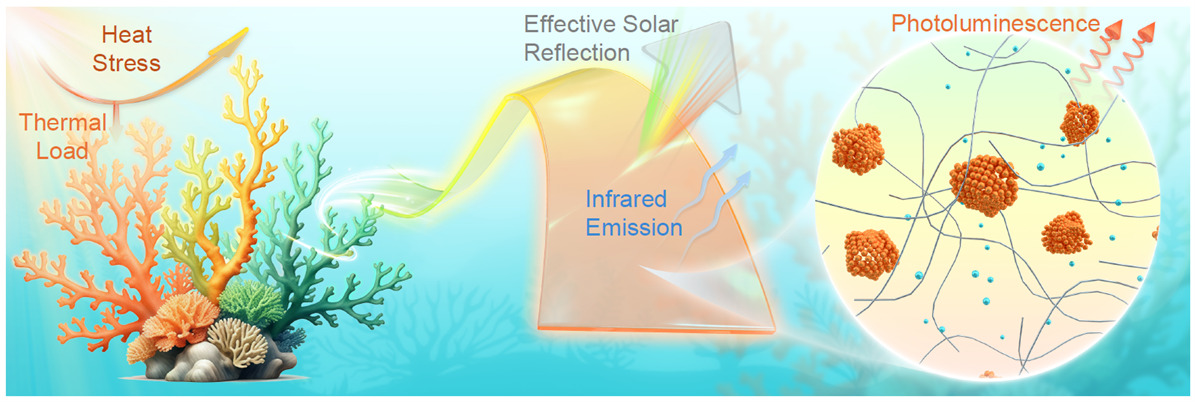
Design principles of the PLACs.
The innovation centers on rare-earth-doped phosphors embedded in a flexible polymer matrix, which converts absorbed sunlight into visible fluorescence while maintaining excellent infrared emission. Through precise optimization of pigment concentration and scattering nanoparticle structures, the material achieves peak spectral reflectance of 141%, a subambient cooling effect of 3.7 °C during peak sunlight, and simulated reductions in urban thermal/visual discomfort of up to ~9%/6%.
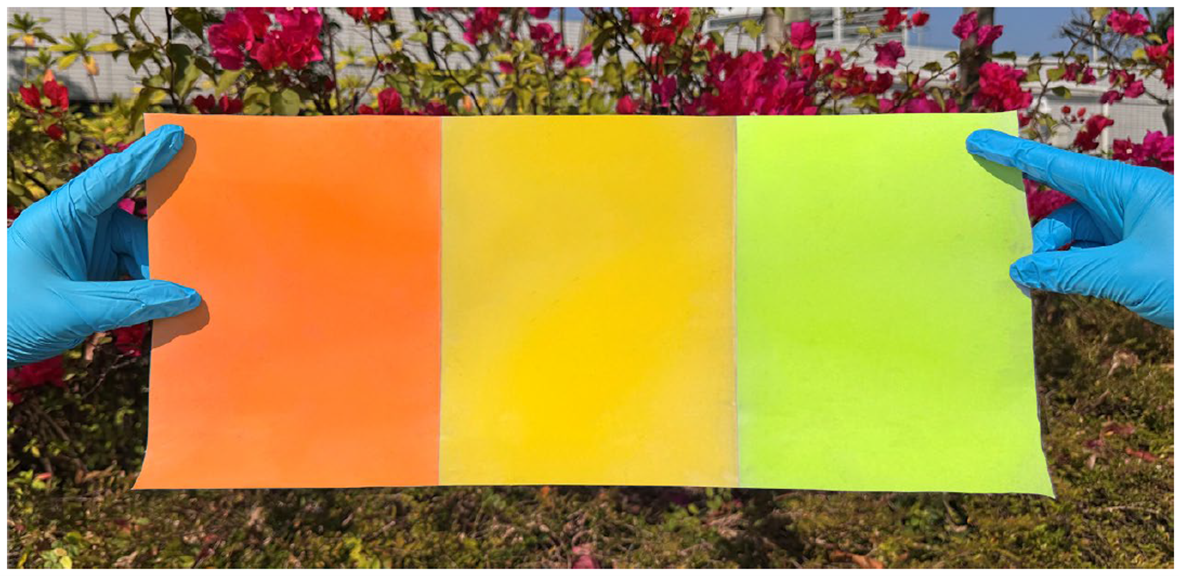
Photograph of PLACs with different colors.
This research marks a significant step toward the widespread adoption of passive radiative cooling technology, offering a sustainable solution to reduce energy consumption while improving urban thermal and visual comfort. Together with their previous advancements—cooling ceramic and smart metafilm—Prof. Tso’s team is pioneering innovative pathways to achieve smarter, more sustainable urban living environments
The full paper is available at: https://doi.org/10.1038/s41893-025-01657-y