

MSE Seminar – Prof. Upadrasta RAMAMURTY (23 May 2026)
23 5月 2026 (周六) | 10:00 上午 - 12:00 下午
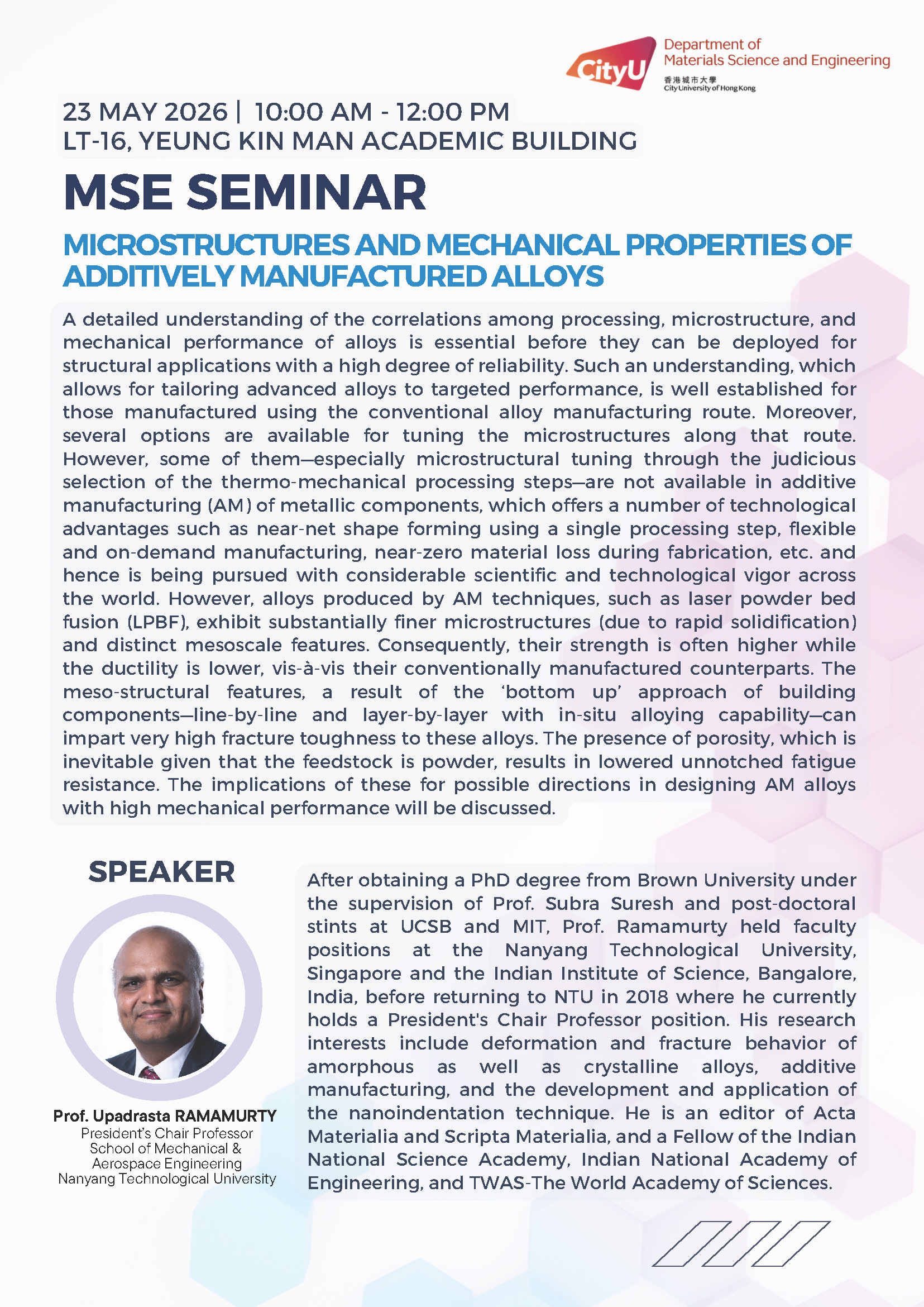
MSE Seminar – Prof. Upadrasta RAMAMURTY (23 May 2026)
| Title: | Microstructures and Mechanical Properties of Additively Manufactured Alloys |
| Speaker: | Prof. Upadrasta RAMAMURTY President’s Chair Professor School of Mechanical & Aerospace Engineering Nanyang Technological University |
| Date: | 23 May 2026 (Saturday) |
| Time: | 10:00 am – 12:00 pm |
| Venue: | LT-16, Yeung Kin Man Academic Building |
| Abstract: | A detailed understanding of the correlations among processing, microstructure, and mechanical performance of alloys is essential before they can be deployed for structural applications with a high degree of reliability. Such an understanding, which allows for tailoring advanced alloys to targeted performance, is well established for those manufactured using the conventional alloy manufacturing route. Moreover, several options are available for tuning the microstructures along that route. However, some of them—especially microstructural tuning through the judicious selection of the thermo-mechanical processing steps—are not available in additive manufacturing (AM) of metallic components, which offers a number of technological advantages such as near-net shape forming using a single processing step, flexible and on-demand manufacturing, near-zero material loss during fabrication, etc. and hence is being pursued with considerable scientific and technological vigor across the world. However, alloys produced by AM techniques, such as laser powder bed fusion (LPBF), exhibit substantially finer microstructures (due to rapid solidification) and distinct mesoscale features. Consequently, their strength is often higher while the ductility is lower, vis-à-vis their conventionally manufactured counterparts. The meso-structural features, a result of the ‘bottom up’ approach of building components—line-by-line and layer-by-layer with in-situ alloying capability—can impart very high fracture toughness to these alloys. The presence of porosity, which is inevitable given that the feedstock is powder, results in lowered unnotched fatigue resistance. The implications of these for possible directions in designing AM alloys with high mechanical performance will be discussed. |
| Enquiries: | mse@cityu.edu.hk |