

Professor Chi Yan Tso Leads Breakthrough Study on White Infrared-Transparent Aerogels for Deep Subambient Radiative Cooling
The School of Energy and Environment (SEE) at City University of Hong Kong (CityUHK) is pleased to announce a significant research breakthrough led by Professor Chi Yan Tso, in collaboration with Professor Kaixin Lin and Professor Ya-Ling He of Xi’an Jiaotong University. Their study, titled “Decoupling solar reflection and thermal emission enables deep subambient radiative cooling for building energy savings”, has been published in the prestigious journal Energy & Environmental Science.
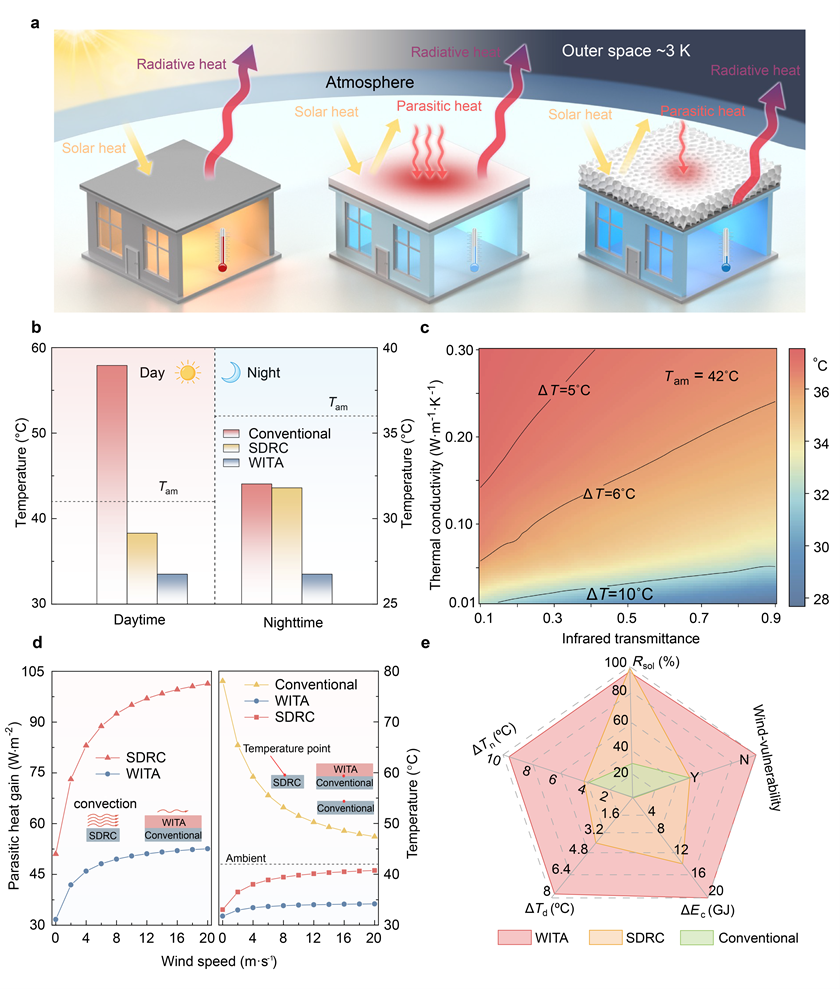
Subambient daytime radiative cooling (SDRC) is an emerging passive cooling technology that lowers surface temperatures without electricity by reflecting incoming solar radiation while simultaneously radiating heat into cold outer space. However, conventional SDRC materials rely on a single exposed surface to perform both solar reflection and thermal emission. This coupled design makes them highly vulnerable to parasitic heat gain from the surrounding environment, limiting their cooling effectiveness. In Hong Kong, this heat gain can exceed 70 W m⁻², accounting for nearly half of the theoretical cooling power.
To overcome this challenge, the research team developed a white infrared-transparent aerogel (WITA) that spatially separates, or decouples, the functions of solar reflection and thermal emission. Fabricated using a simplified one-step solvent-exchange process, WITA achieves up to 94.5% atmospheric-window transmittance, 96.6% solar reflectance, and a thermal conductivity below 0.035 W m⁻¹ K⁻¹.
Beyond material innovation, the team established an experimentally validated multiscale optical-thermal model that bridges microscale light scattering and macroscale heat transfer. This model provides valuable predictive design guidance for future radiative-cooling systems and materials.
Outdoor experiments demonstrated that WITA enables conventional building roofs to outperform existing SDRC materials and enhances the cooling performance of SDRC emitters by more than 5.2 °C. Building energy simulations further showed that the technology can deliver approximately 55% greater annual cooling-energy savings in hot climates compared with current approaches.
In addition to its remarkable cooling capability, WITA offers several practical advantanges, including excellent UV durability, hydrophobicity, flame retardancy, and tunable colouration, making it highly promising for real-world building applications.
This achievement highlights Professor Tso’s leading contributions to the fields of passive radiative cooling and sustainable thermal management, while further strengthening SEE’s commitment to advancing innovative solutions for energy efficiency and climate resilience. The research also reinforces CityUHK’s position as a global leader in environmental and energy research.
The full article can be accessed in Energy & Environmental Science: https://doi.org/10.1039/d6ee03588d