

Hamiltonian learning (HL), enabling precise estimation of system parameters and underlying dynamics, plays a critical role in characterizing quantum systems. However, conventional HL methods face challenges in noise robustness and resource efficiency, especially under limited measurements. In this work, we present Inverse Physics-Informed Neural Networks for Hamiltonian Learning (iPINN-HL), an approach that incorporates the Schrödinger equation as a soft constraint via a loss function penalty into the ML procedure. This formulation allows the model to integrate both observational data and known physical laws to infer Hamiltonian parameters with greater accuracy and resource efficiency. We benchmark iPINN-HL against a deep-neural-network-based quantum state tomography method [denoted as DNN-HL (Deep Neural Network for Hamiltonian Learning)] and demonstrate its effectiveness across several different scenarios, including one-dimensional spin chains, cross-resonance gate calibration, crosstalk identification, and real-time compensation to parameter drift. Our results show that iPINN-HL can approach the Heisenberg limit and exhibits robustness to noises, while outperforming DNN-HL in accuracy and resource efficiency. Therefore, iPINN-HL is a powerful and flexible framework for quantum system characterization for practical tasks.
Read more at Physical Review Research:
https://journals.aps.org/prresearch/abstract/10.1103/nx97-zjdf
Photo caption:
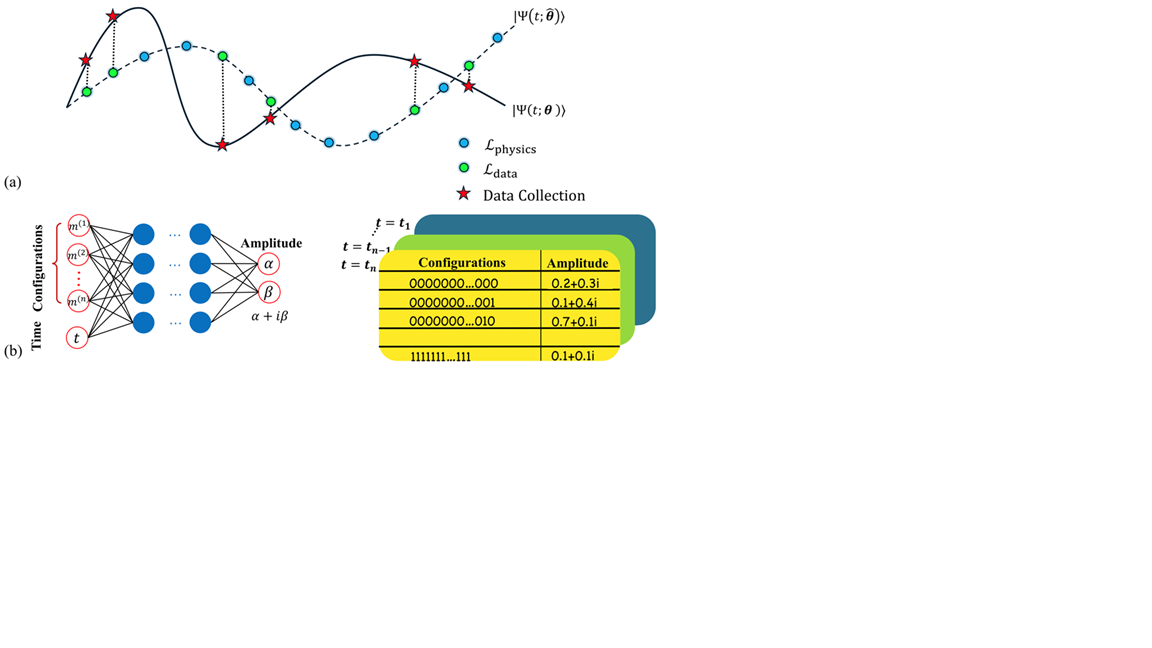
(a) Visualization of PINNs for HL. The solid curve shows the true solution |Ψ(𝑡;𝜽)⟩, while the dashed curve represents the estimated solution | | | |Ψ(𝑡;ˆ𝛉)⟩. Red stars mark data points, green dots indicate prediction errors, and blue dots enforce physical laws by ensuring consistency with the Schrödinger equation. (b) NNQS representation and its tabular form at different time points. The output nodes 𝛼 and 𝛽 of the neural network represent the real and imaginary parts, respectively, of the complex amplitude of the quantum state ⟨𝑚|Ψ(𝑡)⟩ at time 𝑡. The neural network efficiently captures the complex amplitudes of quantum states across various configurations, demonstrating high expressive capacity for representing many-body quantum systems. The table on the right shows the amplitudes of different configurations at discrete time steps 𝑡1,𝑡2,⋯,𝑡𝑛. Automatic differentiation of NNQS enables efficient computation of time derivatives of the quantum state, facilitating the enforcement of dynamical constraints of Schrödinger equation.
12 Dec 2025