

Opportunity
The development of nanozymes, which are artificial enzymes engineered at the nanoscale to mimic natural enzyme functions, presents significant potential across various fields such as medicine, energy, and environmental remediation. However, existing nanozymes face several critical challenges that limit their practical application. These include difficulties in designing and synthesizing nanozymes with desired catalytic properties, ensuring scalability and reproducibility in synthesis, maintaining long-term stability and durability under different environmental conditions, and guaranteeing biocompatibility and non-toxicity for biomedical uses. Additionally, achieving high target specificity and selectivity to avoid interference with other biological processes remains a hurdle. The regulatory and commercialization pathways for nanozymes are also complex and resource-intensive. Specifically, in cancer therapy, particularly for aggressive and treatment-resistant tumors like glioblastoma (GBM), there is a pressing need for more effective catalytic therapies that can overcome the immunosuppressive tumor microenvironment and the blood-brain barrier (BBB). Current nanozymes often lack the precise catalytic activity, stability, and biocompatibility required for such demanding applications, creating an opportunity for innovative solutions that address these limitations and offer new therapeutic strategies.
Technology
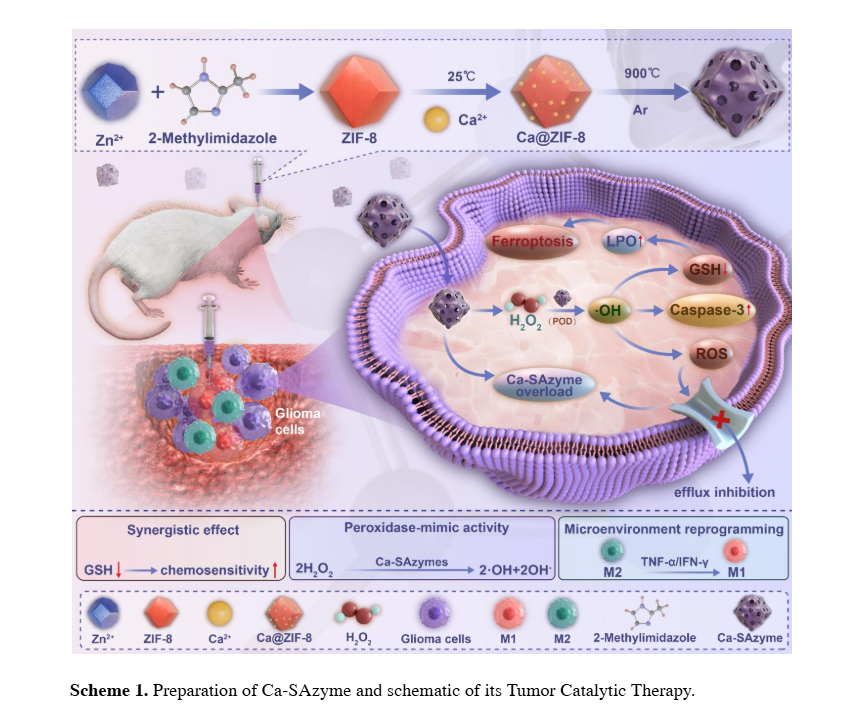
This patent introduces a novel single-atom nanozyme (SAzyme) technology designed to overcome the limitations of existing nanozymes. The innovation centers on nanozymes comprising single atoms of alkaline earth metals (calcium, magnesium, barium, or combinations thereof) loaded onto nitrogen-doped carbon materials. The carbon materials are selected from zeolitic imidazolate frameworks (ZIFs, such as ZIF-8 or ZIF-67), carbon fibers, carbon nanotubes, graphene, carbon black, reduced graphene oxide, or their combinations. The preparation method involves a host-guest approach, where the nitrogen-doped carbon material is mixed with an alkaline earth metal source (e.g., CaCl₂) at room temperature to form a precursor mixture, followed by a pyrolysis process. This method yields nanozymes with a controlled particle size in the range of about 50 nm to 100 nm, which is smaller than previously reported nanoparticles, facilitating delivery across the BBB. The key technological advancement lies in the unique structure where single alkaline earth metal atoms, particularly calcium, are atomically dispersed and stabilized within the nitrogen-doped carbon matrix, forming active sites (e.g., CaN₃ /CaN4 structures) that mimic natural metal protease active sites. This structure provides exceptional peroxidase-like (POD) catalytic activity, high specificity for hydrogen peroxide (H₂O₂), and enhanced stability. The nanozymes function by catalyzing the decomposition of H₂O₂ in the tumor microenvironment to generate reactive oxygen species (ROS), inducing tumor cell apoptosis. Moreover, they act as immune adjuvants, stimulating cytokine production and promoting the polarization of tumor-associated macrophages to reverse the immunosuppressive microenvironment, offering a dual mechanism for cancer therapy.
Advantages
- High catalytic efficiency and specificity, with peroxidase-like activity comparable to natural enzymes.
- Small particle size (50–100 nm) enables effective delivery across biological barriers like the blood-brain barrier.
- Excellent stability and durability under various environmental conditions.
- Good biocompatibility and low toxicity, suitable for biomedical applications.
- Scalable and reproducible synthesis method using cost-effective materials.
- Dual functionality: induces tumor cell apoptosis via ROS generation and modulates the immune microenvironment.
- Potential for treating resistant cancers, including glioblastoma, by overcoming immunosuppressive conditions.
Applications
- Cancer catalytic therapy, particularly for glioblastoma and other refractory tumors with immunosuppressive microenvironments.
- Antimicrobial applications leveraging peroxidase-like activity.
- Biosensing platforms for detecting biological molecules or analytes.
- Drug delivery systems for targeted release of therapeutic agents.
- Tissue engineering by promoting cell growth and tissue regeneration.
- Environmental remediation through catalytic degradation of pollutants.