

Opportunity
The delivery of nucleic acid drugs, such as mRNA, siRNA, and plasmid DNA, faces significant challenges due to their inherent instability at room temperature and poor cellular uptake efficiency. Traditional methods like oral administration suffer from low bioavailability due to first-pass metabolism, while subcutaneous injections require professional assistance and are often painful, leading to poor patient compliance. Additionally, nucleic acid drugs are highly sensitive to temperature, necessitating cold chain storage and transportation, which increases costs and limits accessibility, especially in resource-limited settings. The COVID-19 mRNA vaccines highlighted the potential of nucleic acid drugs but also underscored the need for stable, user-friendly delivery systems that can maintain drug efficacy without refrigeration.
Technology
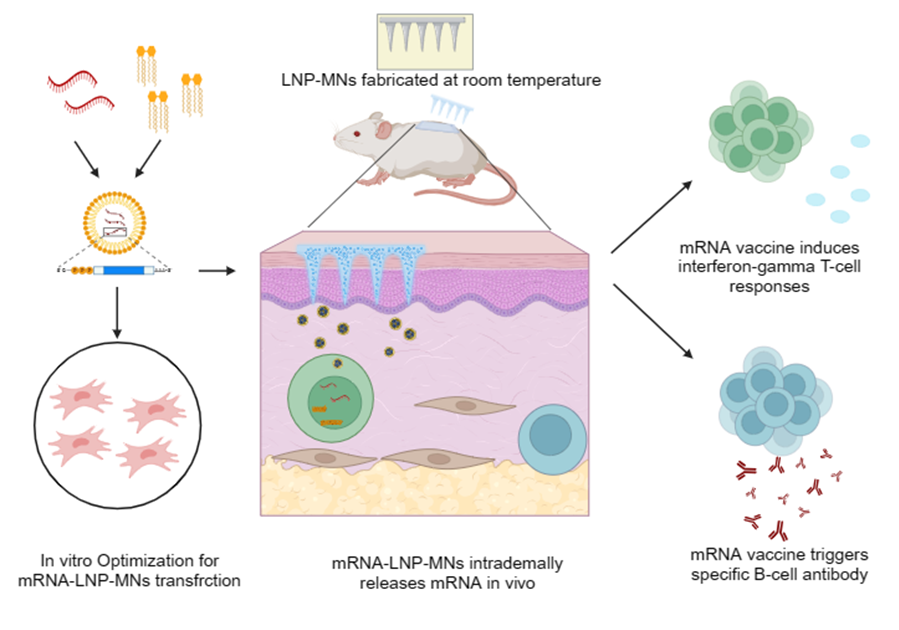
This patent addresses these challenges by introducing a microneedle patch designed for the transdermal delivery of nucleic acid drugs. The patch comprises a base and multiple dissolvable microneedles, each containing: (i) a polymer soluble in human skin layers (e.g., polyvinylpyrrolidone or polyvinyl alcohol), (ii) lipid nanoparticles (LNPs), and (iii) nucleic acid drugs encapsulated within the LNPs. The LNPs are optimized for size (50–220 nm) and composition, incorporating ionizable cationic lipids (e.g., DOTAP), PEGylated lipids (e.g., DSPE-PEG2000), cholesterol, and helper lipids (e.g., DPPC) to enhance stability and cellular uptake. The microneedles penetrate the skin painlessly, dissolve upon insertion, and release the LNPs, which protect the nucleic acids and facilitate efficient intracellular delivery. Crucially, the patch is stable at room temperature (0–40°C) for up to 6 months, eliminating the need for cold storage.
Advantages
- Room-temperature stability: Maintains >50% drug activity for at least 42 days and biological activity for 60 days.
- Painless self-administration: Eliminates the need for needles or professional assistance.
- Enhanced cellular uptake: LNPs protect nucleic acids and improve transfection efficiency.
- Scalable manufacturing: Uses cost-effective microfluidic technology for LNP synthesis.
- Versatile drug loading: Compatible with various nucleic acid drugs (mRNA, siRNA, plasmid DNA, etc.).
Applications
- Vaccination: mRNA vaccines for infectious diseases (e.g., COVID-19).
- Gene therapy: Delivery of siRNA or CRISPR components for genetic disorders.
- Cancer treatment: Localized delivery of nucleic acid-based therapeutics.
- Dermatology: Treatment of skin diseases via transdermal delivery.
- Biopharmaceutical storage: Stable distribution of temperature-sensitive drugs.