

Opportunity
Food waste (FW) represents a critical global challenge, with approximately 931 million tonnes generated annually by retailers and consumers, contributing significantly to greenhouse gas emissions—around 9.3 billion tonnes of CO₂ equivalent in 2017. Current waste management strategies often fail to valorise FW efficiently, particularly its lipid fraction, which is predominantly used for biodiesel production, limiting economic and environmental benefits. Concurrently, the polyurethane (PU) industry heavily relies on fossil-based polyols, raising sustainability concerns. While bio-based polyols from sources like vegetable oils offer alternatives, they often compete with food resources or lack cost-effectiveness. There is a pressing need to develop sustainable, circular economy solutions that transform FW, especially its underutilised lipids, into high-value products like polyurethane rigid foams (PURFs), addressing both waste management and the demand for renewable materials in polymer industries.
Technology
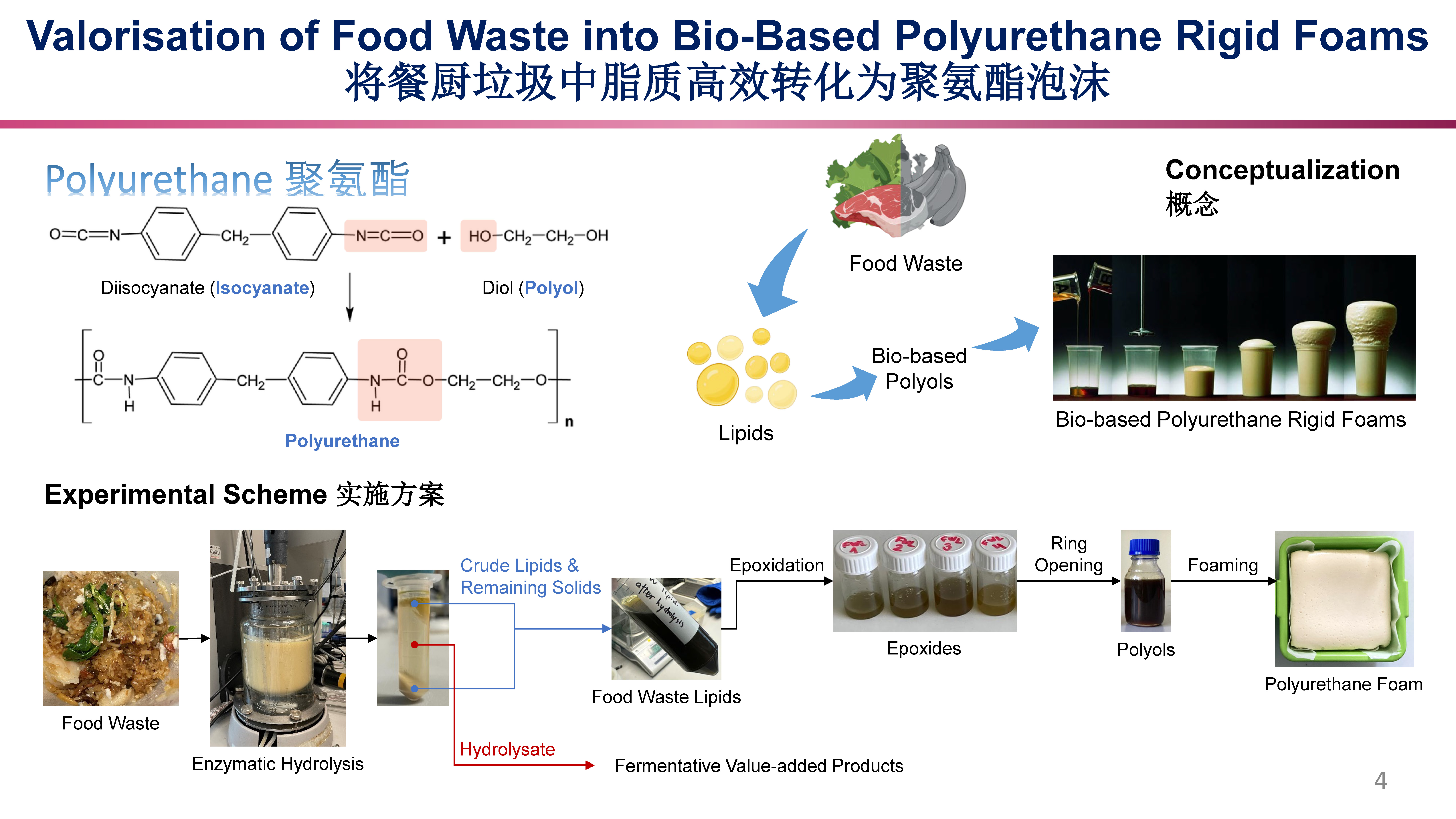
This patent discloses an integrated method for converting food waste into bio-based polyols and subsequently polyurethane rigid foams. The process begins with enzymatic hydrolysis of FW using tailored dosages of lipase and glucoamylase to break down lipids and carbohydrates, optimising nutrient recovery while minimising enzyme costs. Lipids are extracted from the hydrolysed mixture, then converted into polyols through a two-step synthesis: epoxidation using hydrogen peroxide and acetic acid with an ion exchange resin, followed by oxirane ring-opening with diethylene glycol catalysed by fluoroboric acid. The resulting polyols are formulated with polymeric 4,4′-methylene diphenyl isocyanate (pMDI), flame retardants, blowing agents, and catalysts to produce PURFs. Key innovations include cost-effective enzyme dosing, efficient lipid extraction, and a reaction mechanism that yields polyols with suitable hydroxyl values and viscosity for foam production. Techno-economic analysis confirms the viability, with a base case showing high profitability through optimised process parameters.
Advantages
- Converts food waste into valuable bio-based polyols, reducing landfill burden and greenhouse gas emissions.
- Offers a sustainable alternative to fossil-based polyols, decreasing reliance on petrochemicals.
- Achieves high-quality PURFs with properties comparable to conventional foams, including low thermal conductivity (21.2 mW/(m·K)) and good compressive strength.
- Enzymatic hydrolysis is optimised with low enzyme dosages (e.g., 0.1% lipase, 0.01% glucoamylase), enhancing cost-effectiveness.
- The process integrates into a biorefinery model, enabling co-production of animal feed and glucose-rich hydrolysate for additional revenue streams.
- Techno-economic analysis demonstrates strong profitability, with a net present value of US$148.8 million and a short payback time of 0.99 years in the base case.
- Supports circular economy principles by upcycling waste into high-performance insulation materials.
Applications
- Production of polyurethane rigid foams for insulation in construction and refrigeration industries.
- Manufacturing of lightweight, durable materials for automotive and aerospace sectors.
- Development of sustainable packaging materials and cushioning products.
- Creation of bio-based adhesives, sealants, and coatings for various industrial uses.
- Integration into waste management systems for municipalities and food processing facilities to valorise organic waste.
- Use in civil engineering for thermal and acoustic insulation applications.
- Potential for customised foam formulations tailored to specific mechanical or thermal requirements.