


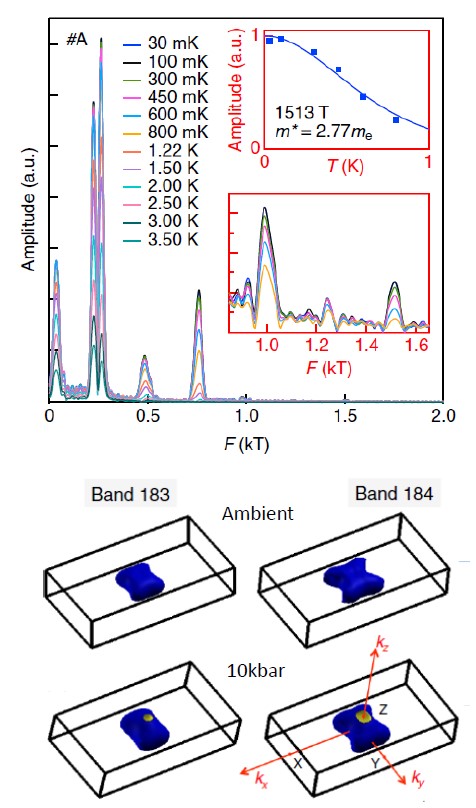
Transition metal dichalcogenide MoTe2 has been extensively studied in the field of condensed matter physics owing to its intriguing non-trivial band topological and magnetotransport properties. Despite many years of efforts, disagreement between the Fermi surface topology as derived from quantum oscillation experiments and that predicted from density function theory (DFT) remains. Specifically, the hole pockets at the Brillouin zone center as predicted by DFT calculation had not been conclusively detected in quantum oscillation experiments so far, raising doubt about the realizability of Majorana states in the material. In this work, we reported the detection of these hole pockets in quantum oscillation and established a possible explanation for the absence of the hole pocket signals in previous quantum oscillation experiments. Combining systematic DFT calculations and high-pressure studies, we showed that the surface curvature of hole pockets decreases under pressure. At ambient pressure, the large effective mass associated with the large Fermi surface curvature makes the detection of the hole pockets challenging. Our finding resolves the long-standing doubt in the community and reestablishes MoTe2 at ambient pressure as a strong candidate of Weyl semimetal.
Read more at Physical Review Letters:
https://doi.org/10.1103/PhysRevLett.124.076402
19 Feb 2020