


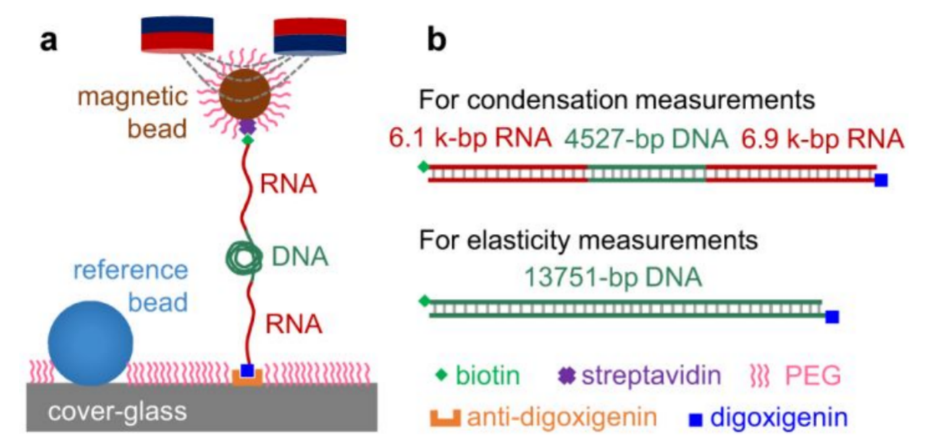
CpG methylation of DNA is common in mammalian cells. In sperms, the DNA has the highest level of CpG methylation and is condensed into toroidal structures. How CpG methylation affects DNA structures and interactions is important to understand its biological roles but is largely unknown. Using an RNA-DNARNA structure, we observed the equilibrium hopping dynamics between the condensed and extended states of DNA in the presence of polyamines or polylysine peptide as a reduced model of histone tails. Combing with the measured DNA elasticities, we report that CpG methylation of each cytosine nucleotide substantially increases DNA-DNA attraction by up to 0.2 kBT. For the DNA with 57% GC content, the relative increase caused by CpG methylation is up to 32% for the spermine-induced DNA-DNA attraction and up to 9% for the polylysine-induced DNA-DNA attraction. These findings help us to evaluate the energetic contributions of CpGmethylation in sperm development and chromatin regulation.CpG methylation of DNA is common in mammalian cells. In sperms, the DNA has the highest level of CpG methylation and is condensed into toroidal structures. How CpG methylation affects DNA structures and interactions is important to understand its biological roles but is largely unknown. Using an RNA-DNARNA structure, we observed the equilibrium hopping dynamics between the condensed and extended states of DNA in the presence of polyamines or polylysine peptide as a reduced model of histone tails. Combing with the measured DNA elasticities, we report that CpG methylation of each cytosine nucleotide substantially increases DNA-DNA attraction by up to 0.2 kBT. For the DNA with 57% GC content, the relative increase caused by CpG methylation is up to 32% for the spermine-induced DNA-DNA attraction and up to 9% for the polylysine-induced DNA-DNA attraction. These findings help us to evaluate the energetic contributions of CpGmethylation in sperm development and chromatin regulation.
Read more at Journal of the American Chemical Society:
https://pubs.acs.org/doi/10.1021/jacs.9b11957
24 Apr 2020