

Opportunity
In modern information retrieval systems, Learning to Rank (LTR) models are widely used to rank documents based on their relevance to user queries. However, a significant challenge arises from the imbalanced distribution of training data, where popular queries (head queries) have abundant user feedback (e.g., clicks), while less popular queries (tail queries) suffer from sparse feedback. This imbalance leads to biased models that prioritize head queries, resulting in poor performance for tail queries. The long-tail distribution of user clicks exacerbates this issue, as tail queries are underrepresented in the training data, causing the model to generalize poorly for these queries. This imbalance not only reduces the overall fairness of the ranking system but also limits its effectiveness in real-world applications where diverse query types are common. Addressing this data imbalance is critical to improving the performance and fairness of ranking models across all query types.
Technology
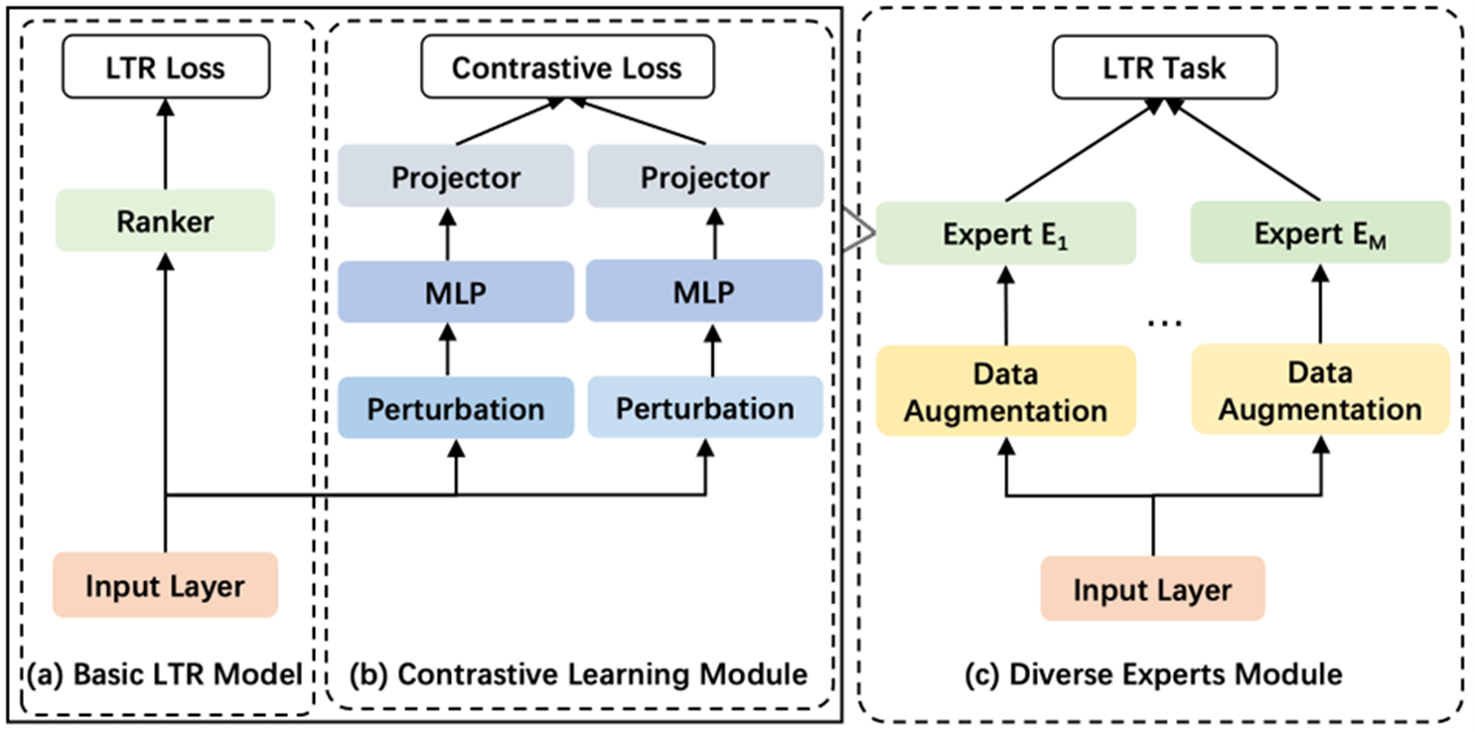
The patent introduces a novel computer-implemented method for training a neural network-based ranking model that effectively addresses the imbalanced data distribution problem. The key innovation lies in two main components: adaptive training data augmentation and contrastive learning. First, the method synthesizes additional training data for tail queries by leveraging semantic similarities between queries. For each query, a representation is derived from its associated query-document pairs, and neighbor queries are identified using k-nearest-neighbor (KNN) methods. New training samples are then generated by interpolating between existing samples from the target query and its neighbors, ensuring a more balanced data distribution.
Second, the patent employs a bilateral branch network architecture with contrastive learning. One branch processes the original imbalanced data, while the other processes augmented data to reduce bias. Contrastive learning enhances representation uniformity by creating perturbed views of input data and maximizing their agreement in latent space. The model is trained using a multi-task objective that combines ranking loss (for relevance prediction) and contrastive loss (for robust feature learning). This dual approach ensures that the model performs well on both head and tail queries while maintaining fairness and generalization capabilities.
Advantages
- Balanced Data Distribution: Adaptive augmentation mitigates data scarcity for tail queries by synthesizing new samples based on semantic neighbors.
- Improved Fairness: The bilateral branch network dynamically adjusts weights for head and tail queries, reducing bias toward popular queries.
- Robust Representations: Contrastive learning enhances feature uniformity by leveraging perturbed views of input data, improving generalization.
- Model-Agnostic Design: The framework can be integrated with various neural ranking architectures without structural constraints.
- Multi-Task Optimization: Joint optimization of ranking and contrastive losses ensures balanced performance across all query types.
Applications
- Search Engines: Enhances ranking fairness for less frequent search queries, improving user experience.
- E-Commerce: Improves product recommendations for niche or less popular items, boosting sales diversity.
- Advertising: Optimizes ad targeting for long-tail keywords, increasing click-through rates and ROI.
- Recommender Systems: Balances recommendations between popular and niche content, enhancing engagement.
- Information Retrieval: Ensures equitable access to relevant documents across diverse query types in academic or enterprise settings.